
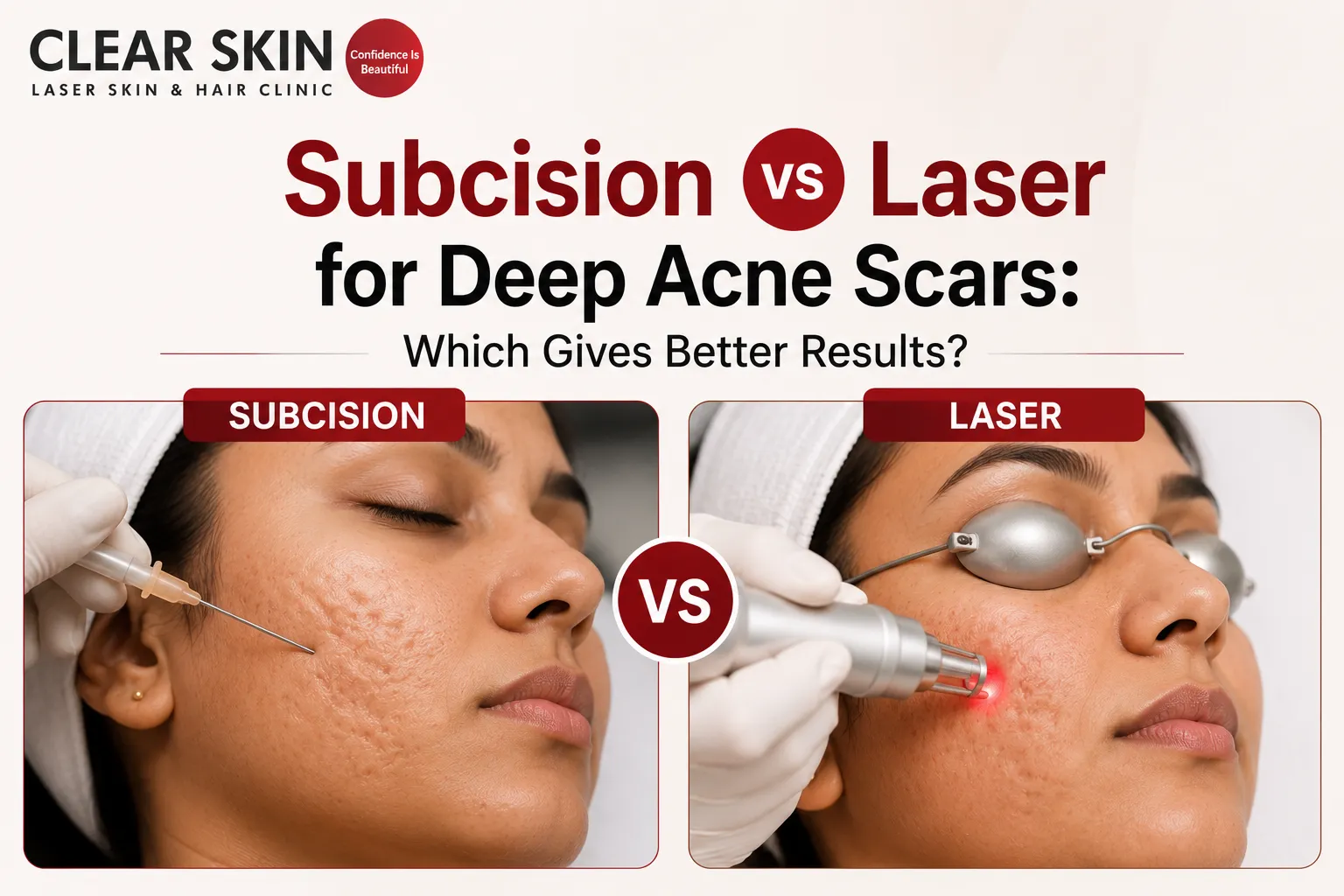
Subcision vs Laser for Deep Acne Scars: Which Gives Better Results?

Written by Clear Skin Content Team | Medically Reviewed by Dr. Dhanraj Chavan on July 23, 2026
Medical Disclaimer: This article is for informational purposes only. Consult a qualified dermatologist for personalised medical advice.
Deep acne scars, rolling depressions that ripple across the cheek, tethered boxcar scars that hold their floor down even when the skin is stretched are among the most structurally complex conditions to treat effectively.
The challenge is not just cosmetic. The problem is mechanical: scar tissue anchored to deeper layers by fibrous bands that physically pull the surface inward, resisting every surface-level treatment applied above them.
Both subcision and laser treatments produce real collagen stimulation and real improvement. But they work through fundamentally different mechanisms and address different aspects of the same structural problem. Understanding this difference explains why patients who rely on laser alone for deeply tethered rolling scars often see partial improvement and why combining both treatments consistently outperforms either used in isolation.
Table Of Content
- What Subcision Is and What It Mechanically Accomplishes?
- Laser Treatments Used for Deep Acne Scars
- The Core Difference: Mechanical vs Biological Action
- The Recommended Combined Protocol
- FAQs
- Conclusion
What Subcision Is and What It Mechanically Accomplishes?
Subcision is a minor surgical procedure performed under local anesthesia. A beveled needle is inserted beneath the scar through a small skin entry point. Once beneath the dermis, the needle moves in a fanning motion physically severing the fibrous connective tissue bands that tether the scar floor to the deeper subcutaneous tissue.
What the Fanning Motion Achieves
The needle motion cuts through fibrous bands, releasing the mechanical tension and allowing the scar floor to rise. The tissue trauma simultaneously triggers a localized wound-healing response that stimulates new collagen production in the subcised space gradually filling the released depression over weeks to months as healing progresses.
What Subcision Cannot Do
Subcision does not remove scar tissue. It does not improve surface skin texture directly. It is not effective for icepick scars (no fibrous band beneath them), hypertrophic scars, or any scar type that is not mechanically tethered. Its scope is specific releasing the anchor and understanding this scope is essential to knowing when to use it. For detailed information on how subcision fits within a broader scar protocol, the subcision treatment explains the procedural steps and candidacy criteria.
Laser Treatments Used for Deep Acne Scars
RF Microneedling — Preferred for Indian Skin
RF energy delivered via microneedles at programmable dermal depths stimulates deep collagen remodeling without ablating the surface. Lower PIH risk than ablative lasers, downtime of 1–3 days, and the option to combine with PRP make it the most commonly recommended first-line option for Indian skin with moderate-to-severe atrophic scars.
Fractional CO2 Laser
Creates microscopic ablative columns in the skin, removing old scar tissue while stimulating collagen remodeling around each column. Effective for boxcar and rolling scars with surface texture loss. Downtime of 5–7 days and higher PIH risk for Fitzpatrick IV–VI skin make it a non-first-line choice for Indian patients in most cases.
Pico Laser (Fractional Mode)
Photoacoustic micro-columns stimulate collagen with minimal thermal damage. Very favorable safety profile for darker Indian skin. Increasingly used for moderate deep scars where low downtime and low PIH risk are prioritized alongside pigmentation concerns.
The Core Difference: Mechanical vs Biological Action
|
Feature |
Subcision |
Laser |
|
Mechanism |
Physical release of fibrous bands |
Collagen stimulation via energy |
|
Level of action |
Sub-dermal — beneath scar floor |
Dermal — within scar tissue |
|
Releases tethering |
Yes, directly |
No |
|
Stimulates new collagen |
Yes, secondary response |
Yes, primary mechanism |
|
Improves surface texture |
Indirect benefit only |
Yes, direct benefit |
|
Best for rolling scars |
Excellent |
Good but cannot release tethering |
|
Best for tethered boxcar |
Excellent for floor release |
Good for edge softening |
|
PIH risk (Indian skin) |
Very low |
Low to moderate |
|
Cost per session (Pune) |
₹5,000–₹12,000 |
₹8,000–₹20,000 |
The Recommended Combined Protocol
Stage 1 — Subcision: Release all tethered scars under local anesthesia. Allow 3–4 weeks for initial healing and the first collagen response.
Stage 2 — RF Microneedling or Pico Laser: With tethering released, apply RF microneedling to remodel collagen in the released space and improve overall atrophic texture. PRP can be added topically post-session to enhance the collagen response.
Stage 3 — Repeat Subcision if Needed: For severely tethered scars, repeat subcision 2–3 times spaced 4–6 weeks apart. Repeated sessions progressively release residual fibrous bands.
Maintenance: Periodic RF microneedling or laser toning sessions annually to preserve structural improvements.
Reviewing before-and-after outcomes for deep scar treatment across different scar profiles helps calibrate realistic expectations before beginning a combined protocol.
Frequently Asked Questions (FAQs)
How long does it take to see results from subcision?
Initial lifting of tethered scars becomes visible within 2–4 weeks. Full collagen remodeling takes 2–3 months per session. Best results from a combined subcision plus RF microneedling protocol are visible 4–6 months after the final session.
Is subcision painful?
Local anesthesia makes the procedure itself minimally painful. Post-procedure bruising and swelling peak at 48–72 hours and resolve within 5–7 days. Over-the-counter pain relief is generally sufficient for post-procedure management.
Can subcision be repeated on the same areas?
Yes. Most protocols involve 2–4 subcision sessions for the same areas spaced 4–6 weeks apart. Repeated subcision progressively releases residual fibrous bands and continues stimulating new collagen with each procedure.
Is subcision safe for Indian skin tones?
Yes. Subcision carries very low PIH risk because it involves no heat, light energy, or chemical exfoliation. This makes it specifically well-suited to Indian Fitzpatrick IV–VI skin where thermal and chemical treatments require careful calibration.
How many total sessions are needed to treat deep rolling scars?
A typical full protocol involves 2–3 subcision sessions plus 3–4 RF microneedling sessions — totaling 5–7 sessions over 4–6 months. Realistic improvement targets for moderate deep rolling scarring are 40–70% reduction in visible scar depth.
Do You Know?
Roughly 250 Patients Are Treated
Everyday By These Dermatologists
(You are one click away from flawless skin)
Meet Our Dermatologist!



Conclusion
For deep rolling and tethered boxcar scars, asking whether subcision or laser is “better” is the wrong question. Both address different structural problems in the same scar.
No laser energy can sever a fibrous band beneath the skin. Lasers remodel collagen in the dermis they cannot physically release mechanical anchors that hold rolling scar depressions in place. Patients who complete multiple laser courses may see general textural improvement while the characteristic wave-like depressions remain essentially unchanged. The surface improved. The mechanical problem beneath did not.
Conversely, subcision releases the tether but does not resurface the skin, does not improve overall atrophic texture between scars, and does not stimulate the broad, deep collagen remodeling that RF microneedling provides. After subcision releases the floor, laser fills the released space with new collagen and improves the overall surface. For a complete overview of acne scar procedures and their clinical combinations, the protocol framework is explained in detail.
“Subcision is one of the most underused procedures for deep acne scars in India. When a patient has clearly tethered rolling scars, trying to treat them with laser alone is working against the physical reality of the condition. Subcision releases the floor RF microneedling does the remodeling above it. Combined, the result is substantially better. We see this repeatedly in patients who come having had multiple laser sessions elsewhere with incomplete results.” — Dr. Dhanraj Chavan, Clear Skin Clinic
Further Reading
How Many Months Before Your Wedding Should You Start Acne Treatment?
Planning your wedding? Find out when to start acne treatment, which treatments may help, and what to avoid before your wedding day.
Isotretinoin (Accutane) for Acne: What to Expect, Side Effects, and Cost
Isotretinoin is the most effective treatment for severe or treatment-resistant acne. Learn who it is for, how it works, what side effects are real, what the cost looks like, and what happens after.
Adult Acne Treatment After 25: Why It Happens and How to Clear It
Acne after 25 has different triggers than teenage acne and needs a different treatment plan. Learn why it persists, what drives it, and how a dermatologist clears it effectively.
Hormonal Acne and PCOS Acne Treatment for Women in Pune
Deep, painful pimples on your jawline and chin that follow your cycle are hormonal acne. Learn what causes it, how PCOS makes it worse, and how dermatologists treat it effectively.
Have thoughts? Please let us know
We are committed not only to treating you, but also educating you.