
Adult Acne Treatment After 25: Why It Happens and How to Clear It?

Written by Clear Skin Content Team | Medically Reviewed by Dr. Dhanraj Chavan on October 22, 2026
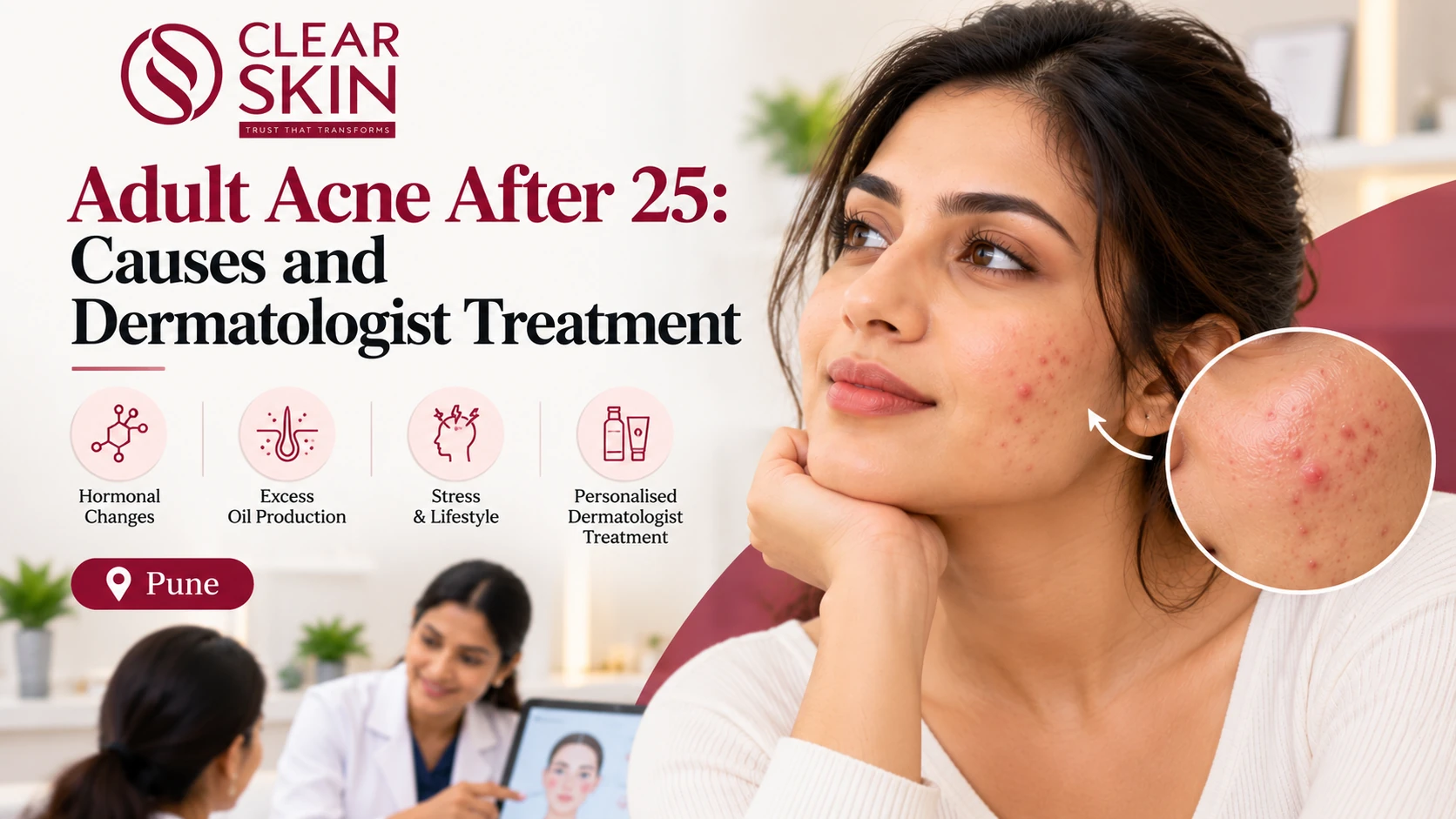
Acne after 25 is not the same condition as teenage acne. It is driven by different triggers , hormones, stress, dietary patterns, and the wrong skincare products , and it responds poorly to the salicylic acid washes that worked at sixteen.
A dermatologist assesses the type, location, and pattern of your breakouts before prescribing treatment. Most adults clear significantly within 3-4 months with the right combination of prescription topicals and, where needed, an oral medication.
You are 28, or 34, or 40. Your teenage skin was fine. And now, suddenly or gradually, your face has breakouts you were not expecting to deal with at this age.
You have tried the products. You have adjusted your diet. You have cut dairy and sugar and you are still waking up to new pimples on your chin or jaw.
This is adult acne. It affects roughly 15% of women and 5% of men over 25, and it is among the most undertreated skin conditions in India because many adults assume they should have outgrown it by now. The problem is not your willpower or your skincare routine. It is a different condition that needs a different treatment.
Table Of Content
- How Adult Acne Differs from Teenage Acne?
- What Triggers Acne After 25?
- Why Your Teenage Products No Longer Work?
- How Dermatologists Diagnose Adult Acne?
- Treatment Options
- Adult Acne and Scarring Risk
- What to Expect: Timeline?
- Expert Insight
- Summary
- Frequently Asked Questions
- Conclusion
At a Glance
|
Condition |
Adult-onset or persistent acne in adults over 25 |
|
Who it affects |
Adults aged 25-45; more common in women |
|
Root causes |
Hormones, stress-related cortisol, wrong products, dietary triggers |
|
Where it appears |
Lower face (jawline, chin), cheeks, back, chest |
|
Key difference from teenage acne |
Slower to heal, more likely to scar, driven by internal triggers not just oil |
|
Treatment approach |
Prescription topicals, oral medication if hormonal, clinic procedures |
|
Time to results |
3-4 months for meaningful clearing |
How Adult Acne Differs from Teenage Acne?
Teenage acne is primarily driven by the surge in androgens at puberty, which ramps up sebum production across the entire face , especially the forehead, nose, and chin. It is widespread, oily, and often resolves as hormone levels stabilize in the early twenties.
Adult acne works differently in three key ways.
The location shifts. Adult breakouts tend to cluster on the lower face: the jawline, chin, and lower cheeks. Forehead and nose acne that continues into adulthood usually has a different trigger from the lower-face pattern.
The lesions are deeper. Adult skin has a thicker dermis than teenage skin. Breakouts tend to be nodular and cystic rather than surface-level whiteheads. They take longer to heal and carry a higher risk of leaving a scar or a dark mark (post-inflammatory hyperpigmentation).
The triggers are internal. Teenage acne is primarily hormonal puberty. Adult acne is driven by a combination of ongoing hormonal fluctuation, chronic stress, lifestyle factors, and often the wrong products. Treating the surface without addressing the internal trigger produces temporary results at best.
What Triggers Acne After 25?
Hormonal Fluctuations
For women, hormones remain the most common driver. Androgens , testosterone and DHT , stimulate sebaceous glands to produce excess oil. Adult women who break out consistently along the jawline and chin before their period, during pregnancy, after stopping the pill, or around perimenopause are experiencing hormonally driven acne. Read our detailed guide on Acne & Pimple conditions treated at Clear Skin Clinic.
Chronic Stress and Cortisol
Stress is a significant and often overlooked trigger for adult acne. The adrenal glands produce cortisol in response to stress. High cortisol stimulates androgen production, which increases sebum output. Adults in demanding work environments who notice that breakouts are worse during high-stress periods are responding to this cortisol pathway , not imagination.
Dietary Patterns
High-glycaemic foods , refined carbohydrates, sugar, white rice, processed snacks , cause an insulin spike. Elevated insulin increases androgen levels, which increases sebum. Dairy, particularly skim milk, has been associated with adult acne in multiple studies, possibly because of IGF-1, a growth hormone found in cow’s milk. The dietary connection is real and worth addressing, but diet alone is rarely sufficient to clear established adult acne.
Wrong Skincare Products
Many adults are using products formulated for oily teenage skin on mature adult skin. Heavy, comedogenic moisturisers block pores. Over-stripping cleansers disrupt the skin barrier, causing reactive oil production. Adults who notice their skin feels tight and clean but continues to break out have often damaged their barrier and are producing compensatory sebum.
Occupational and Environmental Factors
Prolonged mask-wearing (maskne), helmets, or friction from phone contact causes localised breakouts through mechanical pressure , not oil production. Heavy creams required in air-conditioned offices can also block pores in adults whose skin is not inherently oily.
Why Your Teenage Products No Longer work?
The acne products most Indians grow up with , benzoyl peroxide washes, salicylic acid toners, sulphur creams , are designed for oily, proliferating teenage skin.
Adult skin has different needs. The barrier is more fragile. The turnover rate is slower. Aggressive exfoliating products strip the barrier, trigger reactive oil, and worsen inflammation. Many adults find that doubling down on harsh products makes their skin worse, not better , because the skin is responding to barrier damage, not excess oil.
Adult acne treatment is typically gentler on the surface and more targeted internally. The goal is to address the sebum-trigger, support barrier repair, and use clinic procedures to clear existing congestion without further damaging the skin.
How Dermatologists Diagnose Adult Acne?
Diagnosis starts with pattern recognition. A dermatologist assesses:
- Location: Jawline and chin suggest hormonal. Forehead suggests digestive or product-related. Cheeks can be both.
- Lesion type: Surface-level comedones (blackheads, whiteheads) vs deep nodular cysts. Cystic acne needs a different protocol.
- Cycle pattern: Whether breakouts follow the menstrual cycle, stress peaks, or dietary events.
- History: When it started, what you have tried, medications, contraception history, known medical conditions.
For women whose pattern suggests a hormonal cause, blood tests are often ordered: free and total testosterone, DHEAS, LH, FSH, fasting insulin. This is particularly relevant if adult acne came with other androgen signs such as irregular periods, facial hair, or scalp hair thinning.
Treatment Options
Prescription Topicals
Over-the-counter products are rarely sufficient for established adult acne. A dermatologist prescribes topicals that target the specific mechanism.
Tretinoin (retinoic acid): The gold standard for adult acne. It normalises skin cell turnover, prevents pore blockage, and fades post-acne dark marks over time. Adult skin requires a lower starting concentration than teenage skin, with a gradual ramp-up to avoid barrier disruption. Results take 10-12 weeks; initial purging in the first 4-6 weeks is expected.
Azelaic acid: Reduces sebum, fights C. acnes bacteria, and lightens hyperpigmentation. Well-tolerated by Indian skin tones and does not increase sun sensitivity. A strong option for adults who cannot tolerate retinoids.
Topical clindamycin or dapsone: Antibiotic topicals reduce inflammatory lesions. Used short-term in combination with retinoids or benzoyl peroxide to prevent resistance.
Oral Medications
When adult acne is moderate to severe or clearly hormone-driven, oral medications address the internal cause.
Spironolactone: An anti-androgen that reduces oil gland activity. Used at 25-100mg daily in women. Particularly effective for jawline and chin acne that worsens before menstruation. Well-tolerated long-term; your dermatologist monitors potassium and blood pressure in the early months.
Combined oral contraceptive pills (OCPs): Pills containing anti-androgenic progestins such as drospirenone or cyproterone acetate lower free testosterone and reduce breakouts. A useful option for women who also need contraception.
Low-dose antibiotics: Doxycycline or minocycline used short-term (3-4 months) for inflammatory adult acne while waiting for topicals to take effect. Not for long-term use due to resistance risk.
Isotretinoin: Reserved for severe, cystic, or treatment-resistant adult acne. Reduces oil gland size with lasting effect. Requires monthly monitoring and is not suitable during pregnancy. Your dermatologist will discuss whether this is appropriate.
Clinic Procedures
Clinic procedures at Clear Skin Clinic clear existing congestion and prevent scarring while your topical or oral treatment addresses the underlying cause.
Chemical Peels: Salicylic acid peels break down the bonds between clogged skin cells, clear blackheads and whiteheads, and reduce oiliness. Glycolic acid peels additionally stimulate collagen, which helps with the early scarring that deep adult acne lesions cause. A course of 4-6 peels spaced 3-4 weeks apart produces measurable improvement in congestion and skin texture.
HydraFacial Treatment: Combines deep cleansing, exfoliation, and hydration in a single session. Particularly useful for adults whose acne comes with dehydration and barrier compromise from years of harsh products. Safe for sensitive adult skin between more intensive treatments.
Microneedling Radiofrequency (RF): Reduces sebaceous gland activity and stimulates collagen repair. Useful for adults with both active acne and early scar formation. The treatment works at the dermal level, meaning it addresses root causes in the gland rather than just clearing the surface.
Adult Acne and Scarring Risk
Adult skin scars more readily than teenage skin. The reason is slower cellular turnover: a teenager heals a pimple in days; an adult may take two to three weeks. During that longer healing window, deeper lesions have more time to damage the dermal collagen structure and leave a permanent scar.
This makes early treatment more critical in adults, not less. Waiting to see if adult acne resolves on its own is the fastest route to Acne scars that require separate, more intensive treatment.
What to Expect: Timeline?
Weeks 1-4: Skin may purge during the tretinoin introduction phase. This is normal. New comedones are being brought to the surface faster than usual. Resist the urge to stop the prescription.
Months 2-3: Breakout frequency and severity decreases. Existing lesions heal faster. Oiliness begins to reduce if an androgen-targeting medication has been added.
Months 3-4: Significant improvement in most adults. Post-acne dark marks begin to fade with continued tretinoin use. Skin texture becomes more even.
Month 4 onwards: Maintenance phase. Many adults continue a lower-dose retinoid long-term. Annual or biannual review with a dermatologist is advisable to adjust the plan if triggers change , particularly for women through pregnancy or perimenopause.
Expert Insight
“Adult acne patients are often the most frustrated because they have tried everything on their own,” says Dr. Dhanraj Chavan, Senior Dermatologist at Clear Skin Clinic. “What they have tried is teenage acne treatment on adult skin. The correct approach is to diagnose what is actually driving the acne , hormones, barrier disruption, stress , and match the treatment to that cause. Adult acne responds well to the right plan. It just needs the right diagnosis first.”
Summary
Adult acne after 25 is driven by different triggers than teenage acne , primarily hormones, stress-induced cortisol, and barrier disruption from the wrong products. It appears on the lower face, goes deeper, heals more slowly, and scars more readily. The products that worked at sixteen are the wrong tool for adult skin. A dermatologist assesses the pattern, may order hormone blood work, and builds a plan combining prescription topicals with oral medication where needed and clinic procedures to clear existing congestion. Most adults see meaningful improvement in 3-4 months.
Frequently Asked Questions
Is acne after 25 normal or a sign of something wrong?
It is common , affecting around 15% of women and 5% of men over 25 , but it is worth investigating the cause rather than accepting it. In women, persistent adult acne that did not appear until after 20 is frequently hormonal. A dermatologist can determine whether a blood test is needed to check for an underlying hormonal condition such as PCOS.
Why does my acne keep coming back even after I clear it?
Because the trigger has not been addressed. Most over-the-counter products treat the skin surface without correcting the underlying cause , excess androgen activity, barrier disruption, or dietary habits. When the trigger continues, new breakouts follow. A dermatologist-prescribed plan targets the root cause, which is why clinical treatment produces more durable results.
Can adult acne cause permanent scarring?
Yes, and more readily than teenage acne. Adult skin heals more slowly, which gives deep nodular lesions more time to damage the collagen structure underneath. Starting treatment early significantly reduces scarring risk. If scarring has already occurred, separate treatment options are available.
Does stress actually cause acne, or is that a myth?
Stress causes real, measurable hormonal changes that worsen acne. Cortisol, the stress hormone, stimulates androgen production. More androgens means more sebum. More sebum means more clogged pores and more breakouts. Stress management alone will not clear acne, but it is a meaningful contributing factor that your dermatologist will ask about.
I used Accutane (isotretinoin) as a teenager. Can my adult acne come back?
Yes. Isotretinoin achieves lasting remission in most patients, but adult acne can return , particularly in women , if hormonal triggers resurface later in life, such as after stopping the pill, during pregnancy, or approaching perimenopause. A repeat course of isotretinoin is an option in severe cases, but many adults respond well to lower-intensity treatments that were not tried the first time.
Do You Know?
Roughly 250 Patients Are Treated
Everyday By These Dermatologists
(You are one click away from flawless skin)
Meet Our Dermatologist!





Conclusion
Adult acne is not a phase you grow out of on your own , at least not reliably, and not without a risk of scarring in the process. The longer it continues without a targeted plan, the higher the chance of permanent marks that require their own treatment.
The right approach starts with identifying what is actually driving your breakouts, then treating that specific cause. That is a dermatologist’s job, not a trial-and-error skincare routine.
Ready to find out what is causing yours? Find your nearest Clear Skin Clinic on Google Maps or call +91 95845 84111 to book a consultation.
See a doctor urgently if your acne is accompanied by fever, rapidly spreading redness, or a painful swelling that is growing quickly , these can indicate a skin infection or abscess that requires prompt medical attention.
Disclaimer: This article is for general educational purposes only. It does not replace personal medical advice. Consult a qualified dermatologist for an accurate diagnosis and a treatment plan suited to your skin.
Further Reading
Hormonal Acne and PCOS Acne Treatment for Women in Pune
Deep, painful pimples on your jawline and chin that follow your cycle are hormonal acne. Learn what causes it, how PCOS makes it worse, and how dermatologists treat it effectively.
Anti-Aging Treatment Reviews from Pune Patients – HIFU, Fillers and Botox Results at Clear Skin
Laser and chemical peels both treat sun damage and dark spots, but through different mechanisms.
Tattoo Removal Reviews from Pune Patients – Results After Q-Switch Laser at Clear Skin
Laser and chemical peels both treat sun damage and dark spots, but through different mechanisms.
Dark Circles: Fillers vs PRP vs Laser in Pune
Under-eye dark circle treatment in Pune – fillers vs PRP vs laser compared on results, longevity, and cost. Reviewed by Dr. Dhanraj Chavan.
Have thoughts? Please let us know
We are committed not only to treating you, but also educating you.