
Isotretinoin (Accutane) for Acne: What to Expect, Side Effects, and Cost?

Written by Clear Skin Content Team | Medically Reviewed by Dr. Dhanraj Chavan on October 23, 2026
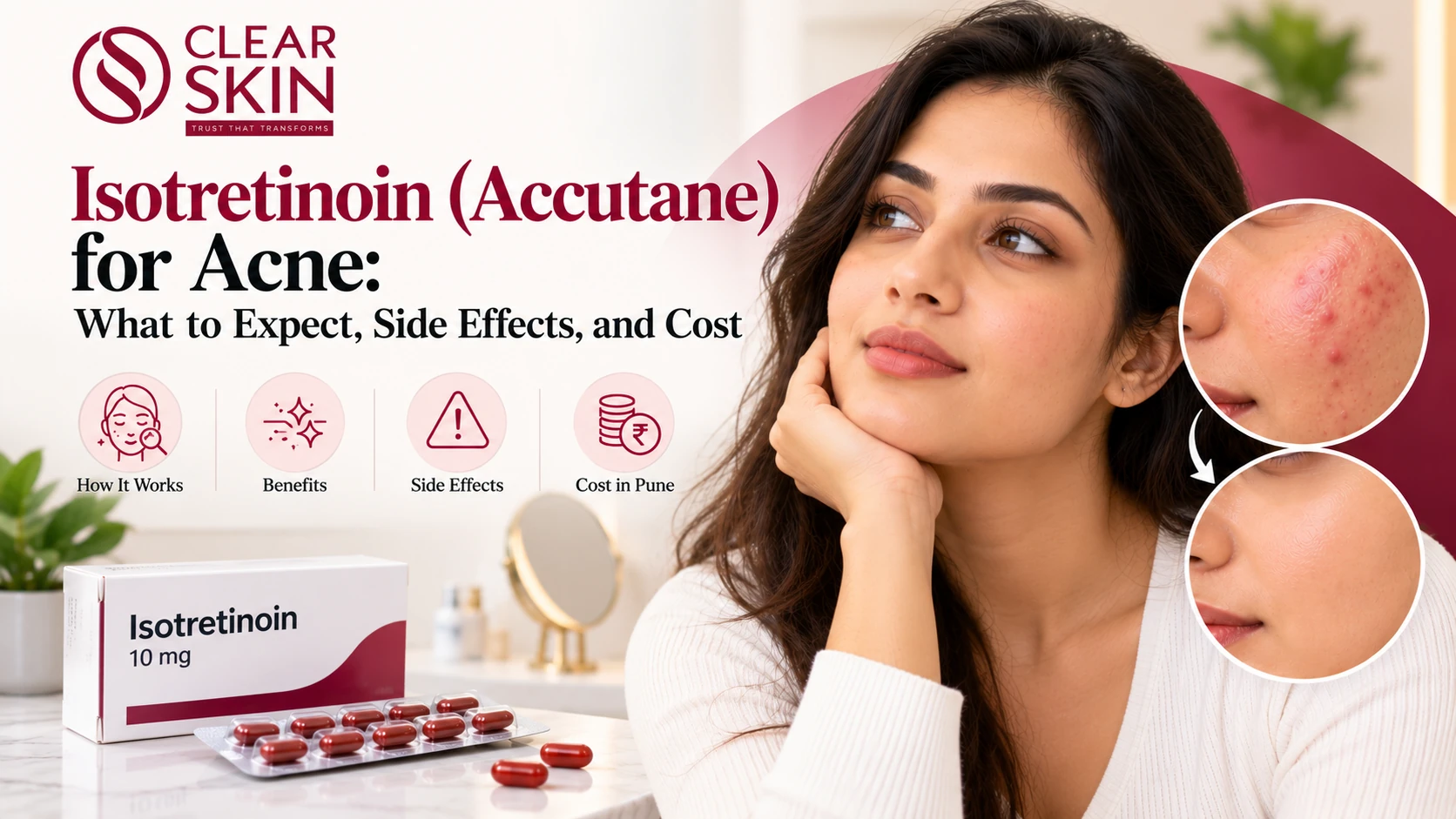
Isotretinoin is an oral vitamin A derivative that reduces the size and activity of oil glands throughout the skin. It is the most effective medical treatment available for severe or treatment-resistant acne. A standard 4-6 month course achieves lasting clearance in 85-90% of patients.
It requires a dermatologist’s prescription, monthly monitoring, and strict contraception in women of childbearing age because it causes serious fetal abnormalities. The side effects most people worry about are either manageable (dryness) or far less common than the internet suggests (mood effects). The side effect that is certain is the one most patients welcome: their acne clears.
You have tried the washes, the antibiotics, the topicals. You have been through two rounds of prescription treatment and your skin is still breaking out with painful, deep nodules that leave marks that take months to fade.
Your dermatologist has mentioned isotretinoin.
You have searched it online and found a mix of dramatic success stories and alarming warning posts. You are not sure what to believe.
This article covers what isotretinoin actually does, who it is and is not suitable for, which side effects are real versus overstated, what the monitoring process involves, and what results to realistically expect.
Table Of Content
- What Is Isotretinoin and How Does It Work?
- Who Is Isotretinoin For?
- The Treatment Process
- Side Effects: What Is Real and What Is Overstated?
- What Results to Expect?
- Cost of Isotretinoin Treatment
- Life During Isotretinoin Treatment: Practical Tips
- Expert Insight
- Summary
- Frequently Asked Questions
- Conclusion
At a Glance
|
Medication |
Isotretinoin (brand names include Accutane, Oratane, Acutret, Tretiva) |
|
What it treats |
Severe nodulo-cystic acne; moderate acne that has not responded to other treatments |
|
How it works |
Reduces oil gland size, normalises skin cell turnover, lowers C. acnes bacteria |
|
Course length |
4-6 months typically; dose depends on body weight |
|
Monitoring required |
Monthly blood tests (liver, lipids); strict contraception for women |
|
Key side effect |
Dryness of skin, lips, eyes , in almost all patients |
|
Remission rate |
85-90% of patients achieve lasting clearance after one course |
|
Who prescribes it |
Dermatologist only , not available over the counter |
What Is Isotretinoin and How Does It Work?
Isotretinoin is a retinoid , a synthetic derivative of vitamin A. Unlike topical retinoids such as tretinoin that work on the skin surface, isotretinoin works systemically from inside the body.
It targets four of the five mechanisms that produce acne simultaneously:
- Reduces sebaceous gland size: Oil glands shrink by 35-58% during treatment. Less oil means fewer clogged pores.
- Normalises skin cell turnover: Prevents the abnormal shedding of dead skin cells that blocks pores.
- Reduces C. acnes colonisation: The acne-causing bacteria cannot survive in a low-oil environment.
- Reduces inflammation: Directly suppresses the inflammatory pathways that cause painful, swollen pimples.
No other treatment addresses all four mechanisms at once. This is why isotretinoin achieves results that topical treatments and antibiotics cannot.
Who Is Isotretinoin For?
Isotretinoin is prescribed for specific presentations. A dermatologist does not prescribe it as a first step.
Appropriate candidates:
- Severe nodulo-cystic acne: large, painful, deep lesions across the face, chest, or back
- Moderate acne that has not cleared after 2-3 properly supervised treatment courses (topical retinoid plus antibiotic, or anti-androgen medications in women)
- Acne that is causing significant scarring despite standard treatment
- Acne that keeps recurring shortly after each treatment round ends
Not appropriate candidates:
- Active liver disease or significantly elevated liver enzymes
- Severe lipid (cholesterol/triglyceride) abnormalities
- Women who are pregnant or not using reliable contraception
- People with a known allergy to vitamin A or retinoids
- Mild acne that has not yet been through standard first-line treatment
Read more about the full range of Acne & Pimple conditions and how they are treated at Clear Skin Clinic.
The Treatment Process
Step 1: Pre-Treatment Blood Work
Before starting isotretinoin, your dermatologist orders baseline blood tests: liver function tests (LFT), fasting lipid profile (cholesterol and triglycerides), complete blood count, and for women, a pregnancy test.
These tests establish your baseline so that any changes during treatment are caught early.
Step 2: Dose Calculation
Isotretinoin dosing is calculated by body weight. The standard target is a cumulative dose of 120-150mg per kilogram over the full course. For a 60kg patient, this means roughly 7,200-9,000mg total , typically spread across 4-6 months at 0.5-1mg/kg per day.
Some dermatologists prefer a low-dose, longer course approach, which produces comparable remission rates with fewer side effects. Your dermatologist will decide the protocol based on your acne severity, weight, and tolerance.
Step 3: Monthly Monitoring
Every month during treatment, you return for:
- Blood tests: LFT and lipid profile repeated to check liver and cholesterol
- Dermatologist review: assessing response, side effects, and dose adjustment
- Women: pregnancy test and contraception confirmation
Missing monitoring visits is not optional. Monthly checks are a clinical safety requirement, not an administrative formality.
Step 4: Contraception for Women
Isotretinoin causes serious and permanent fetal abnormalities (teratogenicity) if taken during pregnancy. Women of childbearing age must use reliable contraception , typically two forms , from one month before starting, throughout the course, and for one month after the final dose.
A dermatologist will discuss the contraception requirement in detail at the first consultation. Women who are planning pregnancy in the near term should not start isotretinoin.
Side Effects: What Is Real and What Is Overstated?
Certain side effects (in most patients)
Dryness: Almost universal. The lips are the most affected , cracking, peeling, and soreness. The skin becomes drier and more sensitive. Eyes may feel dry, particularly for contact lens wearers. This is managed with a thick emollient lip balm applied frequently, a gentle non-foaming moisturiser, and preservative-free lubricating eye drops if needed. The dryness resolves when treatment ends.
Sun sensitivity: Skin is more sensitive to UV during treatment. Daily broad-spectrum SPF 30 or higher is not optional while on isotretinoin.
Initial flare: Some patients experience a worsening of acne in the first 4-6 weeks. This is expected and does not mean the medication is not working. It represents existing congestion being brought to the surface.
Muscle aches: Mild joint and muscle aches are common, particularly in people who exercise intensively. Reducing high-impact exercise during treatment is advisable.
Less common but monitored
Elevated liver enzymes: Occurs in a small percentage of patients. Caught and managed through monthly monitoring. Severe liver toxicity is rare with standard dosing.
Elevated triglycerides: More common in patients with pre-existing lipid abnormalities or those on a high-fat diet. Monitored monthly; dietary modification or dose reduction usually resolves it.
The psychiatric side effect question
You will find strong claims online that isotretinoin causes depression. The evidence is more complex. Multiple large studies have not established a causal relationship between isotretinoin and depression. Some studies have actually found that mood improves when acne clears. At the same time, severe acne itself has well-documented effects on self-esteem and mental health. The current medical consensus is that severe acne is associated with depression, and isotretinoin does not clearly worsen this risk. Your dermatologist will ask about your mental health history before prescribing and will monitor for mood changes during treatment.
What Results to Expect?
During Treatment
Acne typically worsens for the first 4-6 weeks before improving. By month 2-3, new breakouts decrease significantly. By month 4-5, most patients have clear or near-clear skin.
The before and after results from isotretinoin treatment at Clear Skin Clinic reflect this pattern consistently.
After Treatment
The key benefit of isotretinoin is durable remission. 85-90% of patients who complete a full course do not need further acne treatment or maintain clear skin on minimal maintenance. This is distinctly different from antibiotics or topicals, which work only while being used.
A small percentage of patients (10-15%) relapse, usually within 1-2 years. A second course is an option and is generally as effective as the first.
Scarring Prevention
Because isotretinoin stops deep nodulo-cystic lesions from forming, it prevents new scarring during treatment. Existing acne scars do not disappear with isotretinoin alone , scar reduction procedures are a separate step, typically started 3-6 months after the course ends.
Cost of Isotretinoin Treatment
Costs vary based on dose, duration, and the number of monitoring visits. A full course typically involves:
- Dermatologist consultation and follow-up visits (4-6 monthly visits)
- Monthly blood tests (LFT, lipid profile)
- Medication (isotretinoin is available as generic brands in India at a fraction of branded cost)
A dermatologist will provide a full cost breakdown at the initial consultation, accounting for your specific dose and course length. Clear Skin Clinic does not charge for quotes.
Life During Isotretinoin Treatment: Practical Tips
- Apply a thick lip balm (petroleum-based) multiple times daily , before it becomes painful, not after
- Avoid waxing, threading, and laser procedures on the face during treatment; the skin is fragile
- Use only fragrance-free, gentle cleansers and moisturisers
- Do not take vitamin A supplements or high-dose multivitamins; the combination can cause toxicity
- Inform any other doctors treating you that you are on isotretinoin
- Avoid blood donation during treatment and for 30 days after the final dose
Expert Insight
“Isotretinoin has a higher fear factor than its actual risk profile justifies,” says Dr. Dhanraj Chavan, Senior Dermatologist at Clear Skin Clinic. “When we explain the monitoring process and what is actually being measured, most patients understand that it is a supervised medication, not a dangerous one. The monthly checks exist precisely to catch and manage anything before it becomes a problem. For the right patient, there is no more effective treatment.”
Summary
Isotretinoin is an oral medication that reduces oil gland size, normalises skin cell turnover, and eliminates the conditions that produce severe acne. A 4-6 month course achieves lasting clearance in 85-90% of patients. It is appropriate for severe or treatment-resistant acne and requires monthly blood monitoring and strict contraception in women. The main side effects , dryness and sun sensitivity , are manageable and reverse when treatment ends. Scarring is prevented during treatment; existing scars are addressed separately after the course.
Frequently Asked Questions
How long does isotretinoin take to work?
Most patients see the first improvement between weeks 6-10, after the initial purging phase in the first 4-6 weeks. Significant clearing typically occurs by month 3-4. The full course runs 4-6 months. Stopping early because the skin looks clear often leads to relapse , the full cumulative dose is needed for durable remission.
Can I drink alcohol while on isotretinoin?
Your dermatologist will advise avoiding or significantly limiting alcohol during treatment. Both isotretinoin and alcohol are processed by the liver, and the combination increases the risk of elevated liver enzymes. Monthly liver function tests monitor this, but the safest approach is to avoid alcohol entirely during the course.
Will isotretinoin remove my existing acne scars?
No. Isotretinoin prevents new scars from forming during treatment by stopping deep nodular lesions, but it does not reverse existing scar tissue. Scar reduction , through treatments such as fractional lasers, microneedling RF, or subcision , is a separate step, typically started 3-6 months after the course finishes when the skin has recovered.
Can men take isotretinoin without the contraception requirement?
Yes. The strict contraception requirement applies only to women of childbearing age because isotretinoin causes fetalfoetal abnormalities. Men do not face this restriction, though they are advised not to donate blood or sperm during treatment and for 30 days after the final dose.
Is generic isotretinoin (Tretiva, Acutret) as effective as branded Accutane?
Yes. Generic isotretinoin contains the same active molecule at the same dosage. The branded version Accutane is no longer widely marketed in India. Generic brands such as Tretiva and Acutret are the standard prescription used by dermatologists across India and produce equivalent clinical outcomes.
Do You Know?
Roughly 250 Patients Are Treated
Everyday By These Dermatologists
(You are one click away from flawless skin)
Meet Our Dermatologist!



Conclusion
Isotretinoin is the most effective acne treatment available. For patients with severe or persistent acne, it offers something no topical or antibiotic can match: a genuine chance of long-term clear skin, not just temporary suppression.
The decision to start is a clinical one, made with a dermatologist who reviews your full picture , blood work, acne history, contraception needs, and lifestyle. If you have been on multiple treatments without lasting results, isotretinoin is worth a proper consultation to assess whether it is right for you.
Find Clear Skin Clinic on Google Maps or call +91 95845 84111 to a dermatologist for Isotretinoin (Accutane) for Acne
See a doctor urgently if you experience sudden severe abdominal pain, yellowing of the skin or eyes, or extreme mood changes while on isotretinoin , contact your dermatologist or seek medical attention immediately.
Disclaimer: This article is for general educational purposes only. It does not replace personal medical advice. Isotretinoin is a prescription medication that requires medical supervision. Consult a qualified dermatologist to determine whether it is appropriate for your skin.
Further Reading
Adult Acne Treatment After 25: Why It Happens and How to Clear It
Acne after 25 has different triggers than teenage acne and needs a different treatment plan. Learn why it persists, what drives it, and how a dermatologist clears it effectively.
Hormonal Acne and PCOS Acne Treatment for Women in Pune
Deep, painful pimples on your jawline and chin that follow your cycle are hormonal acne. Learn what causes it, how PCOS makes it worse, and how dermatologists treat it effectively.
Anti-Aging Treatment Reviews from Pune Patients – HIFU, Fillers and Botox Results at Clear Skin
Laser and chemical peels both treat sun damage and dark spots, but through different mechanisms.
Tattoo Removal Reviews from Pune Patients – Results After Q-Switch Laser at Clear Skin
Laser and chemical peels both treat sun damage and dark spots, but through different mechanisms.
Have thoughts? Please let us know
We are committed not only to treating you, but also educating you.