
Carbon Laser vs Chemical Peel for Acne: Which Works Better for Oily Indian Skin?

Written by Clear Skin Content Team | Medically Reviewed by Dr. Dhanraj Chavan on July 24, 2026
Medical Disclaimer: This article is for informational purposes only. Consult a qualified dermatologist for personalised medical advice.
Carbon laser and chemical peels are both effective acne treatments, but they target different skin concerns. Choosing the right option depends on whether your primary concern is excess oil, active breakouts, clogged pores, or post-acne pigmentation.
Two treatments dominate the short-term acne management conversation in Indian dermatology clinics right now: the carbon laser peel and chemical peels. Both appear on clinic websites with impressive marketing language. Both produce real, visible results. But they work through entirely different mechanisms, suit different acne presentations, and serve different patient profiles.
Choosing the wrong treatment for your skin type and acne type doesn’t just produce mediocre results , it means you’ve spent time and money addressing the wrong aspect of the problem. Carbon laser and chemical peels are not interchangeable tools. Understanding what each does specifically is what allows you to make the right call.
Table Of Content
- How Carbon Laser Peels Work for Acne?
- How Chemical Peels Work for Acne?
- Direct Comparison: Carbon Laser Peel & Chemical Peel
- Which Works Better for Oily, Acne-Prone Indian Skin?
- What Happens After Active Acne Is Controlled?
- FAQs
- Conclusion
How Carbon Laser Peels Work for Acne?
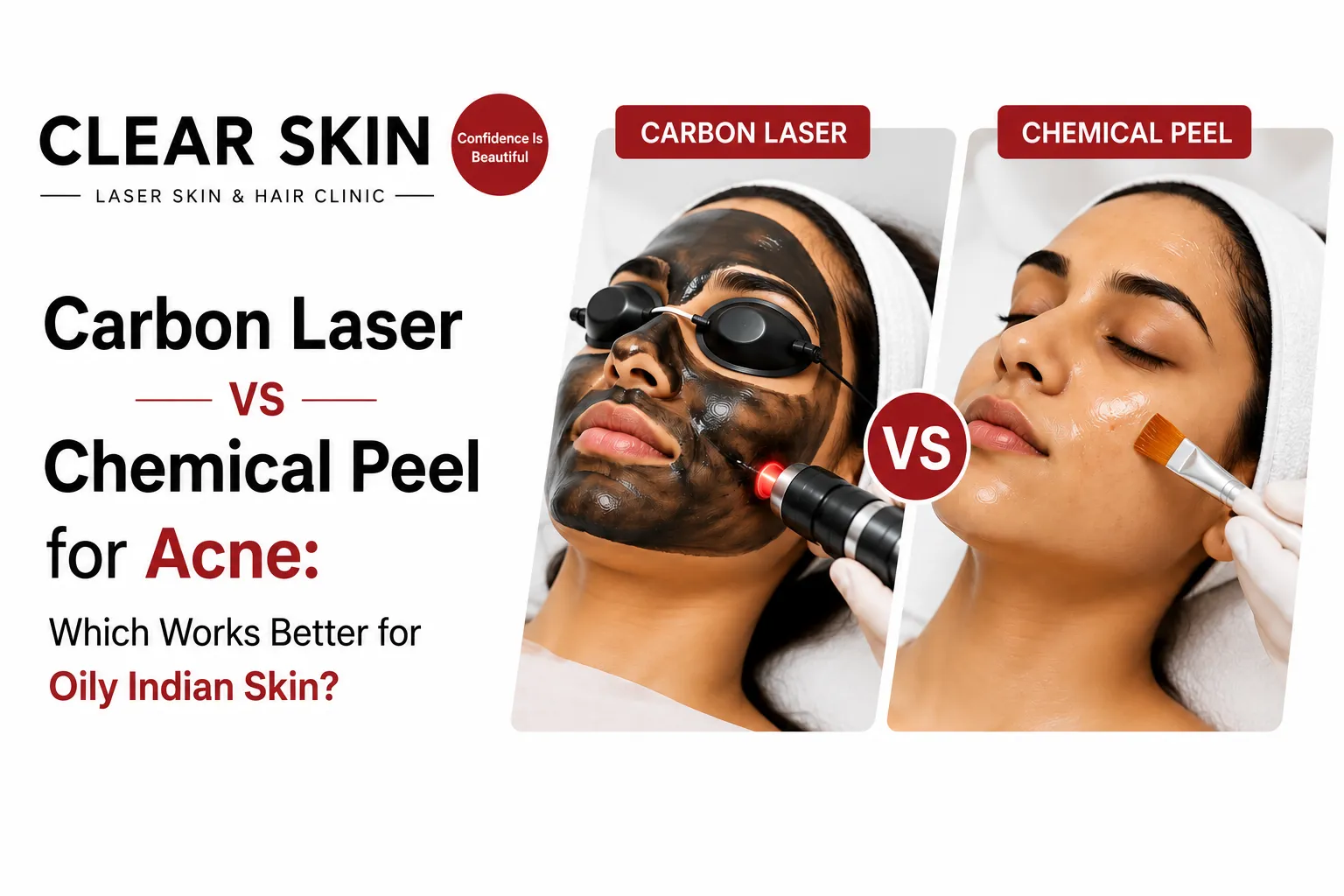
The carbon laser peel, the Hollywood peel, is a two-stage procedure combining a carbon paste application with Q-switched Nd: YAG laser passes.
Stage 1: Carbon Application
A thin layer of liquid carbon paste is applied to the face and allowed to dry. The microscopic carbon particles penetrate pore openings, physically binding to trapped sebum, dead skin cells, and surface bacteria inside the pore. This binding action is passive; the carbon works as a biological sponge, drawing out debris during the time it sits on the skin.
Stage 2: Laser Vaporization
The Q-switched Nd: YAG laser passes over the carbon-coated face. Laser energy is preferentially absorbed by the dark carbon particles and vaporizes them instantaneously, along with everything bound to them: sebum, keratin debris, bacteria. The vaporization creates a micro-thermal effect that heats the sebaceous gland, temporarily reducing oil production for 3–4 weeks after each session. A second, lighter laser pass without the carbon provides mild epidermal stimulation and brightening.
What Carbon Laser Delivers for Acne
Immediate pore cleansing, visible reduction in surface congestion, 3–4 week sebum reduction, mild bacterial load reduction, and a visible skin brightness immediately post-treatment. Zero downtime; patients walk out and return to normal activity immediately. Results are genuine but not permanently structural; carbon laser is a purification treatment, not a long-term remodeling intervention. Consistent monthly sessions maintain the benefit.
How Chemical Peels Work for Acne?
Chemical peels apply acid solutions to accelerate cell turnover, dissolve intrapore debris, and target the bacterial and inflammatory environment of active acne.
Salicylic Acid: The Intrapore Specialist
Salicylic acid is lipophilic , it dissolves in oil. This allows it to penetrate sebaceous pores where water-based acids like glycolic cannot reach. Inside the follicle, it dissolves the oil-keratin plug forming comedones, exfoliates the pore lining, reduces Propionibacterium acnes bacterial load, and has intrinsic anti-inflammatory properties. At 20–30% or as a salicylic-mandelic combination, it is the most clinically targeted peel for comedonal and inflammatory acne.
Mandelic Acid: The Safe Choice for Indian Skin
Mandelic acid’s large molecular structure produces slower, more uniform absorption than glycolic acid. Significantly lower irritation and lower PIH risk on Fitzpatrick IV–VI skin , directly relevant for Indian patients where active acne is already generating PIH risk from the breakouts themselves. The salicylic-mandelic combination delivers intrapore salicylic action alongside gentler surface exfoliation from mandelic, making it the standard peel choice for active acne on Indian skin.
What to Expect From a Peel Course
A standard course involves 6–8 sessions spaced 2–3 weeks apart. An initial purging in sessions 1–2 , where sub-surface comedones come to the surface before clearing , is normal and expected. Downtime is 1–3 days of mild redness and flaking. PIH improvement from each session develops over 4–6 weeks as exfoliated melanin clears. Understanding how chemical peels work for different skin concerns clarifies their role within a broader treatment plan.
Direct Comparison: Carbon Laser Peel & Chemical Peel
|
Factor |
Carbon Laser Peel |
Chemical Peel (Salicylic-Mandelic) |
|
Penetrates inside pores |
Yes , via carbon particle binding |
Yes , salicylic acid lipophilic penetration |
|
Reduces sebum production |
Yes , thermal sebaceous gland effect |
Indirectly |
|
Treats inflammatory acne |
Moderate |
Excellent |
|
Treats blackheads/comedones |
Excellent |
Excellent |
|
Addresses PIH |
Mild general brightening |
Yes , targeted epidermal clearing |
|
PIH risk on Indian skin |
Very low |
Low-moderate (acid-dependent) |
|
Downtime |
None |
1–3 days |
|
Sessions needed |
4–6 |
6–8 |
|
Cost per session (Pune) |
5,000–₹7,000 |
₹2,000–₹5,000 |
Which Works Better for Oily, Acne-Prone Indian Skin?
Carbon Laser Is Better for Congestion and Oiliness
If your primary concern is visibly enlarged pores, persistent oiliness, surface blackheads, and skin that feels congested and dull , carbon laser delivers immediate visible improvement with zero downtime. For patients who cannot take any recovery time due to work or social commitments, it is the most practical option for consistent improvement. The visible pore-clearing and instant brightness are its genuine strengths.
Chemical Peels Are Better for Active Breakouts and PIH
For moderate-to-severe inflammatory acne , papules, pustules, regular new breakouts , salicylic-mandelic peels address the intrapore environment more directly and completely. The lipophilic salicylic penetration disrupts comedone formation at its origin in a way surface carbon vaporization cannot replicate. For patients with concurrent PIH, peels address both simultaneously within the same treatment. Carbon peel treatment and chemical peels serve adjacent but distinct roles in a complete acne protocol.
Why the Combination Outperforms Either Alone?
For patients with oily skin, active breakouts, and concurrent PIH , the typical Indian skin acne presentation , combining both treatments in a staged protocol consistently outperforms either alone. Chemical peels clear the active inflammatory environment and PIH; carbon laser maintains pore clarity and manages oiliness between peel sessions. Many structured acne protocols alternate peel and carbon laser sessions across the same treatment course.
“Both carbon laser and salicylic peels address acne from the pore inward but through different mechanisms. For patients with predominantly oily, congested skin without significant active inflammation, carbon laser is often the more comfortable and practical maintenance treatment. For active acne with regular inflammatory breakouts, the peel protocol produces more targeted clearing. Combining both in a thoughtful sequence gets better results than choosing one permanently.” , Dr. Dhanraj Chavan, Clear Skin Clinic
What Happens After Active Acne Is Controlled?
Once breakout frequency is substantially reduced through a structured peel or combined protocol, the next clinical step is addressing the structural aftermath: post-acne PIH marks and any atrophic scarring that has developed. Both require separate, targeted treatment. The pigmentation component responds to continued peels and laser toning; structural scarring requires RF microneedling, subcision, or laser resurfacing depending on scar type.
For patients who have developed noticeable scarring from prior breakouts, a dedicated acne scar assessment is the appropriate next step after active acne control is established.
Frequently Asked Questions (FAQs)
How many carbon laser sessions are needed for acne?
A starting course is 4–6 sessions spaced 3–4 weeks apart. Results build cumulatively. Monthly maintenance sessions sustain pore clarity and oil control for ongoing oily, acne-prone skin management.
Can chemical peels make acne temporarily worse?
A purging response in the first 1–2 sessions is normal , the acid brings sub-surface comedones to the surface. This resolves by session 3 and is followed by progressive improvement. True worsening beyond the purge window signals a protocol review, not a reason to stop treatment.
Can carbon laser be done on active acne?
Yes , carbon laser can safely be performed on skin with mild-to-moderate active acne. Its antibacterial surface effect is part of its clinical mechanism. For severe active cystic acne, your dermatologist will guide the sequencing.
Which chemical peel is best for acne on dark Indian skin?
Salicylic-mandelic combination or mandelic acid alone. The large molecular size of mandelic acid produces slower absorption and substantially less irritation than glycolic acid on Fitzpatrick IV–VI skin , reducing PIH risk that active acne patients are already vulnerable to.
Is carbon laser painful?
Carbon laser is one of the most comfortable in-clinic procedures available. The paste application is painless; the laser passes produce a mild warm sensation. No numbing cream is required. Most patients describe it as entirely comfortable throughout.
Do You Know?
Roughly 250 Patients Are Treated
Everyday By These Dermatologists
(You are one click away from flawless skin)
Meet Our Dermatologist!





Conclusion
Choosing between a carbon laser peel and a chemical peel depends on the type of acne you’re treating rather than which treatment is more advanced.
Carbon laser is an excellent option for oily skin, enlarged pores, blackheads, and mild congestion, offering visible improvement with virtually no downtime. Chemical peels, particularly salicylic-mandelic peels, are better suited for active inflammatory acne, clogged pores, and post-acne pigmentation because they target the underlying causes of breakouts.
For many patients with oily, acne-prone Indian skin, the most effective approach is not choosing one treatment over the other but combining both as part of a personalised treatment plan. While chemical peels help control active acne and reduce pigmentation, carbon laser sessions can maintain oil balance and keep pores clear between treatments.
If you’re unsure which option is right for your skin, consult the dermatologists at Clear Skin Clinic Pune. After assessing your acne severity, skin type, and treatment goals, they can recommend a customised protocol designed to deliver clearer skin with safe, long-lasting results.
Further Reading
Isotretinoin (Accutane) for Acne: What to Expect, Side Effects, and Cost
Isotretinoin is the most effective treatment for severe or treatment-resistant acne. Learn who it is for, how it works, what side effects are real, what the cost looks like, and what happens after.
Adult Acne Treatment After 25: Why It Happens and How to Clear It
Acne after 25 has different triggers than teenage acne and needs a different treatment plan. Learn why it persists, what drives it, and how a dermatologist clears it effectively.
Hormonal Acne and PCOS Acne Treatment for Women in Pune
Deep, painful pimples on your jawline and chin that follow your cycle are hormonal acne. Learn what causes it, how PCOS makes it worse, and how dermatologists treat it effectively.
Anti-Aging Treatment Reviews from Pune Patients – HIFU, Fillers and Botox Results at Clear Skin
Laser and chemical peels both treat sun damage and dark spots, but through different mechanisms.
Have thoughts? Please let us know
We are committed not only to treating you, but also educating you.