
RF Microneedling for Acne Scars in Pune: What Results to Expect and Is It Worth It?

Written by Clear Skin Content Team | Medically Reviewed by Dr. Dhanraj Chavan on July 21, 2026
Medical Disclaimer: This article is for informational purposes only. Consult a qualified dermatologist for personalised medical advice.
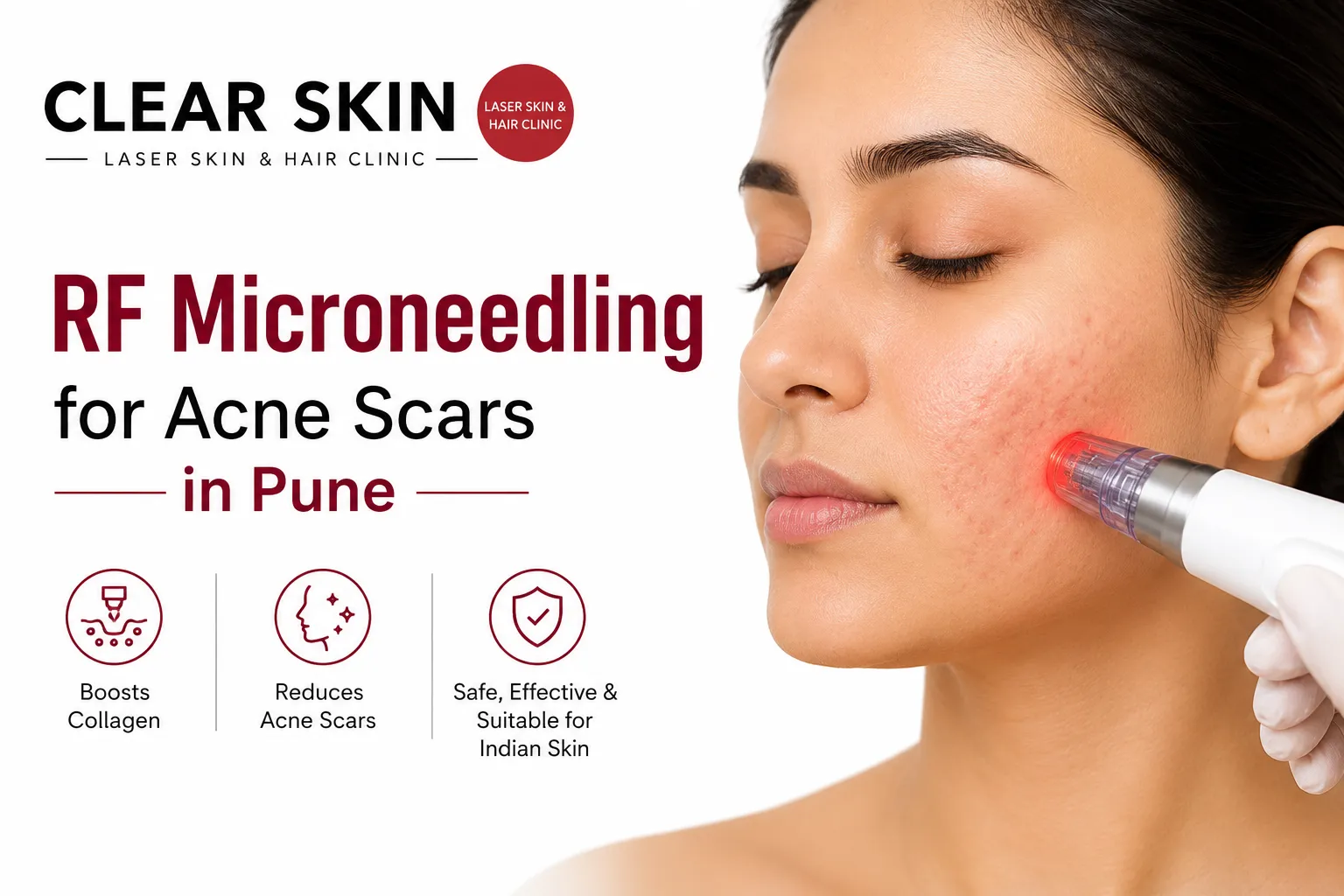
RF microneedling is one of the most effective treatments for acne scars on Indian skin, but the best results depend on choosing the right scar type, completing the recommended sessions, and following a personalised treatment plan.
RF microneedling appears on almost every dermatology clinic’s treatment menu in Pune , typically listed alongside compelling before-and-after results and a premium price tag. It generates genuine interest among patients dealing with post-acne scarring, and that interest is justified. RF microneedling is one of the most effective, well-tolerated scar treatments available for Indian skin. But it’s also frequently oversimplified in clinic marketing, leading to mismatched expectations: patients who thought they’d see dramatic transformation after two sessions, or who chose it for scar types it wasn’t the right tool for.
This article gives you a complete, honest picture: the science, the scar-type matching, the realistic timeline, and the cost-versus-outcome calculation for Pune patients.
Table Of Content
- What RF Microneedling Actually Does to Scar Tissue
- Which Scar Types Respond Best to RF Microneedling?
- How Many Sessions Do You Actually Need?
- RF Microneedling vs Other Scar Treatments: Where It Stands?
- Is RF Microneedling Worth the Cost in Pune?
- FAQs
- Conclusion
What RF Microneedling Actually Does to Scar Tissue?
RF microneedling , radiofrequency microneedling , combines two individually established treatments into a single procedure that addresses acne scars at the depth where they actually live.
The Microneedling Component
Fine-gauge needles penetrate the skin to preset depths, creating hundreds of controlled micro-injuries across the treatment area. These micro-injuries trigger the wound-healing cascade , the same biological sequence the skin uses to repair any damage , stimulating fibroblasts to produce new collagen and elastin. Standard microneedling alone produces meaningful improvement for superficial texture and mild scarring.
The Radiofrequency Component
RF energy is delivered through the needle tips directly into the dermis at the precise depth of penetration , typically 1.5mm to 3.5mm depending on scar depth and treatment area. This targeted heat creates a second, deeper wave of collagen stimulation and simultaneously causes tissue contraction. The RF energy reaches the dermis where scar tissue actually lives , not just the surface.
Why the Combination Outperforms Either Alone
Most atrophic acne scars are a dermal problem. Standard surface microneedling addresses the upper skin layers. RF microneedling delivers energy to the depth where scar tissue sits , which consistently produces more significant improvement for moderate-to-severe atrophic scarring than standard microneedling. This depth of action is the defining clinical advantage.
Which Scar Types Respond Best to RF Microneedling?
| Scar Type | RF Microneedling Response | Notes |
| Rolling scars | Excellent | Dermal collagen fills undulations progressively |
| Shallow boxcar scars | Good | Edges soften with sessions |
| Deep tethered boxcar scars | Moderate | Subcision first significantly improves outcomes |
| Icepick scars | Limited | TCA CROSS is more targeted and cost-effective |
| Atrophic surface texture | Excellent | One of the best treatments for diffuse texture loss |
| Enlarged pores with scarring | Excellent | RF heat contracts pore walls |
| Active acne | Not recommended | Acne must be controlled 3–6 months first |
For patients with mixed scar types, RF microneedling is often combined with targeted add-ons: TCA CROSS for icepick scars, subcision for deeply tethered rolling or boxcar scars. Understanding the full range of acne scar procedures helps clarify which combination is appropriate for your specific scar profile.
How Many Sessions Do You Actually Need?
This is where most clinics are vague or optimistic. The realistic breakdown:
Mild Scarring
2–3 sessions spaced 4–6 weeks apart typically produces satisfying visible improvement for patients with predominantly shallow surface texture loss and mild atrophic depressions.
Moderate Scarring
3–4 sessions is the standard recommendation. This is the most common presentation among patients seeking scar treatment, and RF microneedling is well-matched to this scar profile.
Severe or Mixed Scarring
4–6 sessions, frequently combined with subcision treatment for tethered scars or TCA CROSS for icepick scars. A proper scar mapping consultation before beginning defines which combination protocol is appropriate.
When Results Become Visible
Results are not immediate. Collagen remodeling takes 6–8 weeks per session to become visually apparent, and continues for up to 6 months after the final session. Patients who evaluate results two weeks post-treatment are assessing them far too early. Final outcomes are best measured 4–6 months after the last session.
“RF microneedling is one of the most versatile tools in our scar protocol because it works at the dermal level , where most atrophic scar tissue actually lives , while keeping surface trauma genuinely minimal. For Indian skin, it’s often our first recommendation over fractional CO2 laser because the PIH risk is significantly lower while achieving equivalent depth of collagen stimulation. Adding PRP in the same session enhances the collagen response further.” ,
RF Microneedling vs Other Scar Treatments: Where It Stands?
|
Treatment |
Best Scar Type |
Sessions |
Cost/Session (Pune) |
Downtime |
PIH Risk |
|
RF Microneedling |
Rolling, atrophic, pores |
3–5 |
₹8,000–₹18,000 |
1–3 days |
Low |
|
Fractional CO2 Laser |
All atrophic, surface texture |
2–4 |
₹10,000–₹20,000 |
5–7 days |
Moderate |
|
PRP + Microneedling |
Rolling, mild atrophic |
3–4 |
₹6,000–₹12,000 |
1–2 days |
Very low |
|
Subcision |
Tethered rolling, boxcar |
2–4 |
₹5,000–₹12,000 |
2–4 days |
Very low |
|
TCA CROSS |
Icepick scars |
3–6 |
₹3,000–₹7,000 |
3–5 days |
Low |
Seeing real patient results across treatment modalities helps set realistic expectations for what improvement looks like at different scar severity levels.
Is RF Microneedling Worth the Cost in Pune?
When It Is Worth It?
RF microneedling is worth the investment when your scars are rolling, atrophic, or mixed with significant surface texture loss; when PIH risk from more aggressive ablative treatments is a concern; when you are prepared to complete the full recommended course and wait for the full collagen maturation timeline; and when your active acne has been stable for at least 3–6 months.
When It May Not Be Optimal?
It is less appropriate when your scars are predominantly icepick , where TCA CROSS is more targeted and significantly cheaper. It is also not the right standalone choice for deeply tethered scars without subcision first.
Frequently Asked Questions (FAQs)
How long do RF microneedling results last?
Results are long-lasting because they are structural , driven by new collagen formation in the dermis. Collagen naturally degrades over time, and most patients benefit from a maintenance session every 12–18 months to sustain structural improvements.
Is RF microneedling painful?
Discomfort is well-managed with topical anesthetic applied 30–45 minutes before the session. Most patients describe the procedure as warm pressure , tolerable and manageable throughout. No significant pain during a properly numbed session.
Can RF microneedling be done on active acne?
No. Active inflammatory acne must be controlled before RF microneedling begins. Treating inflamed skin can spread bacteria through treatment channels and worsen inflammation. A minimum of 3–6 months of stable, breakout-free skin is required.
What is the downtime for RF microneedling?
Skin appears red and feels warm for 24–48 hours. Mild swelling for the first 12–24 hours is normal. Most patients return to work within 48–72 hours. Makeup is permitted after 48 hours once micro-channels have closed. No significant crusting or peeling with correctly administered RF microneedling.
Can RF microneedling treat both acne scars and enlarged pores?
Yes. The dermal collagen stimulation and RF-induced tissue contraction improve both simultaneously. Patients with pore enlargement alongside atrophic scarring often see meaningful improvement in both from the same treatment course.
Do You Know?
Roughly 250 Patients Are Treated
Everyday By These Dermatologists
(You are one click away from flawless skin)
Meet Our Dermatologist!


Conclusion
RF microneedling is one of the most effective treatments for improving rolling scars, shallow boxcar scars, enlarged pores, and overall skin texture on Indian skin. By delivering radiofrequency energy deep into the dermis, it stimulates natural collagen production where acne scars develop, leading to gradual and long-lasting improvement with minimal downtime.
However, the best results come from selecting the right treatment for your scar type rather than relying on a single procedure. Deep tethered scars may require subcision before RF microneedling, while icepick scars often respond better to TCA CROSS. A personalised treatment plan designed by an experienced dermatologist can significantly improve outcomes and reduce the risk of unnecessary procedures.
If you’re considering RF microneedling for acne scars in Pune, consult the dermatologists at Clear Skin Clinic. After assessing your scar type, skin condition, and treatment goals, they’ll recommend a customised protocol to help you achieve smoother, healthier-looking skin with realistic, long-lasting results.
Further Reading
How Many Months Before Your Wedding Should You Start Acne Treatment?
Planning your wedding? Find out when to start acne treatment, which treatments may help, and what to avoid before your wedding day.
Isotretinoin (Accutane) for Acne: What to Expect, Side Effects, and Cost
Isotretinoin is the most effective treatment for severe or treatment-resistant acne. Learn who it is for, how it works, what side effects are real, what the cost looks like, and what happens after.
Adult Acne Treatment After 25: Why It Happens and How to Clear It
Acne after 25 has different triggers than teenage acne and needs a different treatment plan. Learn why it persists, what drives it, and how a dermatologist clears it effectively.
Hormonal Acne and PCOS Acne Treatment for Women in Pune
Deep, painful pimples on your jawline and chin that follow your cycle are hormonal acne. Learn what causes it, how PCOS makes it worse, and how dermatologists treat it effectively.
Have thoughts? Please let us know
We are committed not only to treating you, but also educating you.