
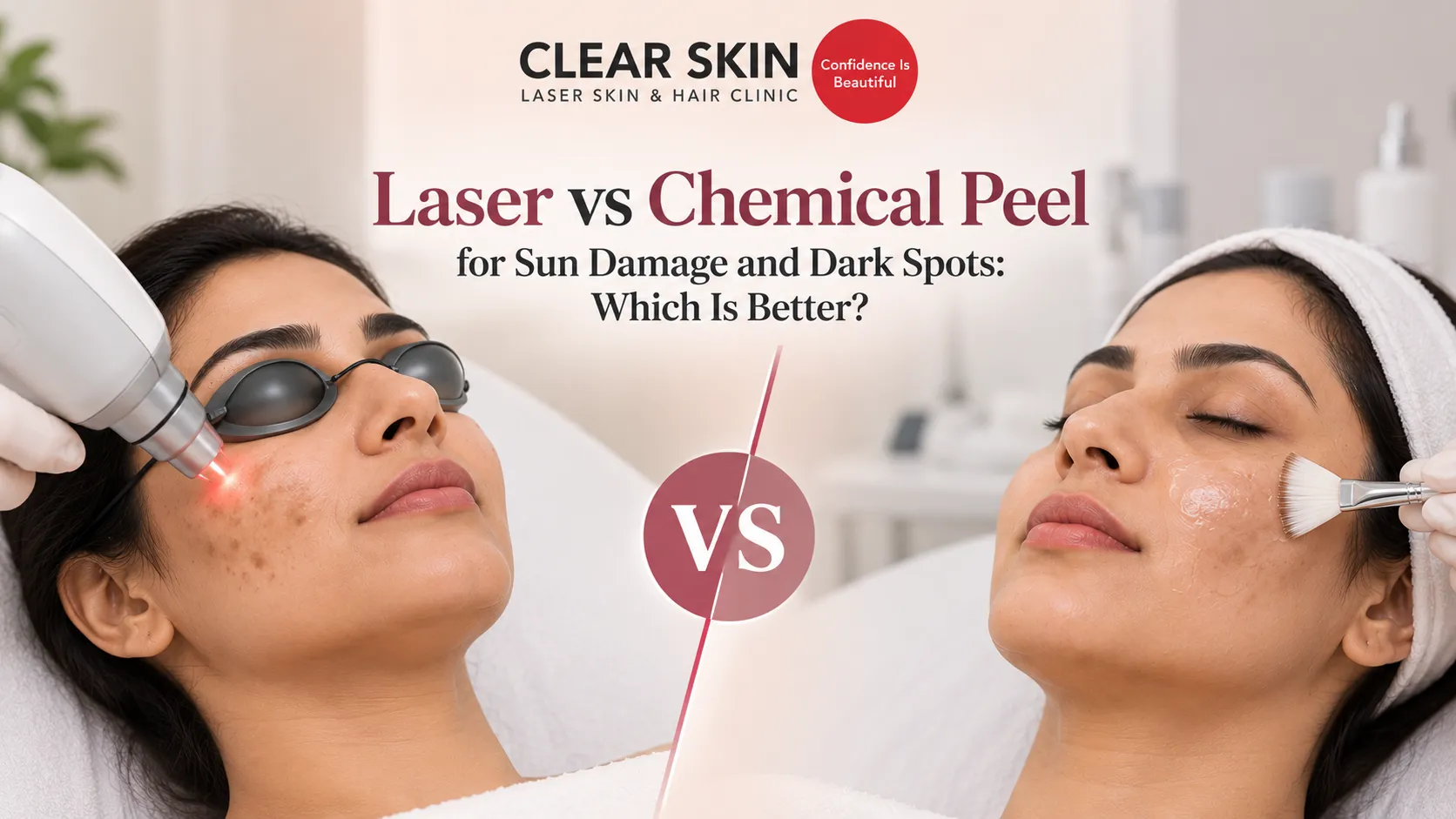
Laser vs Chemical Peel for Sun Damage and Dark Spots: Which Is Better?

Written by Clear Skin Content Team | Medically Reviewed by Dr. Dhanraj Chavan on September 27, 2026
Is this article for you?
- You have sun-damaged skin with overall uneven tone: Chemical peel section is for you first
- You have specific, defined dark spots that topicals haven’t shifted: Laser section is your focus
- You have melasma: Read the dedicated melasma subsection before deciding anything
- You have Indian skin and are worried about making pigmentation worse: Read the Indian skin risk section specifically
Chemical peels are better for broad, surface-level sun damage and uneven tone. Laser is better for discrete, defined dark spots that have not responded to peels or topicals. For most Indian patients, the right sequence is peels first (lower PIH risk, broader improvement), then laser for any stubborn spots that remain. Combining both in a planned sequence consistently outperforms either treatment used alone for established sun damage and mixed pigmentation.
Summary
- Chemical peels address broad surface pigmentation, general uneven tone, and texture simultaneously. Best starting point for most Indian patients with sun damage.
- Laser treatments target discrete, defined dark spots with precision. Most effective after peels have addressed the surface layer.
- For Indian Fitzpatrick IV to VI skin, PIH risk from both treatments is real and manageable with correct technique, acid selection, laser settings, and post-treatment protocol.
- Melasma requires specific management: conservative peels and topicals first, laser used cautiously and at low fluence only after topical approaches plateau.
- The most effective approach for established sun damage is a planned sequence: skincare foundation plus peels, then laser for residual discrete spots.
- SPF 50 PA+++ every single day is non-negotiable throughout treatment and indefinitely after. Without it, UV exposure reverses all results daily.
Table Of Content
- Laser vs Chemical Peel for Sun Damage and Dark Spots
- How Chemical Peels Treat Sun Damage and Dark Spots?
- How Laser Treatments Target Dark Spots?
- The Indian Skin Risk Factor: Why This Choice Matters More Here?
- The Melasma Exception
- Which to Choose and When?
- What to Expect From Each Treatment?
- Frequently Asked Questions
- Conclusion
Laser vs Chemical Peel for Sun Damage and Dark Spots
|
Chemical Peel |
Laser Treatment |
|
|
Mechanism |
Chemical exfoliation removing pigmented surface cells |
Light energy targeting melanin or resurfacing skin layers |
|
Best for |
Mild to moderate surface pigmentation, texture, uneven tone |
Discrete established dark spots, deeper pigmentation, lentigines |
|
Results onset |
Visible after 2 to 3 sessions |
Visible after 2 to 4 sessions |
|
Sessions needed |
4 to 6 sessions |
4 to 8 sessions |
|
Downtime |
1 to 7 days (peel depth dependent) |
1 to 5 days (laser type dependent) |
|
Cost per session |
Rs. 2,000 to 8,000 |
Rs. 5,000 to 20,000 |
|
PIH risk (Indian skin) |
Moderate, lower with gentler acids |
Moderate to high if not calibrated for Indian skin |
|
SPF requirement |
Mandatory post-treatment |
Mandatory post-treatment |
How Chemical Peels Treat Sun Damage and Dark Spots?
A chemical peel applies an acid solution to the skin surface for a controlled period of time. The acid breaks down the bonds between surface skin cells, causing the top layers to shed over the following days and reveal newer, less pigmented skin beneath. The depth of the peel, and therefore the depth of the change it produces, is determined by the type of acid and its concentration.
Superficial peels (glycolic acid 20 to 50%, lactic acid, mandelic acid): Remove only the outermost epidermal layer. Suitable for mild surface pigmentation, general uneven tone, and post-inflammatory marks that are in the superficial layers. Downtime is 2 to 4 days of flaking. PIH risk for Indian skin is low to moderate when concentrations are matched correctly to skin type.
Medium depth peels (TCA 15 to 35%, Jessner’s solution): Penetrate into the mid-epidermis and superficial dermis. More effective for established sun damage, moderate dark spots, and more significant textural changes. Downtime is 5 to 7 days of visible peeling. PIH risk for Indian skin is moderate and requires careful post-peel management including strict SPF and sometimes topical corticosteroids or skin-brightening ingredients during recovery.
What Peels Are Best At
Chemical peels address broad surface pigmentation particularly well. If the concern is overall uneven tone, a face that looks generally darker and patchier than it used to, or multiple small surface marks scattered across the face, a peel series improves all of these simultaneously in a single treatment type. Peels also improve surface texture alongside pigmentation, which laser treatments targeting melanin specifically do not always address as comprehensively.
For pigmentation conditions with a significant surface component (post-inflammatory hyperpigmentation from acne, mild tanning, early sun spots), a glycolic or lactic acid peel series is often the most efficient starting point.
How Laser Treatments Target Dark Spots?
Lasers used for pigmentation work differently from chemical peels. Rather than chemically dissolving surface cells broadly, lasers deliver specific wavelengths of light that are preferentially absorbed by melanin in pigmented cells. The light energy is converted to heat, which destroys the melanin granules. The body then clears the fragmented pigment through its natural immune processes over the following weeks.
Q-switched Nd:YAG laser: Delivers energy at 1064nm and 532nm wavelengths. The 1064nm wavelength is the standard for Indian skin pigmentation treatment, as it has lower melanin absorption in the epidermis than 532nm (reducing surface PIH risk) while still effectively targeting deeper pigmented lesions. Used for sun spots, lentigines, post-inflammatory marks, and general toning. A well-calibrated Q-switched Nd:YAG laser treatment at correct settings for Fitzpatrick IV to VI skin is one of the most effective tools for established pigmentation that has not responded to peels.
Pico laser: Delivers energy in ultra-short picosecond pulses, creating a photoacoustic effect rather than primarily a photothermal one. This means less heat generation in the skin and lower PIH risk for Indian skin compared to longer-pulse laser systems. Increasingly preferred for Indian Fitzpatrick IV to V skin for this reason, though cost per session is typically higher than Q-switch.
Fractional laser (CO2 or Er:YAG): Ablative resurfacing that removes the entire surface of treated micro-columns of skin. Highly effective for photoaging, texture, and deep sun damage but carries significant PIH risk for Indian skin. Generally not a first-line choice for Fitzpatrick IV to VI patients for pigmentation concerns specifically.
What Laser Is Best At
Laser is most effective for discrete, defined pigmented lesions: individual sun spots, lentigines (flat brown spots that appear with age and sun exposure), and localised areas of PIH that have not responded adequately to peels and topicals. The targeted energy delivery allows specific spots to be treated with precision that chemical peels, which work across the whole treated surface, cannot match.
The Indian Skin Risk Factor: Why This Choice Matters More Here?
For Fitzpatrick IV to VI skin, the primary risk of both chemical peels and laser treatments is post-inflammatory hyperpigmentation: new darkening that appears in response to the treatment itself. This is the most frustrating outcome in pigmentation treatment because the treatment intended to lighten the skin produces new darkening.
PIH risk is higher for Indian skin because Indian melanocytes are more reactive. They produce melanin more readily in response to any inflammatory stimulus, including the controlled inflammation that both peels and lasers intentionally create. Managing this risk requires:
For peels: Starting with lower acid concentrations and building up gradually. Using mandelic acid as an alternative to glycolic for more sensitive skin, as it has larger molecular size and penetrates more slowly with lower irritation. Strict post-peel SPF and avoidance of heat exposure for 1 to 2 weeks. Pre-treatment skin priming with vitamin C serum and niacinamide for 4 to 6 weeks before the first peel session.
For laser: Using wavelengths and settings validated specifically for darker Indian skin (1064nm Q-switch, Pico laser). Conservative fluence settings on initial sessions, building only if tolerance is confirmed. Mandatory post-treatment SPF 50 and sun avoidance for 2 weeks minimum. A pre-laser brightening protocol for 4 to 6 weeks prior to reduce background melanin load.
Both treatments require a minimum of SPF 50 PA++++(Usually PA+++ is enough, but for Indians, PA++++ sunscreen is preferable for stronger UVA protection. ) used daily from the day treatment begins and continued indefinitely thereafter. Without this, UV exposure reverses treatment progress daily. No peel or laser result is sustainable without it.
The Melasma Exception
Melasma deserves a specific note because it is extremely common in Indian women and because the laser vs peel question has a different answer for melasma than for other types of pigmentation.
Melasma is a hormonally driven, UV-aggravated pigmentation condition that involves deep dermal melanin deposits in addition to epidermal pigmentation. It is chronic and recurrent, not curable. Aggressive laser treatment for melasma carries a significant risk of rebound hyperpigmentation, where the melasma returns darker than before treatment. This has caused Pico and Q-switch laser to be used cautiously and at conservative settings for melasma specifically.
For melasma treatment, chemical peels at appropriate concentrations and a rigorous topical protocol (prescription-grade hydroquinone combinations, azelaic acid, tranexamic acid, vitamin C, SPF) are typically the first-line approach. Laser is introduced conservatively and at low fluence if topical and peel approaches have reached a plateau. Any dermatologist recommending aggressive laser treatment for melasma without this context is worth seeking a second opinion from.
Which to Choose and When?
|
Situation |
Start With |
Add Later If Needed |
|
General sun damage, uneven tone |
Chemical peel series |
Laser toning for residual spots |
|
Specific defined dark spots |
Chemical peel series to prime skin |
Q-switch or Pico laser for persistent spots |
|
Post-acne PIH, surface marks |
Glycolic or lactic acid peels |
Laser only if peels plateau |
|
Melasma |
Topical protocol plus gentle peels |
Conservative laser at low fluence |
|
Deep sun damage, photodamaged texture |
TCA peel series |
Fractional laser cautiously if Indian skin permits |
|
Maintenance after clearance |
Monthly superficial peels |
Periodic laser toning sessions |
“For Indian patients with sun damage and dark spots, my general sequence is: establish the skincare foundation with vitamin C and SPF, run a peel series to lift the surface pigmentation and improve overall tone, and then use laser precisely for whatever discrete spots remain after 3 to 4 months of peels. Going straight to aggressive laser on Indian skin without this preparation increases PIH risk substantially. The peel series also primes the skin to respond better to laser when it is used. Sequence matters as much as treatment selection in pigmentation management.” , Dr. Dhanraj Chavan, Clear Skin Clinic
Book a Pigmentation Treatment Consultation at Clear Skin Clinic: Call +91 95845 84111
What to Expect From Each Treatment?
Chemical peel series expectations: After the first session, skin may look worse before it looks better as surface cells shed. Visible improvement in tone typically begins by session 2 to 3. Significant improvement in overall evenness and surface texture by session 4 to 6. The improvement continues to develop for 4 to 6 weeks after the final session as new skin matures. Maintenance peels every 6 to 8 weeks preserve results.
Laser treatment expectations: Sun spots and discrete pigmentation typically darken briefly immediately post-treatment (a normal response as the melanin clusters before clearance) before lightening over 1 to 2 weeks. Significant improvement in targeted areas after 2 to 4 sessions. Full clearance of stubborn spots may take 6 to 8 sessions for established hyperpigmentation. PIH from laser treatment, if it occurs, is manageable with a dermatologist-supervised recovery protocol and typically resolves within 6 to 12 weeks with correct management.
For ongoing skin rejuvenation beyond pigmentation treatment, combining the peel and laser protocol with medical-grade vitamin C serum, retinoids, and consistent SPF produces the most durable improvement in overall skin clarity and tone.
For patients in Pune seeking TCA peel treatment or laser pigmentation sessions, a consultation that includes precise skin type assessment and a sequenced treatment plan is the starting point for safe, effective results.
Visit Clear Skin Clinic in Pune
Frequently Asked Questions
How many peel sessions does it take to see a visible difference in dark spots?
Most patients notice visible improvement in overall skin tone by sessions 2 to 3 in a glycolic acid peel series. Significant improvement in surface dark spots typically becomes apparent by sessions 3 to 4. A full series of 4 to 6 sessions produces the most complete result, with improvement continuing to develop for several weeks after the final session.
Can I do peels and laser in the same month?
Generally not. Chemical peels and laser treatments are not typically combined in the same session or within the same 2 to 4 week window, as each creates skin inflammation that the other would compound. The standard approach is to complete a peel series, allow the skin to fully recover, then assess what remains before introducing laser. A dermatologist will advise on the appropriate gap between modalities for your specific treatment course.
Will laser treatment make my dark spots permanently disappear?
Laser can produce significant to complete clearance of specific pigmented lesions like sun spots and lentigines. These spots, once cleared, may not recur in the same location if UV protection is maintained consistently. However, new sun exposure without SPF will create new pigmentation over time. Melasma and post-inflammatory marks have a higher tendency to recur because the trigger (hormones, breakouts, UV) persists.
Is it safe to get a chemical peel in summer in India?
Summer peels are possible but require additional precautions. Heat and sun exposure immediately post-peel significantly increase PIH risk. Many dermatologists prefer to schedule peel series during cooler months (October to February in most of India) when sun exposure is more manageable and the risk of heat-triggered PIH is lower. If summer peels are needed, superficial peels at lower concentrations are safer than medium-depth peels during high-UV months.
What is the difference between tanning and true sun damage?
Tanning is a temporary UV-induced increase in melanin production in the upper skin layers that fades as those cells shed, typically over 4 to 8 weeks with sun avoidance. True sun damage includes permanent structural changes: melanocyte dysregulation, established lentigines, textural changes from collagen photodamage, and pigmentation that has moved into deeper skin layers. Chemical peels and laser treatments are indicated for true sun damage; tanning often responds to topicals and sun avoidance alone without requiring clinic treatment.
Do You Know?
Roughly 250 Patients Are Treated
Everyday By These Dermatologists
(You are one click away from flawless skin)
Meet Our Dermatologist!


Conclusion
Chemical peels and laser treatments can both play an important role in managing sun damage and dark spots, but the right choice depends on the type and depth of pigmentation. Chemical peels are generally suited to broad surface pigmentation, uneven tone, and superficial marks, while laser treatment offers more targeted treatment for defined spots that remain after other approaches.
For Indian skin, treatment planning is especially important because both procedures can trigger post-inflammatory hyperpigmentation if the treatment, settings, or aftercare are not appropriately selected. Melasma also requires a more cautious approach, with topical treatment and gentle peels generally considered before introducing laser.
In many cases, pigmentation management works best as a planned sequence rather than choosing one treatment in isolation. A dermatologist can assess the type of pigmentation, determine your skin’s tolerance, and create a treatment plan that balances results with safety.
Further Reading
Dermal Fillers vs Botox in Pune: Cost, Results, and Which to Choose
Dermal fillers and Botox are often confused but treat completely different concerns.
PIH After Acne: Causes & Treatment | Clear Skin Pune
Post-inflammatory hyperpigmentation (PIH) is a flat dark mark after acne, not a scar. Learn why Indian skin is prone to it and how Clear Skin Pune treats it.
Gym & Sweat Acne: Causes & Prevention | Clear Skin Pune
Gym acne (acne mechanica) is caused by sweat, heat, and friction. Learn where it appears, why Pune’s humidity worsens it, and how to prevent breakouts.
Best Treatments for Back Acne and Body Scars
Struggling with back acne and body scars? Learn about effective home remedies and professional treatments to achieve clear, blemish-free skin.
Have thoughts? Please let us know
We are committed not only to treating you, but also educating you.