
Dermal Fillers vs Botox in Pune: Cost, Results, and Which to Choose?

Written by Clear Skin Content Team | Medically Reviewed by Dr. Dhanraj Chavan on September 28, 2026
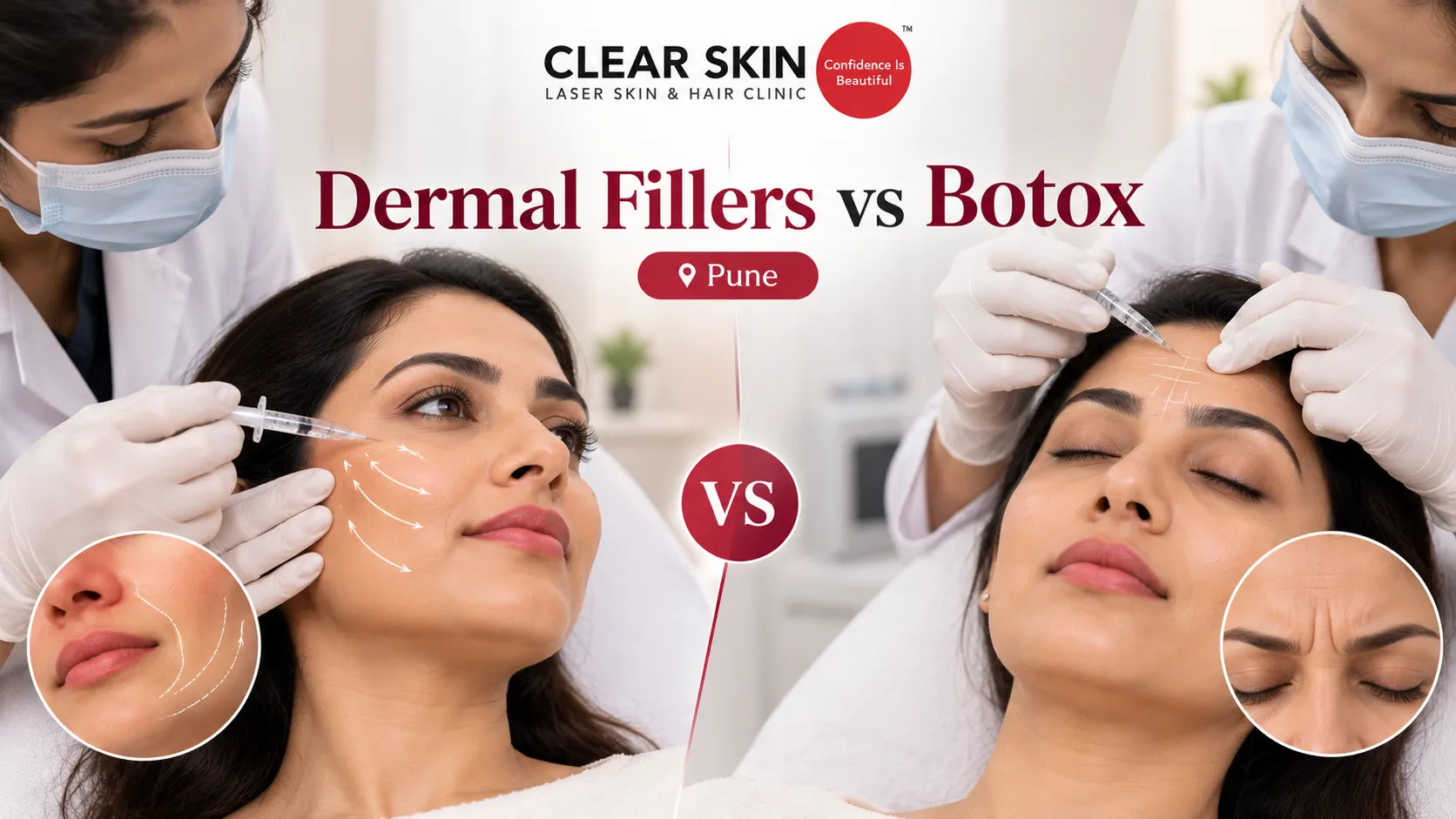
Dermal Fillers vs Botox: At a Glance
|
Botox |
Dermal Fillers |
|
|
Mechanism |
Relaxes muscles causing expression wrinkles |
Restores lost volume beneath the skin |
|
Best for |
Forehead lines, crow’s feet, frown lines |
Hollow cheeks, thin lips, under-eye area, jawline |
|
Results onset |
5 to 7 days |
Immediate |
|
Results last |
3 to 6 months |
9 to 18 months |
|
Downtime |
None |
1 to 3 days |
|
Reversible |
No (wears off naturally) |
Yes, HA fillers only |
|
Cost per session |
Rs. 5,000 to 15,000 per area |
Rs. 15,000 to 40,000 per syringe |
|
PIH risk (Indian skin) |
Very low |
Very low |
Is this article for you?
- You have forehead lines, frown lines, or crow’s feet: Botox section is for you
- Your cheeks look flat, lips thin, or under-eyes hollow: Fillers section is for you
- You are not sure which one you need: Read both, then the “how to choose” section
- You want to know the real cost over time: Jump to the cost breakdown
Botox and dermal fillers solve different problems. Botox relaxes facial muscles to smooth wrinkles caused by repeated expressions. Fillers restore volume that has been lost with age. Using Botox for volume loss does nothing. Using fillers for expression wrinkles is unnecessary. The right choice depends entirely on which change you are looking at in the mirror.
Table Of Content
- How Botox Works?
- How Dermal Fillers Work?
- The Core Difference: Volume vs Movement
- Honest Cost Breakdown
- Indian Skin Considerations
- Can Botox and Fillers Be Combined?
- Frequently Asked Questions
- Conclusion
How Botox Works?
Botox is an injectable neuromodulator , it modifies nerve signals to muscles. When injected into a specific facial muscle in a small, precisely controlled dose, it blocks the acetylcholine signal that tells that muscle to contract. The muscle relaxes. It stops pulling on the skin above it. The skin smooths out.
This mechanism is specifically effective for wrinkles that are caused by the repetitive movement of facial muscles over years. Every time you raise your eyebrows, squint, or frown, the muscles involved contract and crease the skin above them. Do this tens of thousands of times over decades and the crease becomes permanently etched into the skin even when you are not making the expression. Botox prevents the muscle from creating the crease repeatedly, allowing the skin to stop reinforcing it and gradually smooth.
What Botox Treats?
The classic Botox areas are: horizontal forehead lines (frontalis muscle), vertical frown lines between the brows (glabellar lines, the 11s), and crow’s feet at the outer corners of the eyes (orbicularis oculi muscle). Additional applications include: bunny lines on the nose bridge, the lip flip (relaxing the upper lip border to show more lip), brow lift (relaxing depressor muscles), chin dimpling, and neck bands (platysmal bands).
Every one of these applications addresses muscles. None of them addresses volume.
How Dermal Fillers Work?
Dermal fillers are gel-like substances injected beneath the skin to replace volume that has been lost or to add structural support where it is lacking. The most widely used type is hyaluronic acid (HA), a substance naturally present in skin and connective tissue. HA filler gels are engineered in a range of densities: thinner gels for delicate areas like the under-eye, thicker gels for structural support in the cheeks and jawline.
When injected into a volume-deficient area, the filler physically occupies the space that has been lost. Cheeks that have deflated regain their shape. Hollow under-eyes fill in. Thin lips gain volume and definition. The result is immediate and visible from the day of treatment.
HA fillers also attract and bind water molecules in the tissue around them, which contributes to the hydration and subtle plumping effect around the injection site beyond just the physical volume of the gel itself.
What Fillers Treat?
Fillers address structural changes caused by volume loss, not muscle movement. Primary filler areas: mid-cheek deflation (the most common cause of the “tired” look as early as the mid-30s), temporal hollowing, tear trough and under-eye hollowness, thin or deflated lips, nasolabial folds deepened by descending cheek pads above, marionette lines, jawline definition, and chin projection.
A crucial clarification: nasolabial folds (the lines running from the nose corners to the mouth corners) are listed as a filler target, not a Botox target. This surprises some patients who think of them as expression lines. In most cases they are caused primarily by cheek pad descent , as the cheek tissue slides down with age, it piles up in the nasolabial crease below. Filling the cheek above provides structural support that softens the fold, rather than injecting filler directly into the fold itself. This is why nasolabial fold treatment in experienced hands often focuses on the mid-cheek.
The Core Difference: Volume vs Movement
|
Concern |
The Cause |
The Right Treatment |
|
Forehead lines when raising brows |
Frontalis muscle contraction |
Botox |
|
Frown lines between brows |
Corrugator muscle contraction |
Botox |
|
Crow’s feet |
Orbicularis oculi contraction |
Botox |
|
Flat or hollow cheeks |
Volume loss in fat compartments |
Fillers |
|
Hollow under-eyes |
Volume loss and fat pad thinning |
Fillers (tear trough) |
|
Thin or deflated lips |
Lip volume loss with age |
Fillers |
|
Deep nasolabial folds |
Cheek pad descent and volume loss |
Fillers (cheek) |
|
Temporal hollowing |
Fat pad loss at temples |
Fillers |
|
Jawline definition loss |
Volume and structural changes |
Fillers |
Honest Cost Breakdown
Botox costs are typically quoted per area or per unit. Per-area pricing in India runs approximately Rs. 5,000 to 15,000 per treatment zone (forehead, frown lines, and crow’s feet each count as one zone). Most patients treat two to three areas per session. Full-face Botox across three zones runs Rs. 12,000 to 35,000 per session. Sessions are required every 3 to 6 months to maintain the result.
Annual Botox maintenance cost for two to three areas: approximately Rs. 24,000 to 70,000 per year depending on how frequently the patient repeats and how many areas are treated.
Filler costs are quoted per syringe (1ml). One syringe costs Rs. 15,000 to 40,000 depending on the brand and density. Most treatment areas require 0.5 to 2 syringes. Cheek enhancement typically uses 1 to 2 syringes per cheek. Lip augmentation uses 0.5 to 1 syringe. Tear trough treatment uses 0.5 to 1 syringe per side.
A single area filler session: Rs. 15,000 to 40,000. Full-face volume restoration across multiple areas in one session: Rs. 40,000 to 120,000. Fillers last 9 to 18 months, so annual cost is lower than Botox when calculated per year of maintained result.
Over 3 years, the economics roughly balance out for patients maintaining both: annual Botox maintenance plus filler touch-ups every 12 to 18 months costs approximately Rs. 40,000 to 80,000 per year for patients treating three Botox zones plus one to two filler areas.
Indian Skin Considerations
Both Botox and HA fillers carry very low PIH risk for Indian Fitzpatrick IV to VI skin, which is a significant advantage over energy-based treatments. Neither creates surface trauma, heat damage, or chemical exfoliation at the skin surface , the primary triggers of PIH in darker skin tones.
The main Indian-skin-specific consideration for fillers is product selection and technique in the tear trough area. The under-eye skin in Indian patients tends to be thin, and the vascularity in this area means bruising is common. Experienced injectors use blunt cannulas rather than sharp needles in this area to significantly reduce bruising risk and improve safety of placement.
For Botox in Indian patients, dosing should account for the fact that some Indian patients have naturally stronger masseter muscles (jaw muscles) due to dietary habits involving harder or more fibrous foods. Masseter Botox for jaw slimming or teeth-grinding treatment may require higher doses than standard Western dosing guides suggest.
Patients with existing pigmentation concerns can safely proceed with both Botox and HA filler treatments. If peels or laser treatments for pigmentation are also planned, these are typically spaced 2 to 4 weeks apart from injectable sessions to allow independent recovery assessment.
“Most patients who come to us having had disappointing results from injectables at other clinics have one thing in common: the treatment they received did not match the concern they described. Botox for a face that primarily needs volume restoration, or fillers placed in areas that would have responded better to energy-based tightening. The consultation is where the outcome is decided. A ten-minute proper assessment of which mechanism of aging is dominant in a patient’s face determines which treatment will actually work, and which will be a waste of their money.” , Dr. Dhanraj Chavan, Clear Skin Clinic
Book a Filler or Botox Consultation at Clear Skin Clinic: Call +91 95845 84111
Can Botox and Fillers Be Combined?
Yes. Combining them is sometimes called a “liquid facelift” and for patients in their late 30s to early 50s who show both volume loss and dynamic wrinkles, the combination is often the most appropriate recommendation.
The approach: Botox is used to address expression wrinkles in the forehead and eye area. Fillers are used to restore volume in the cheeks, lips, or under-eyes. The two treatments are typically performed in the same session or within a few weeks of each other, with no interaction or interference between them.
The result of a well-planned liquid facelift is a face that looks simultaneously rested (from the volume restoration) and smooth (from the expression wrinkle treatment) , which is closer to natural youth than either treatment achieves independently. Combined treatment costs more upfront but addresses aging more comprehensively and tends to produce results patients find more satisfying than either treatment alone.
For skin rejuvenation beyond injectable treatments, combining Botox and fillers with a medical-grade skincare protocol, chemical peels for texture and pigmentation, or energy-based treatments like HIFU for skin tightening extends the overall result and addresses aspects of aging that injectables cannot reach.
Visit Clear Skin Clinic in Pune
Frequently Asked Questions
Does Botox hurt?
Botox injections use a very fine needle and the procedure takes only a few minutes per area. Most patients describe the sensation as a brief, mild sting. Numbing cream is not typically required, though some clinics offer it for sensitive patients. There is no recovery period after Botox.
How do I know if I need fillers or Botox?
Look at the concern you want to treat when your face is completely relaxed. If it is significantly less visible at rest than when making expressions, it is likely a dynamic wrinkle suited to Botox. If it is consistently visible regardless of expression, and involves a hollow, flat, or sunken area, fillers are more likely to be appropriate. A dermatologist assessment is the definitive way to confirm.
Can fillers go wrong? What are the risks?
HA fillers carry risks including bruising (common and temporary), swelling, asymmetry, and in rare cases, vascular occlusion if filler is inadvertently injected into a blood vessel. The last risk is serious but extremely rare when treatment is performed by an experienced dermatologist using correct technique. HA fillers are reversible with hyaluronidase, which dissolves the filler within 24 to 48 hours if a complication or unsatisfactory result occurs.
How long does filler last in the lips?
Lip filler typically lasts 6 to 12 months. The lips are a high-movement area and filler metabolises faster there than in lower-movement areas like the temples or cheeks. Thicker HA gel formulations last longer in the lips than thinner ones.
Should I do Botox or fillers first if I’m getting both?
There is no strict rule. Many patients receive both in the same session. If done separately, most practitioners prefer to assess the full Botox result (2 weeks post-injection) before placing fillers, so the filler placement is done in the context of the settled Botox result. This allows precise assessment of remaining volume needs after expression lines have been addressed.
Do You Know?
Roughly 250 Patients Are Treated
Everyday By These Dermatologists
(You are one click away from flawless skin)
Meet Our Dermatologist!



Conclusion
Further Reading
Laser vs Chemical Peel for Sun Damage and Dark Spots: Which Is Better?
Laser and chemical peels both treat sun damage and dark spots, but through different mechanisms.
PIH After Acne: Causes & Treatment | Clear Skin Pune
Post-inflammatory hyperpigmentation (PIH) is a flat dark mark after acne, not a scar. Learn why Indian skin is prone to it and how Clear Skin Pune treats it.
Gym & Sweat Acne: Causes & Prevention | Clear Skin Pune
Gym acne (acne mechanica) is caused by sweat, heat, and friction. Learn where it appears, why Pune’s humidity worsens it, and how to prevent breakouts.
Best Treatments for Back Acne and Body Scars
Struggling with back acne and body scars? Learn about effective home remedies and professional treatments to achieve clear, blemish-free skin.
Have thoughts? Please let us know
We are committed not only to treating you, but also educating you.