
Is HIFU Skin Tightening Worth the Cost in Pune? Honest Patient Results

Written by Clear Skin Content Team | Medically Reviewed by Dr. Dhanraj Chavan on September 29, 2026
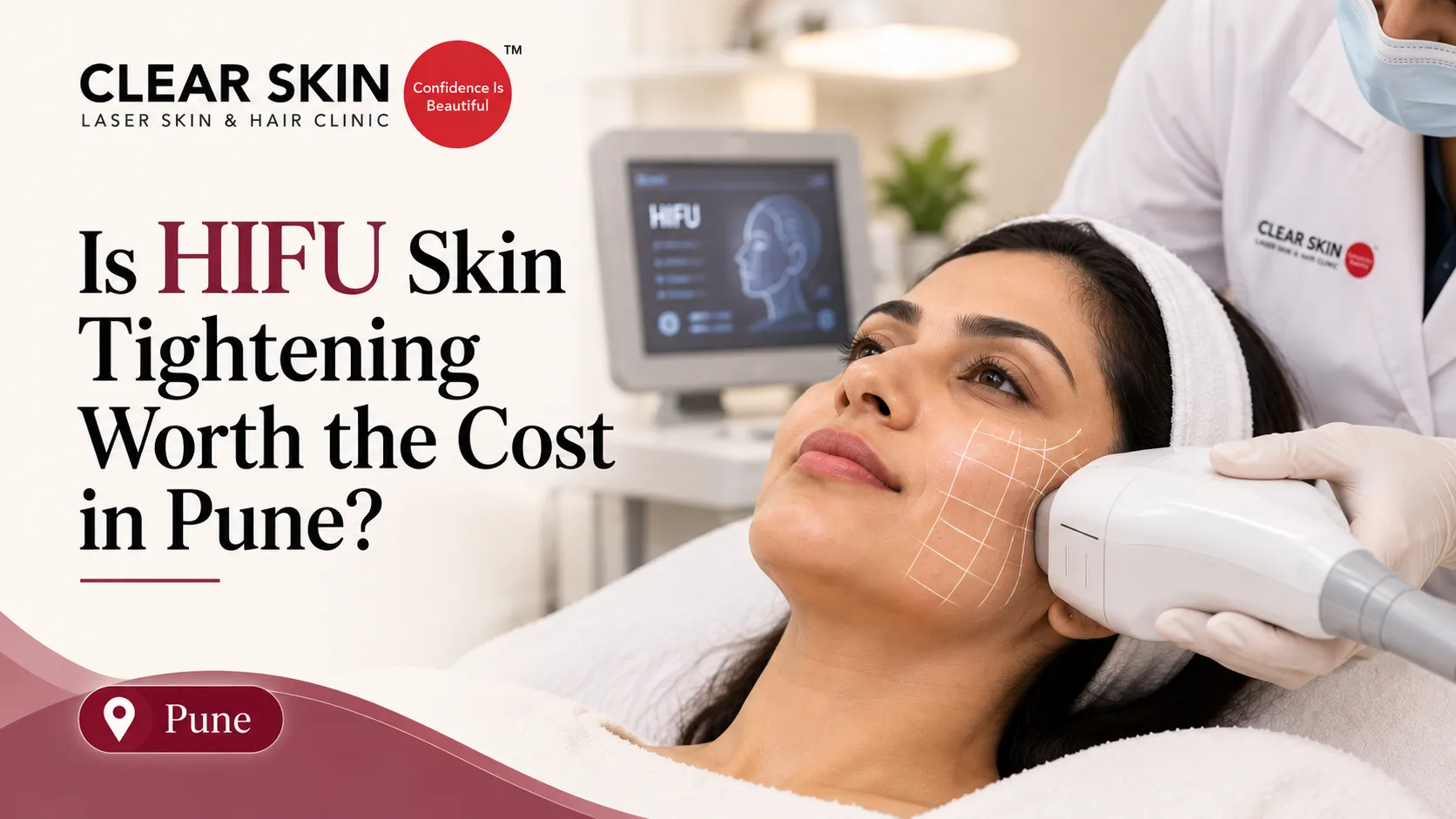
HIFU is worth the cost for the right patient. If your primary concern is early to moderate skin laxity (skin that feels looser and less firm than it used to), HIFU delivers measurable, natural-looking improvement that builds over 3 to 6 months and lasts 12 to 18 months. If your primary concern is significant structural sagging, hollow areas from volume loss, or deep static wrinkles, HIFU will underdeliver because it is not designed to fix those problems. The treatment works. The question is whether it matches your specific concern.
Every few months, a new wave of patients books HIFU sessions after seeing results on a colleague or a social media post, then returns to the clinic 4 months later wondering why they did not see the same improvement. The procedure was performed correctly. The machine was functioning properly. The dermatologist was experienced. The problem was not the treatment. The problem was the expectation.
HIFU is not a universal non-surgical facelift. It is a specific intervention for a specific stage of facial aging, and it delivers genuinely impressive results when used for what it is actually designed to do. That patient who had the dramatic result your colleague described? She almost certainly had the exact skin concern HIFU is built to address. The patients who walk away disappointed almost always had a different concern that HIFU cannot correct.
This article cuts through the marketing and tells you exactly who benefits from HIFU, what realistic results look like for Indian skin, and how to assess whether your specific concern falls within what this treatment can deliver.
Table Of Content
- What HIFU Actually Does Inside the Skin?
- Who Actually Gets Good Results From HIFU?
- What Realistic Results Look Like for Indian Skin?
- Is the Cost Justified?
- What to Expect Before, During, and After HIFU?
- Summary
- Frequently Asked Questions
- Conclusion
What HIFU Actually Does Inside the Skin?
HIFU stands for High-Intensity Focused Ultrasound. The technology uses focused ultrasound energy that bypasses the skin surface entirely and creates precise focal points of thermal injury at specific depths below the skin: typically 1.5mm (dermis), 3mm (deep dermis), and 4.5mm (the SMAS layer, which is the deep structural facial layer that a surgeon targets in a traditional surgical facelift).
At each focal point, the concentrated heat causes controlled micro-coagulation , tiny zones of thermal damage that the body immediately begins repairing. The repair response involves the production of new collagen and elastin. This collagen renewal process takes 3 to 6 months to fully develop, which is why HIFU results are not immediately visible and why impatient assessments at 4 to 6 weeks post-treatment frequently underestimate the final outcome.
Why the SMAS Layer Matters?
The SMAS is the layer that determines facial structure. It is what sags, and what is surgically repositioned in a facelift. HIFU is the only non-surgical treatment with clinically validated ability to deliver energy precisely to this depth , which is the reason it produces genuine structural firming rather than just superficial skin improvement. No topical product, superficial laser, or radiofrequency device used at standard settings reaches the SMAS.
This is HIFU’s major clinical advantage. It is also the source of much of the disappointment, because reaching the SMAS is not the same as repositioning tissue that has significantly descended. HIFU tightens what is there. It cannot put back what has fallen.
Who Actually Gets Good Results From HIFU?
Best candidates: Patients aged 30 to 50 with early to moderate skin laxity , skin that feels less firm than it used to, a jawline that is losing definition without prominent jowling yet, early neck looseness, skin around the brow or lower face that looks less supported. Also patients who have maintained good facial volume and structure but notice overall skin firmness declining.
HIFU works particularly well as a preventive treatment in the late 30s to early 40s. At this stage, the SMAS and dermis still have sufficient collagen-producing capacity to respond robustly to the stimulus. The treatment essentially resets the collagen clock in treated areas, slowing the rate of further laxity development and providing visible firmness improvement simultaneously.
Patients who see limited results from HIFU: Those with significant structural sagging , prominent jowls, clearly descended cheek pads, deep skin folds at rest. HIFU cannot mechanically reposition tissue that has substantially descended. Those with significant volume loss presenting as hollowness under the eyes or flat mid-cheeks. HIFU tightens existing tissue but does not restore volume. Those with very thin, sun-damaged skin that has lost significant elasticity , the collagen response may be diminished because the skin’s regenerative capacity is reduced.
What Realistic Results Look Like for Indian Skin?
For suitable candidates, HIFU produces three categories of visible improvement:
Jawline definition: One of the most consistent and noticeable outcomes. The jawline appears sharper and more defined, with early jowling reduced and the transition between face and neck clarified. This is often the improvement that generates the most positive feedback from patients and people around them.
Overall skin firmness: The skin feels noticeably firmer to touch at 3 months. The general looseness that had developed is reduced. Skin holds makeup better and looks less “tired” at the end of the day.
Brow position: Mild brow lift is a commonly reported outcome in patients with early brow ptosis. The brow appears slightly more elevated and the eye area more open as the SMAS tightening above propagates upward.
Indian Skin Specifics
For Fitzpatrick IV to VI skin, HIFU has a favorable safety profile that many other skin-tightening treatments do not share. Because the ultrasound energy bypasses the epidermis and melanocytes entirely, the risk of post-inflammatory hyperpigmentation (PIH) is very low. This makes HIFU one of the most suitable energy-based skin-tightening options for Indian patients who are appropriately cautious about any treatment that creates surface heat or light exposure. Patients managing pigmentation conditions alongside anti-aging goals can typically proceed with HIFU without the PIH concern that applies to many laser alternatives.
The collagen response in Indian skin is generally robust. Patients with Fitzpatrick IV to V skin often achieve good results from HIFU with consistent collagen production throughout the 3 to 6 month development phase.
Is the Cost Justified?
HIFU in India typically costs Rs. 20,000 to 50,000 per full-face session, depending on the device used, the clinic’s expertise level, and whether neck treatment is included. This is a significant investment. The “is it worth it” calculation depends on what you are comparing it to.
Compared to monthly superficial facials: A series of superficial facials over 12 months produces no meaningful structural change in skin firmness. HIFU at a similar cumulative cost produces documented collagen stimulation at depths no facial can reach. The comparison is not close.
Compared to dermal fillers for the same concern: If the primary concern is genuinely laxity (not volume loss), HIFU addresses the structural problem. Fillers placed in an attempt to compensate for laxity produce a temporary appearance of support without addressing the underlying cause, and require more frequent repetition. HIFU is better value for the right concern.
Compared to thread lift for the same concern: For early laxity without significant descent, HIFU often produces comparable firmness improvement at lower cost and with zero downtime. For moderate to significant descent, threads outperform HIFU. The comparison depends entirely on the degree of aging present.
Compared to doing nothing: Skin laxity is progressive. The same HIFU investment at 38 may delay the need for thread lift or surgical intervention by 3 to 5 years by maintaining the SMAS integrity during the period when that is still realistic with non-surgical treatment.
“HIFU is one of the treatments patients most frequently have mixed feelings about, and almost always because they were not the right candidate for it. When I see a patient with genuinely appropriate laxity for HIFU and they complete the treatment, the results are consistently good , the jawline sharpens, the skin firms, the brow lifts subtly. When a patient with significant volume loss or structural descent expects the same result, they are asking HIFU to solve a problem it was not engineered to address. The consultation before HIFU is where the real value is. The right patient for this treatment should walk out looking meaningfully better.” , Dr. Dhanraj Chavan, Clear Skin Clinic
Book a HIFU Consultation at Clear Skin Clinic: Call +91 95845 84111
What to Expect Before, During, and After HIFU?
Before: A consultation where your skin laxity, volume status, and structural descent are assessed. The dermatologist should confirm you are a suitable candidate before scheduling treatment. No special preparation is required. Avoid retinoids and active exfoliants for 3 to 5 days pre-treatment.
During: The transducer is placed against the skin and moved systematically across the treatment area. You will feel heat and tingling sensations , sometimes sharp briefly , as each focal point is created. The sensation is uncomfortable for most patients but tolerable without general anesthesia. Full-face treatment takes 60 to 90 minutes. No numbing cream is needed for most devices, though some clinics offer topical anesthetic for sensitive patients.
After: Redness and mild swelling are common for a few hours post-treatment. Some patients notice mild tingling or a feeling of tightness for several days. There is no visible wound, no bandaging, and no downtime in the conventional sense , most patients return to normal activity immediately. Makeup can be applied the same day.
Results timeline: Initial tightening sensation from the immediate tissue response is noticed by some patients in the first few weeks. Meaningful visible improvement begins at 8 to 12 weeks. Peak results are at 3 to 6 months. Maintenance sessions are recommended at 12 to 18 months.
For patients looking to complement HIFU with additional skin rejuvenation treatments, combining HIFU with a topical collagen-support protocol (medical-grade retinol, peptides, vitamin C) between sessions is consistently recommended to support and extend the collagen stimulus.
Visit Clear Skin Clinic in Pune
Summary
- HIFU delivers genuine skin-tightening results by stimulating collagen in the dermis and SMAS layer through focused ultrasound energy.
- It is the right treatment for early to moderate skin laxity. It is not the right treatment for significant tissue descent, volume loss, or deep static wrinkles.
- Results develop over 3 to 6 months and last 12 to 18 months. Patients who assess results at 4 to 6 weeks are assessing too early.
- For Indian skin, HIFU carries very low PIH risk because it bypasses the skin surface entirely, making it a well-suited option for Fitzpatrick IV to VI patients.
- At Rs. 20,000 to 50,000 per session, HIFU is worth the cost for the right candidate. For the wrong candidate, no amount of treatment quality will produce the result they are expecting.
- The consultation is the most important part. A dermatologist who assesses whether you are actually a HIFU candidate before booking your session is the one worth trusting.
Frequently Asked Questions
How many HIFU sessions does it take to see results?
Most patients complete one session and see results develop over the following 3 to 6 months. Patients with more advanced laxity may benefit from a second session 3 to 4 months after the first in the initial year, followed by annual maintenance. A single session produces meaningful improvement in appropriate candidates.
Does HIFU hurt?
HIFU involves noticeable heat and tingling sensations during delivery of each focal point. The sensation ranges from mild to sharp briefly, depending on the area treated and individual sensitivity. It is generally described as uncomfortable rather than painful. The procedure does not require sedation or general anesthesia.
Can HIFU be combined with other anti-aging treatments?
Yes. HIFU combines well with Botox (performed before or after, with a 2-week gap), dermal fillers (scheduled separately to allow independent assessment of each result), and topical prescription protocols. Thread lift and HIFU address the same general area through different mechanisms , a dermatologist can advise whether both are indicated for your degree of aging.
Will HIFU cause skin darkening on Indian skin?
HIFU bypasses the epidermis and melanocytes entirely, delivering energy below the skin surface. The PIH risk associated with surface-heating treatments (lasers, certain radiofrequency devices) does not apply to HIFU in the same way. It is one of the preferred skin-tightening options for Indian patients specifically because of this favorable pigmentation safety profile.
What is the difference between HIFU and radiofrequency (RF) for skin tightening?
Both use energy to stimulate collagen, but at different depths. RF (used in devices like RF microneedling) primarily targets the dermis. HIFU reaches the dermis and the deeper SMAS layer. For patients with early laxity where dermal improvement is the primary goal, RF may be sufficient. For patients where SMAS-level tightening is relevant, HIFU treats the problem more precisely. In some cases both are used in a protocol, targeting different tissue depths simultaneously.
Do You Know?
Roughly 250 Patients Are Treated
Everyday By These Dermatologists
(You are one click away from flawless skin)
Meet Our Dermatologist!

Conclusion
Botox and thread lifts are not interchangeable treatments. Botox is best suited for dynamic expression lines, while thread lifts are designed to address structural sagging and tissue descent. For patients experiencing both concerns, combining the two may provide a more comprehensive result. The best approach depends on your facial anatomy, skin laxity, wrinkle pattern, and individual goals. A dermatologist can assess these factors and recommend the treatment or combination that is most appropriate for you.
Further Reading
Dermal Fillers vs Botox in Pune: Cost, Results, and Which to Choose
Dermal fillers and Botox are often confused but treat completely different concerns.
Laser vs Chemical Peel for Sun Damage and Dark Spots: Which Is Better?
Laser and chemical peels both treat sun damage and dark spots, but through different mechanisms.
PIH After Acne: Causes & Treatment | Clear Skin Pune
Post-inflammatory hyperpigmentation (PIH) is a flat dark mark after acne, not a scar. Learn why Indian skin is prone to it and how Clear Skin Pune treats it.
Gym & Sweat Acne: Causes & Prevention | Clear Skin Pune
Gym acne (acne mechanica) is caused by sweat, heat, and friction. Learn where it appears, why Pune’s humidity worsens it, and how to prevent breakouts.
Have thoughts? Please let us know
We are committed not only to treating you, but also educating you.