
Can You Combine Acne Treatments? Peel, Laser, and Microneedling Together

Written by Clear Skin Content Team | Medically Reviewed by Dr. Dhanraj Chavan on October 28, 2026
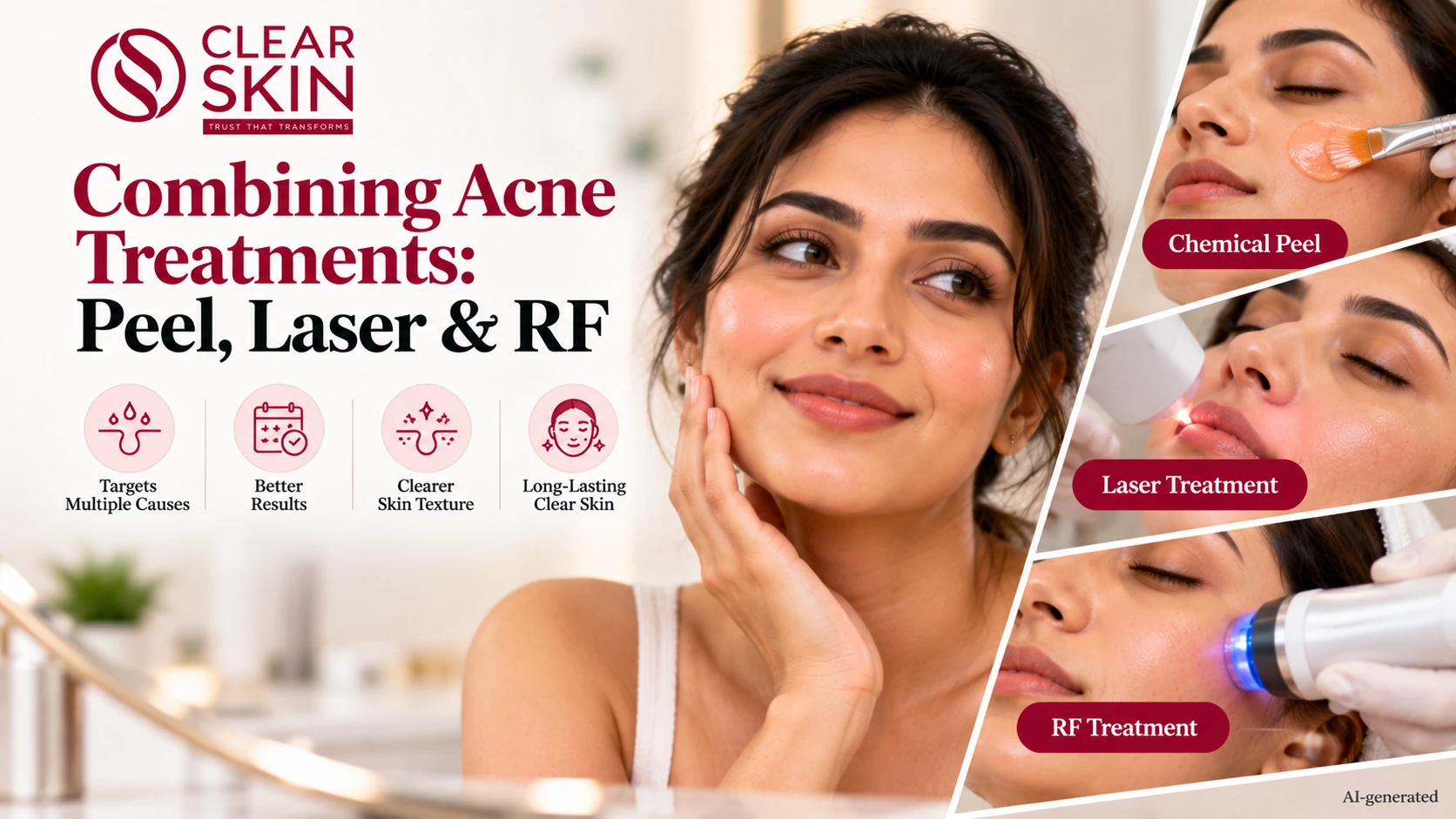
Combining acne treatments is not only possible but often more effective than using a single treatment at a time , because different treatments target different parts of the same problem. A chemical peel clears surface congestion and accelerates cell turnover. RF microneedling reduces oil gland activity and builds collagen. PRP accelerates healing. Laser targets dark marks. Each works on a different layer and mechanism, which means they complement rather than duplicate each other. The rules are: prescription treatment is the foundation, procedures are the layer built on top, and no two treatments that work the same mechanism should be done too close together.
You have been on a prescription retinoid for four months. Your breakouts are less frequent. But you still have congestion, a few active spots, and dark marks from the pimples that have healed.
Your dermatologist has mentioned a peel course. You have also heard that microneedling RF helps with oil control. And someone at the clinic mentioned PRP for healing.
Can you do all of these together? Which combination makes sense? Is there any risk in layering treatments?
These are the right questions , and the answers depend on understanding what each treatment does and how they interact.
Table Of Content
- Why Combination Treatment Works?
- The Foundation Rule: Prescription Treatment First
- Effective Combinations Explained
- What Needs Spacing , and What to Avoid?
- The Logic of Building a Combination Plan
- What to Tell Your Dermatologist?
- Expert Insight
- Summary
- Frequently Asked Questions
- Conclusion
Why Combination Treatment Works?
Acne is not a single-mechanism condition. At any given time, it involves:
- Excess sebum production (oil gland hyperactivity)
- Follicular blockage (abnormal skin cell shedding)
- Bacterial colonisation (C. acnes proliferating in clogged pores)
- Inflammation (the immune response to bacteria)
- Post-inflammatory changes (dark marks, early scar formation)
No single procedure addresses all five simultaneously. A chemical peel works primarily on the first three. RF microneedling works primarily on sebum reduction and collagen repair. Laser treatments target the pigmentation in dark marks. PRP accelerates healing and reduces inflammation.
This is why strategic combination produces better outcomes than any single treatment alone: each procedure contributes to a different part of the problem, and together they cover the full picture.
The Foundation Rule: Prescription Treatment First
Before any combination of clinic procedures makes sense, a prescription plan must be in place. This is non-negotiable.
Procedures clear existing congestion and improve skin quality. They do not stop the sebum overproduction, hormonal trigger, or bacterial load that creates new acne continuously. Without prescription treatment (a topical retinoid, and oral medication if needed), procedures are maintenance without a foundation , the problem keeps rebuilding faster than the procedures can clear it.
The correct sequence is:
- Dermatologist consultation and prescription (topical retinoid, spironolactone or OCP if hormonal, antibiotics if inflammatory)
- Allow 4-6 weeks for the prescription to begin working and the skin to adjust
- Add clinic procedures to accelerate clearing and address existing damage
Procedures added before the prescription is established waste time and money.
Effective Combinations Explained
Chemical Peel + RF Microneedling
This is one of the most commonly used and well-tolerated combinations for moderate acne with early scarring.
Why they work together: Chemical Peels work at the skin surface , clearing pores, reducing oil, and accelerating the removal of damaged outer skin cells. Microneedling Radiofrequency (RF) works at the dermal level , delivering radiofrequency energy deep into the sebaceous glands and dermis to reduce oil production and stimulate collagen. These two treatments operate at different depths and through different mechanisms.
How they are scheduled: They are not done on the same day. A typical plan spaces a peel session and an RF session 2-3 weeks apart, so each is done on recovered skin. Over a 3-4 month plan, a patient might complete 4-5 peels and 3 RF sessions in alternating sequence.
Who benefits most: Patients with moderate to severe acne who also have early post-acne scarring or persistent oiliness. The peel manages active congestion while the RF addresses the sebaceous overactivity driving it and the collagen loss causing texture changes.
RF Microneedling + PRP
Platelet Rich Plasma Therapy (PRP) is drawn from the patient’s own blood, concentrated, and applied topically or injected into the skin immediately after RF microneedling.
Why they work together: RF microneedling creates thousands of micro-channels in the skin through its needles. Applying PRP immediately after delivers growth factors directly through these open channels , deeper and more effectively than topical application alone. The PRP accelerates healing, reduces the post-treatment redness, and enhances collagen stimulation beyond what the RF achieves alone.
How they are scheduled: In the same session, PRP is applied immediately after RF. This is a same-session combination, not a two-appointment combination.
Who benefits most: Patients with active acne plus significant congestion or early scarring, and those who want to minimise downtime , the PRP shortens the recovery window after RF.
Peel + Laser for Pigmentation
For patients who have cleared active acne and are now primarily dealing with post-acne dark marks (PIH), combining a brightening chemical peel with a targeted laser is effective.
Pico Laser Treatment delivers ultra-short pulses of energy that fragment melanin deposits in PIH without damaging surrounding tissue. Used alongside a salicylic acid peel series, it addresses both the surface discolouration and the deeper pigment that superficial peels cannot always reach.
How they are scheduled: Peel and laser sessions are not done on the same day. A minimum of 2 weeks between a peel and a laser session allows the skin to recover from the peel’s exfoliation before the laser session. The order varies by dermatologist preference and skin condition.
Who benefits most: Patients with resolved or controlled active acne whose main remaining concern is moderate to severe PIH.
What Needs Spacing , and What to Avoid?
Some combinations require careful spacing because they work through the same mechanism (exfoliation or barrier disruption) and the skin needs time to recover between them.
|
Combination |
Safe? |
Minimum Interval |
|
Chemical peel + RF microneedling |
Yes |
2 weeks between sessions |
|
RF microneedling + PRP |
Yes (same session) |
Done together |
|
Peel + pico laser |
Yes |
2 weeks between sessions |
|
Two chemical peels |
Yes, in a course |
3-4 weeks between each peel |
|
Peel + HydraFacial |
Yes |
1 week after peel |
|
Peel + dermabrasion |
Not together |
Too much barrier disruption |
|
Laser + laser (different types) |
Discuss with dermatologist |
Minimum 4 weeks |
|
Any procedure + isotretinoin course |
Generally no |
Wait 3-6 months post-course |
The principle behind spacing is barrier recovery. The skin barrier , the protective outer layer , is disrupted by every exfoliating or energy-based treatment. Allowing it to recover before the next treatment is not optional; a compromised barrier is more vulnerable to inflammation, infection, and post-inflammatory hyperpigmentation, particularly on Indian skin tones.
The Logic of Building a Combination Plan
A well-designed combination plan has three phases that reflect where the skin is in treatment:
Phase 1: Active treatment (months 1-3) Goal: Reduce active breakouts and sebum. Stop new lesion formation. Main tools: Prescription topicals + oral medication. Clinic sessions begin , typically a peel course. RF microneedling can start in this phase if scarring is already present.
Phase 2: Consolidation (months 3-6) Goal: Clear remaining congestion. Prevent new breakouts. Begin addressing marks and texture. Main tools: Continued prescription. Peel course completes. RF + PRP sessions if scarring. Laser added if PIH is the primary remaining concern.
Phase 3: Maintenance (beyond 6 months) Goal: Prevent recurrence. Maintain clear skin and even tone. Main tools: Low-frequency prescription (often topical retinoid 2-3 nights per week). Monthly or 6-weekly HydraFacial for maintenance. Occasional peel or laser session if new pigmentation develops.
What to Tell Your Dermatologist?
When building a combination plan, the most useful information you can bring to the consultation is:
- How long you have had acne and what it looked like at its worst
- What treatments you have already tried, and for how long
- Whether your acne is currently active (new lesions appearing) or predominantly marks and texture
- Any medications you are taking, including oral contraceptives
- Your events or deadlines , if there is a wedding or important event, the plan adapts accordingly
- Your skin’s past reaction to any treatments (if any caused a bad reaction)
A dermatologist designs the combination based on this information, not a generic protocol.
Expert Insight
“Combination therapy is how we get the best results , but the order and timing matter enormously,” says Dr. Dhanraj Chavan, Senior Dermatologist at Clear Skin Clinic. “I see patients who have done multiple treatments without a clear sequence and are frustrated that they are not seeing results. The problem is usually that they are doing the procedures without the prescription foundation, or doing too much at once without allowing recovery. A structured plan produces far better outcomes than treating the calendar as a booking sheet.”
Summary
Combining acne treatments is appropriate and effective when the treatments target different mechanisms, are spaced to allow barrier recovery, and are built on a foundation of prescription medical treatment.
The strongest combinations are chemical peel plus RF microneedling (different depths, different mechanisms), and RF microneedling plus PRP in the same session (enhanced healing). Laser treatments are added when PIH is the primary concern, with a minimum spacing of 2 weeks from other exfoliating sessions. No combination should be started while on isotretinoin. A dermatologist structures the sequence based on your specific acne type, stage, and timeline.
Frequently Asked Questions
Can I do a chemical peel and RF microneedling in the same week?
Not on the same day, and ideally with at least 2 weeks between sessions. Both treatments disrupt the skin barrier , a peel through chemical exfoliation, RF through the microneedle channels. Doing them close together without recovery time risks prolonged barrier compromise, increased sensitivity, and a higher risk of post-inflammatory hyperpigmentation on Indian skin. A dermatologist will space them appropriately within a structured plan.
How many sessions of each treatment do I typically need?
For a standard moderate acne plan: 4-6 chemical peel sessions spaced 3-4 weeks apart; 3-4 RF microneedling sessions spaced 4 weeks apart; PRP added to RF sessions as appropriate. Laser sessions for PIH are typically 2-4 sessions spaced 4-6 weeks apart. The total plan runs roughly 4-6 months from first session to completion of active treatment.
Will combining treatments make the results come faster?
Yes, meaningfully so , because each treatment addresses a different aspect of the problem simultaneously. A chemical peel course alone clears congestion. Adding RF alongside it also reduces sebum and begins collagen repair during the same period. The combination achieves in 4-6 months what sequential single treatments might take 9-12 months to achieve.
My skin is sensitive. Is combination treatment safe for me?
Sensitive skin requires more careful spacing and lower treatment intensities, but it does not preclude combination treatment. A dermatologist starts at conservative settings, assesses your skin’s response, and adjusts from there. Sensitive skin typically needs longer recovery intervals , 3-4 weeks between sessions rather than 2 , and gentler peel concentrations. The plan is longer but achieves the same outcome.
Can I do combination treatment while on a retinoid?
Yes, with adjustments. Topical retinoids are compatible with most clinic procedures during maintenance (low-frequency use). During the initial adjustment phase when the retinoid is causing dryness or peeling, it is better to allow the skin to settle before adding clinic procedures. Pause topical retinoid application for 3-5 days before and after a peel or laser session to reduce irritation. Your dermatologist will give specific instructions.
Do You Know?
Roughly 250 Patients Are Treated
Everyday By These Dermatologists
(You are one click away from flawless skin)
Meet Our Dermatologist!


Conclusion
Combination treatment is not about doing more , it is about doing the right things in the right order. A structured plan that pairs prescription treatment with strategically sequenced clinic procedures clears acne faster, prevents scarring, and produces results that single treatments delivered randomly cannot.
To get a combination plan built around your specific skin, find your nearest Clear Skin Clinic on Google Maps or +91 95845 84111 to consultation.
See a doctor urgently if any clinic treatment produces rapidly spreading redness, pain, or signs of infection , contact your dermatologist promptly rather than waiting for a scheduled follow-up.
Disclaimer: This article is for general educational purposes only. It does not replace personal medical advice. Treatment combinations should be designed and supervised by a qualified dermatologist based on your skin’s current condition and medical history.
Further Reading
HydraFacial for Acne-Prone Skin: Safe or Not?
Is HydraFacial safe for acne-prone skin? Discover its benefits, risks, suitability for active acne and when to consult a dermatologist in Pune.
Acne Treatment for Men: Beard Acne, Shaving Bumps, and Gym Acne
Men’s acne has specific triggers , shaving, beard hair, gym sweat, and protein supplements , that women’s acne does not. Learn what is driving yours and how a dermatologist treats it.
Cortisone Injection for a Pimple: When It Works, Risks, and Cost
A cortisone injection can flatten a deep, painful pimple in 24–48 hours. Understand when it works, possible risks, and treatment costs.
How Many Months Before Your Wedding Should You Start Acne Treatment?
Planning your wedding? Find out when to start acne treatment, which treatments may help, and what to avoid before your wedding day.
Have thoughts? Please let us know
We are committed not only to treating you, but also educating you.