
Cortisone Injection for a Pimple: When It Works, Risks, and Cost?

Written by Clear Skin Content Team | Medically Reviewed by Dr. Dhanraj Chavan on October 25, 2026
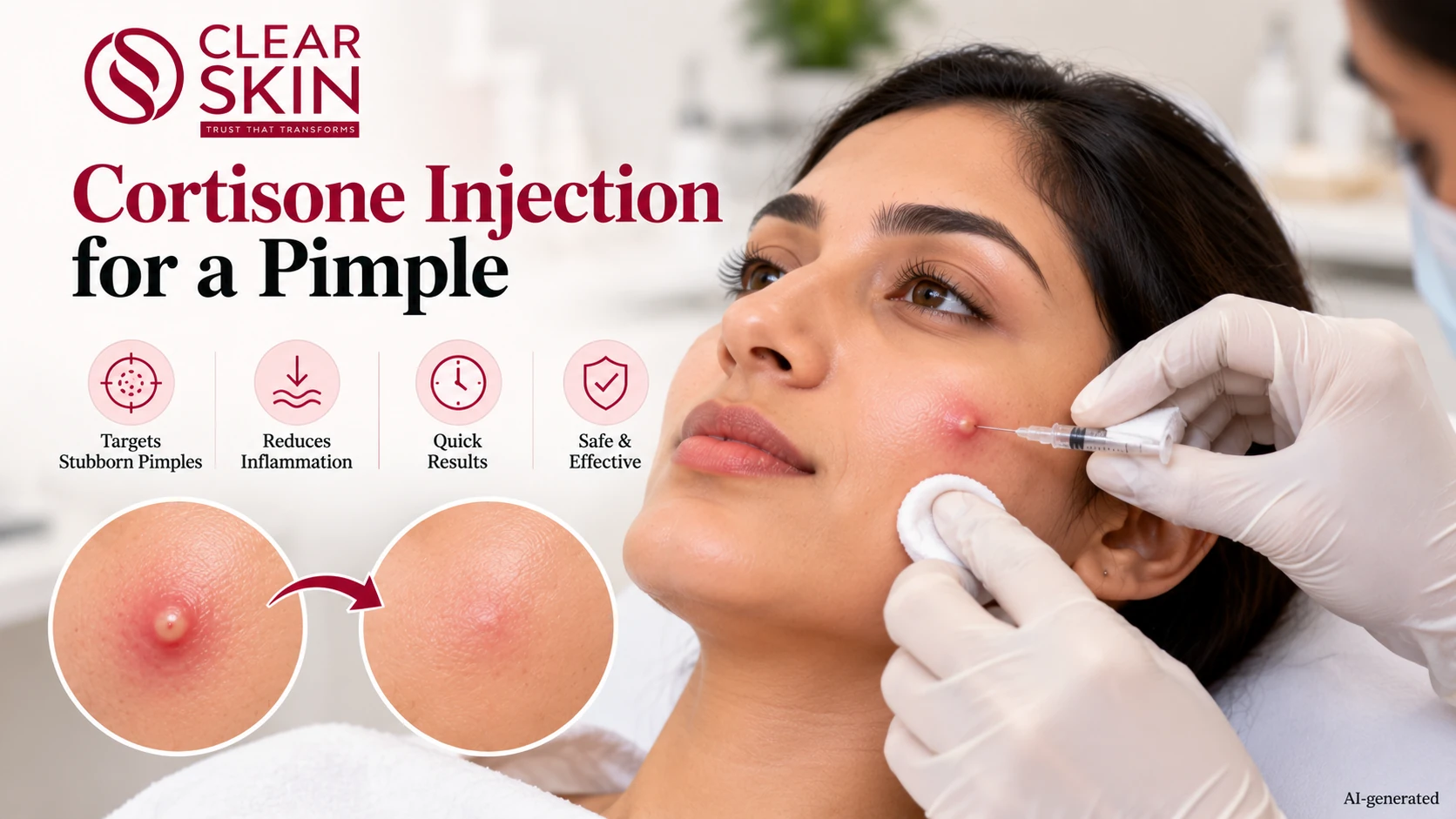
A cortisone injection , specifically, an intralesional injection of triamcinolone acetonide , is injected directly into a deep, inflamed nodular or cystic pimple. It delivers a targeted anti-inflammatory dose that flattens the lesion within 24-48 hours and prevents it from scarring. It works only on the right type of pimple: a deep, painful, inflamed nodule or cyst. It has no effect on surface whiteheads, blackheads, or dark marks. The main risk is a small skin dent (atrophy) at the injection site if the concentration or volume is too high , which is why this must be done by a dermatologist, not replicated at home or in a salon.
You have a deep, painful pimple sitting along your jaw. You can feel it before you can see it. It is not coming to a head. It is sitting underneath the skin like a warm, throbbing knot, and you have an event in two days.
You have heard that a doctor can inject something into it and it disappears.
That is essentially correct , with important caveats about which type of pimple responds, how the injection works, and what can go wrong if it is done incorrectly.
Table Of Content
- What Is a Cortisone Injection for a Pimple?
- When a Cortisone Injection Works?
- When a Cortisone Injection Does Not Work?
- The Procedure: What Actually Happens?
- How Fast Does It Work?
- Risks and What Can Go Wrong?
- Cost
- Is This a Treatment or Just a Quick Fix?
- Expert Insight
- Summary
- Frequently Asked Questions
- Conclusion
At a Glance
|
Procedure |
Intralesional triamcinolone acetonide injection |
|
What it treats |
Deep, painful nodular or cystic pimples |
|
What it does NOT treat |
Surface whiteheads, blackheads, or flat dark marks |
|
How fast it works |
Noticeable flattening within 24-48 hours; full resolution in 3-5 days |
|
Risks |
Skin atrophy (dent) or hypopigmentation if overdosed , rare at correct concentration |
|
Who administers it |
Dermatologist only , not a salon procedure |
|
Is it a long-term treatment? |
No. It resolves individual lesions; it does not prevent new ones |
What Is a Cortisone Injection for a Pimple?
The formal name is an intralesional corticosteroid injection. The medication used is triamcinolone acetonide , a synthetic corticosteroid , diluted to a very low concentration (typically 2-3mg/mL for facial lesions) and injected directly into the pimple using a fine-gauge needle.
Cortisone is a potent anti-inflammatory. Delivered precisely into the lesion, it suppresses the immune response driving the inflammation, reduces swelling rapidly, and allows the lesion to resolve without rupturing. When a deep pimple ruptures under the skin , whether from squeezing or on its own , the debris spreads into surrounding tissue and causes the dermal damage that leads to scarring. Stopping the inflammation before rupture is why early injection is preferable to waiting.
The Intralesional Drug treatment at Clear Skin Clinic covers exactly this procedure.
When a Cortisone Injection Works?
The injection is effective specifically on inflammatory lesions with significant dermal involvement.
It works well for:
- Nodules: Large, firm, painful lesions that sit deep in the skin without a visible head. These are the pimples that take 3-4 weeks to resolve on their own and almost always leave a dark mark or early scar.
- Cysts: Fluid or semi-solid deep lesions that feel like a soft lump under the skin. Cysts are prone to rupture and scarring. An injection resolves them without the rupture risk.
- Pre-event lesions: When a nodule or cyst appears before a wedding, photograph, job interview, or significant event and rapid resolution matters.
- Recurrent lesions: Some patients consistently develop a nodule in the same spot (jaw, chin, cheek). Repeated injections at that location, combined with a broader treatment plan, manage recurrence until the underlying cause is addressed.
When a Cortisone Injection Does Not Work?
The injection is often requested for the wrong type of lesion. It will not produce the expected result in:
- Surface whiteheads (closed comedones): These are congested pores without significant inflammation. There is no inflammatory process to suppress. The injection adds no benefit.
- Blackheads (open comedones): Same logic. These are mechanical blockages, not inflammatory lesions. The correct treatment is a chemical peel or extraction, not an injection.
- Post-inflammatory hyperpigmentation (PIH): The dark flat marks left after a pimple heals are not active pimples. Cortisone does not fade them. Topical treatments or peels address PIH. See the full range of Acne & Pimple conditions for how PIH is treated separately from active acne.
- Active pustules with a visible head: A pimple that has already come to a surface head will resolve on its own within a few days. Injection add
The Procedure: What Actually Happens?
The appointment for a single lesion injection takes 5-10 minutes.
- The dermatologist examines the lesion to confirm it is nodular or cystic and appropriate for injection.
- The skin surface is cleaned with an antiseptic.
- A fine-gauge needle (typically 30G) is used to inject a small volume (0.1-0.3mL) of diluted triamcinolone directly into the lesion.
- The area is gently pressed to distribute the medication evenly through the lesion.
- There is no bandage, no recovery time, and no restrictions on going out afterwards.
The injection itself produces a brief sting lasting 1-2 seconds. Most patients describe mild pressure during the procedure. There is no anaesthetic required for facial lesions at this volume.
How Fast Does It Work??
Within 24-48 hours: the lesion begins to flatten noticeably. The pain and tenderness resolve first.
Within 3-5 days: the lesion is significantly smaller, often flat. In many cases it resolves without leaving a dark mark, because the inflammation was suppressed before it could damage the surrounding skin.
Full resolution timeline depends on how large and how established the lesion was at the time of injection. A lesion injected within 24-48 hours of appearing resolves faster and more completely than one that has been developing for a week.
This is why the most effective use of this procedure is early , at the first sign of a deep pimple, not after days of hoping it resolves on its own.
Risks and What Can Go Wrong?
The two significant risks with intralesional cortisone injection are both dose-related , and both preventable when the procedure is done correctly.
Skin atrophy (a small dent): If the concentration of triamcinolone is too high or the volume injected is too large, the corticosteroid can suppress local collagen production, leaving a small depression at the injection site. This is the risk that makes home remedies attempting to replicate this procedure dangerous. At the correct dilution for facial lesions (2-3mg/mL), atrophy risk is low. At the higher concentrations used for body keloids (10-40mg/mL), facial atrophy is a near-certainty.
Dermal atrophy from an appropriately dosed facial injection, if it occurs, usually resolves on its own within 3-6 months as the body rebuilds local collagen.
Hypopigmentation: The injected corticosteroid can occasionally reduce melanin production at the injection site, leaving a lighter patch. This is more common on darker Indian skin tones. At the low concentrations used for facial acne injections, hypopigmentation is uncommon but a reason to use the minimum effective dose.
Infection: Extremely rare. The skin is cleaned before injection and the needle is sterile. Infection risk is not a meaningful concern with standard clinic technique.
Preventing acne scars is precisely why early injection at the correct dose is preferable to letting a nodule rupture on its own.
Cost
The cost of an intralesional injection for a single lesion is a fraction of a full treatment session. Clinics typically charge per lesion injected. Multiple lesions in one visit are priced accordingly.
A dermatologist will give a clear cost estimate at the consultation. There is no lengthy preparation or aftercare cost.
Is This a Treatment or Just a Quick Fix?
This is the most important question, and the honest answer is: a quick fix for the specific lesion. An excellent, medically appropriate quick fix , but a quick fix.
An intralesional injection resolves the pimple in front of it. It does nothing to address why that pimple formed, and it will not prevent the next one. Patients who rely on repeated injections without addressing the underlying sebum excess, hormonal trigger, or bacterial colonisation are managing symptoms, not the condition.
The appropriate use of this procedure is as part of a broader acne management plan , handling urgent, painful lesions while the underlying treatment plan (topical retinoids, oral medications, Chemical Peels) works on the root cause.
Expert Insight
“An intralesional injection is one of the most immediately satisfying procedures in dermatology , for both the patient and the doctor,” says Dr. Dhanraj Chavan, Senior Dermatologist at Clear Skin Clinic. “A patient comes in with a painful nodule and leaves knowing it will be gone in two days. But I always make sure the patient understands this is solving today’s problem. We still need to address what is causing these lesions in the first place, or they will keep coming back.”
Summary
A cortisone injection for a pimple is an intralesional injection of triamcinolone acetonide, administered directly into a deep nodular or cystic lesion by a dermatologist. It reduces inflammation rapidly, flattening the lesion in 24-48 hours and preventing the scarring that deep pimples commonly cause.
It works only on inflamed, deep lesions , not on surface comedones or dark marks. The risks, primarily skin atrophy, are dose-dependent and uncommon at the correct concentration for facial acne. It is a targeted intervention for specific lesions, not a substitute for a full acne treatment plan.
Frequently Asked Questions
My wedding is in 2 months. Is it too late to start treatment?
No. Two months of proper treatment will reduce active breakouts, accelerate healing, and improve skin texture noticeably. A dermatologist will focus on the fastest-acting combination: a prescription topical, an anti-inflammatory oral medication if appropriate, and 2-3 clinical sessions. Manage expectations: severe acne or deep dark marks may not fully clear in 2 months, but meaningful improvement is realistic for most people.
Can I start isotretinoin 4 months before my wedding?
Not advisably. Isotretinoin requires 4-6 months for a full course, plus mandatory monthly monitoring. Starting 4 months before means the course will not be complete by the wedding. More importantly, the initial purging phase (weeks 4-6) falls uncomfortably close to the event. If you have the time, starting 6-8 months out is the safer choice.
Will bridal facials from a salon help clear my acne?
Salon facials address the skin surface. They may provide temporary brightening but do not treat the sebaceous gland activity, bacterial colonisation, or hormonal triggers driving acne. For results that last through your wedding and beyond, a dermatologist-supervised medical treatment plan is necessary. Salon facials are a complement to medical treatment, not a substitute.
My skin has been clear for 2 months. Should I stop treatment before the wedding?
No. Clear skin means the treatment is working , it does not mean the underlying condition is resolved. Stopping prescription treatment before the wedding reactivates the trigger and risks a breakout in the exact window you want clear skin. Discuss a maintenance protocol with your dermatologist, but do not stop independently.
Can men also benefit from a pre-wedding skin plan?
Yes. Grooms increasingly book pre-wedding consultations for acne, oiliness, and uneven skin tone. The same principles apply: start 4-6 months before the wedding, address the trigger, complete a course of clinical procedures. Shaving-related acne on the neck and jaw is particularly common in men and responds well to treatment.
Do You Know?
Roughly 250 Patients Are Treated
Everyday By These Dermatologists
(You are one click away from flawless skin)
Meet Our Dermatologist!





Conclusion
Your wedding photographs are permanent. Your skin treatment plan does not have to be complicated , but it does have to start early enough to work.
If your wedding is six months away, book a consultation this week. If it is three months away, book it today. The Acne & Pimple team at Clear Skin Clinic has worked with hundreds of brides and grooms on pre-wedding skin plans.
Find your nearest Clear Skin Clinic on Google Maps or +91 95845 84111 to a bridal skin consultation.
See a doctor urgently if a pimple or cyst becomes rapidly painful, swollen, and warm to the touch , this may indicate infection and requires prompt treatment, not home remedies.
Disclaimer: This article is for general educational purposes only. It does not replace personal medical advice. Treatment timelines vary depending on acne severity, skin type, and individual response. Consult a qualified dermatologist for a plan suited to your specific skin.
Further Reading
How Many Months Before Your Wedding Should You Start Acne Treatment?
Planning your wedding? Find out when to start acne treatment, which treatments may help, and what to avoid before your wedding day.
Isotretinoin (Accutane) for Acne: What to Expect, Side Effects, and Cost
Isotretinoin is the most effective treatment for severe or treatment-resistant acne. Learn who it is for, how it works, what side effects are real, what the cost looks like, and what happens after.
Adult Acne Treatment After 25: Why It Happens and How to Clear It
Acne after 25 has different triggers than teenage acne and needs a different treatment plan. Learn why it persists, what drives it, and how a dermatologist clears it effectively.
Hormonal Acne and PCOS Acne Treatment for Women in Pune
Deep, painful pimples on your jawline and chin that follow your cycle are hormonal acne. Learn what causes it, how PCOS makes it worse, and how dermatologists treat it effectively.
Have thoughts? Please let us know
We are committed not only to treating you, but also educating you.