
Chemical Peel vs Laser for Active Acne: Which Works Faster on Indian Skin?

Written by Clear Skin Content Team | Medically Reviewed by Dr. Dhanraj Chavan on June 26, 2026
Medical Disclaimer: This article is for informational purposes only. Consult a qualified dermatologist for personalised medical advice.
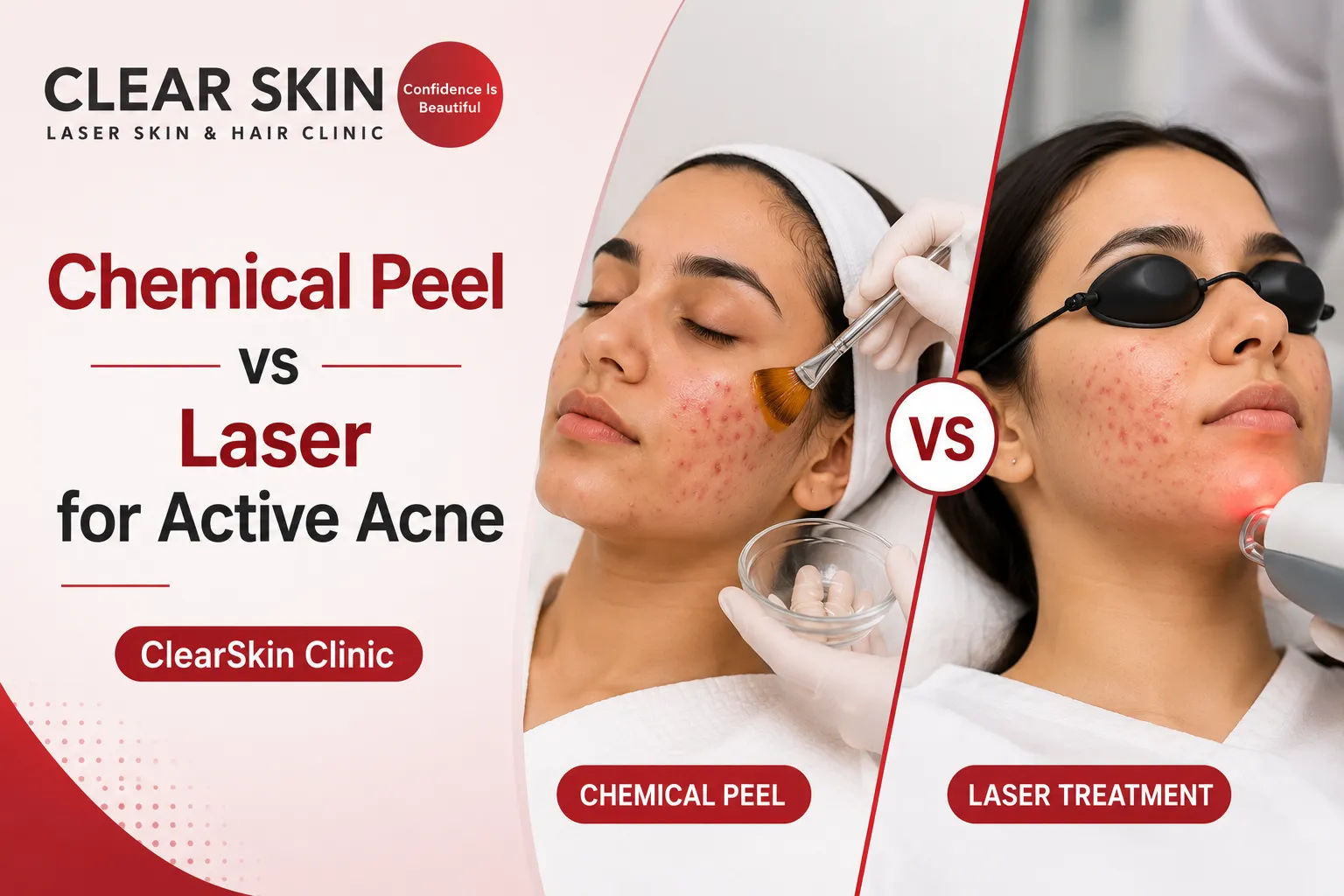
Which treatment clears active acne faster on Indian skin, chemical peels or laser? The answer depends on more than just the technology.
You’ve done the research, you’ve booked a consultation, and now your dermatologist is discussing two options: chemical peels or laser treatment for your active acne. Both sound clinical and effective. Both appear on the treatment menu of every reputable skin clinic. But they work through completely different mechanisms, suit different skin profiles, carry different risks for Indian skin, and produce results on different timelines.
Choosing the wrong one or using either without understanding what it actually does is one of the most common reasons patients complete a full treatment course and still feel their results were underwhelming. This article gives you a clear, honest breakdown of both options so you can walk into your next consultation fully informed.
Table Of Content
- Why Active Acne Requires a Different Approach Than Acne Scars?
- How Chemical Peels Work Against Active Acne?
- How Laser Treatments Work Against Active Acne?
- Direct Comparison: Chemical Peel vs Carbon Laser for Active Acne
- The Role of a Structured Home Protocol
- What Happens After Active Acne Is Controlled?
- FAQs
Why Active A Acne Requires a Different Approach Than Acne Scars?
This distinction matters before anything else. Active acne, like breakouts, inflamed papules, pustules, and congested pores producing new comedones, is a different clinical problem from the scarring and PIH that acne leaves behind after it clears.
Scar treatments like fractional CO2 laser or RF microneedling are designed for stable, healed skin. Using them on actively inflamed skin spreads bacteria through treatment channels, worsens the inflammatory environment, and can generate new scarring in areas being treated. The rule is consistent across all credible dermatology protocols: active acne must be substantially controlled before scar treatment begins.
Chemical peels and specific laser modalities, primarily carbon laser, are the in-clinic treatments that work during the active acne phase. Understanding how each works explains when to use which.
How Chemical Peels Work Against Active Acne?
Chemical peels apply an acid solution to the skin to exfoliate dead cells, unblock pores, reduce bacterial load, and stimulate controlled skin renewal. For active acne specifically, the mechanism goes deeper than surface exfoliation and the type of acid used determines how deep.
Salicylic Acid: The Gold Standard for Active Acne
Salicylic acid is lipophilic it dissolves in oil rather than water. This single property makes it uniquely suited for acne treatment. While water-based acids like glycolic exfoliate the skin surface, salicylic acid penetrates into sebaceous pores, dissolves the oil-keratin debris that forms comedones from the inside, and exfoliates the pore lining itself. It also has mild anti-inflammatory and antibacterial properties, directly addressing two of the mechanisms driving active breakouts.
At 20–30% concentration or as a salicylic-mandelic combination, it is the most targeted peel for comedonal and inflammatory acne on Indian skin. Results build progressively across a full course most patients see meaningful improvement in breakout frequency by sessions 3–4, with continued PIH clearing beyond that.
Why Mandelic Acid Is the Safer Peel for Indian Skin
Mandelic acid has a larger molecular structure than glycolic acid. Larger molecules absorb more slowly, penetrate more uniformly, and cause significantly less irritation. For Indian Fitzpatrick IV–VI skin, where even mild peel irritation can trigger post-inflammatory hyperpigmentation (PIH), this slower kinetic profile is a genuine clinical advantage not just a marketing point.
Salicylic-mandelic combination peels deliver salicylic acid’s intrapore action alongside mandelic acid’s gentler epidermal exfoliation, making it the most commonly used and safest peel combination for active acne on darker Indian skin tones.
Glycolic Acid Peels: Effective But Requiring More Caution
Glycolic acid at 20–50% addresses surface cell buildup, mildly unblocks pores, and improves skin texture. More effective for post-acne textural improvement and mild PIH than for actively inflamed breakouts. Requires careful concentration selection on Indian skin too high, too fast, or too frequently used raises PIH risk significantly. Generally positioned as a second-line option after salicylic-mandelic for darker skin tones.
What to Expect From a Chemical Peel Course
A standard course for active inflammatory acne involves 6–8 peel sessions spaced 2–3 weeks apart. An initial purging response where sub-surface comedones come to the surface is common in the first 1–2 sessions and is a sign the peel is reaching blocked pores, not a complication. Downtime is 1–3 days of mild redness and flaking. The full PIH improvement from each session develops over 4–6 weeks as exfoliated melanin clears from the epidermis.
How Laser Treatments Work Against Active Acne?
Not all laser treatments are appropriate for active acne. Fractional CO2 and Er:YAG lasers which are ablative and create real surface trauma should not be used on inflamed, active skin. The lasers used during the active acne phase work through different, non-ablative mechanisms.
Carbon Laser Peel: The Most Practical Laser for Active Acne
The carbon laser peel also called the Hollywood peel is a two-stage treatment combining a carbon paste application with Q-switched Nd:YAG laser passes. A thin layer of carbon paste is applied to the face. The carbon particles penetrate pore openings, physically binding to trapped sebum, dead cells, and surface bacteria.
When the laser passes over the carbon-coated skin, the energy is selectively absorbed by the dark carbon particles and vaporizes them along with everything bound to them including the debris and bacteria inside pores. The thermal energy from the vaporization also heats the sebaceous glands, producing a temporary reduction in oil production. A second, gentler laser pass without the carbon provides mild collagen stimulation and brightening.
The result: deep pore cleansing, immediate sebum reduction for 3–4 weeks, surface bacteria reduction, and an instant post-treatment brightness with zero downtime. Carbon peel treatment is one of the few in-clinic procedures appropriate for patients who cannot take any recovery time there is no redness, peeling, or visible healing period.
Q-Switched Nd:YAG Laser for Acne Bacteria
At 1064nm, Q-switched laser delivers photothermal energy that selectively targets Propionibacterium acnes the bacteria involved in inflammatory acne pathogenesis. The heat disrupts bacterial cell membranes and reduces the inflammatory bacterial load without damaging surrounding skin. It also mildly reduces sebaceous gland activity over a treatment course.
This is the same wavelength used for laser toning, which addresses concurrent PIH alongside active acne a clinically useful dual benefit for Indian skin patients dealing with both simultaneously.
What Laser Treatment for Active Acne Cannot Do?
No laser during the active acne phase replaces the intrapore chemical exfoliation that salicylic acid delivers. Carbon laser cleans the surface of pores and reduces sebum. It does not chemically dissolve the lipid-keratin plug forming inside the follicle lining the way salicylic acid does. For patients with predominantly comedonal acne, a peel-first approach typically produces better primary clearing.
“For patients with active inflammatory acne on Indian skin, our first in-clinic recommendation is almost always a salicylic-mandelic peel series because salicylic acid gets inside the pore in a way that no surface laser can. We add carbon laser for patients with significant oiliness and congestion, or for those who need a zero-downtime option. The two work through different mechanisms, and using both together within a structured protocol consistently outperforms either used alone.”
आंखों के काले घेरे – कारण और उपाय (Under Eye Dark Circles: Causes & Treatments)
Direct Comparison: Chemical Peel vs Carbon Laser for Active Acne
|
Factor |
Chemical Peel (Salicylic-Mandelic) |
Carbon Laser Peel |
|
Penetrates inside pores |
Yes lipophilic salicylic acid |
Partially carbon binds at pore openings |
|
Reduces sebum production |
Indirectly |
Yes temporary thermal effect |
|
Treats inflammatory acne |
Excellent |
Moderate |
|
Treats comedonal acne |
Excellent |
Good |
|
Addresses PIH simultaneously |
Yes |
Mild brightening only |
|
PIH risk on Indian skin |
Low-moderate (acid-dependent) |
Very low |
|
Downtime |
1–3 days |
None |
|
Sessions needed |
6–8 |
4–6 |
|
Cost per session (Pune) |
₹2,000–₹5,000 |
₹3,000–₹7,000 |
|
Best for |
Inflammatory + comedonal acne with PIH |
Oily, congested skin; zero downtime needed |
When Is Each Treatment the Right Choice?
Choose Chemical Peels When:
You have moderate-to-severe inflammatory acne with regular new breakouts. You have concurrent PIH from previous breakouts that needs to be addressed simultaneously. You are comfortable with 1–3 days of mild redness and flaking after each session. You want the most clinically targeted approach to reducing breakout frequency.
Choose Carbon Laser When:
Your primary concerns are enlarged pores, excess oiliness, and surface congestion rather than deep inflammatory breakouts. You cannot tolerate any downtime or visible peeling due to work or social commitments. You want a maintenance treatment between chemical peel sessions. You have mild-to-moderate acne where surface purification is the dominant need.
Combine Both When:
You have mixed acne active inflammatory breakouts alongside persistent oiliness and pore congestion. You want the fastest overall improvement by addressing different aspects of the condition simultaneously. Your dermatologist structures them into an alternating or staged protocol within the same treatment course.
The Role of a Structured Home Protocol
Neither chemical peels nor laser treatment works optimally in isolation from a consistent home routine. In-clinic sessions deliver accelerated improvement within the session; your home protocol is what maintains and compounds that improvement between sessions.
For active acne on Indian skin, a structured home protocol alongside in-clinic treatment should include a low-concentration salicylic acid or mandelic acid wash, a topical retinoid or benzoyl peroxide appropriate for your acne type and skin tolerance, a brightening agent targeting PIH niacinamide at 4–10% or tranexamic acid are both well-tolerated on Indian skin and SPF 50+ every morning without exception. Skipping home care between sessions is one of the most common reasons a properly designed treatment course produces only modest results.
Frequently Asked Questions (FAQs)
How long does it take to see results from acne treatment?
Visible improvement typically begins within 4–6 weeks of starting a structured topical protocol combined with in-clinic sessions. Full control of moderate acne usually takes 3–4 months. PIH from prior breakouts continues to improve beyond the active treatment phase. Cystic acne on oral isotretinoin generally shows meaningful improvement within 6–8 weeks of initiating the medication.
Can acne come back after treatment is complete?
Yes acne has both genetic and hormonal components that don’t disappear after treatment. A structured course reduces active breakouts significantly and prevents new scarring, but long-term maintenance with topical home care and periodic in-clinic sessions is what keeps skin stable over time. Clinics that don’t build a maintenance plan into the discussion are leaving out the most important part.
Is chemical peel safe for acne on Indian skin?
Yes, with correct acid selection. Salicylic-mandelic combination peels and mandelic acid peels are the safest starting options for Fitzpatrick IV–VI skin their lower irritation profiles significantly reduce PIH risk compared to pure glycolic peels at equivalent treatment depths. Concentration, number of layers, and interval between sessions are all calibrated to your skin tone.
What’s the difference between a dermatologist and a cosmetologist for acne treatment?
A dermatologist is a qualified physician with specific medical training in skin conditions. They can diagnose your acne type, prescribe oral and topical medications including isotretinoin, and manage complications. A cosmetologist is trained in cosmetic procedures but is not medically qualified to diagnose or prescribe. For moderate-to-severe or persistent acne especially where scarring is a risk a dermatologist is the appropriate provider.
Do I need to stop my current skincare before my first consultation?
Do not stop any prescribed medication before your appointment. Bring your full current product lineup cleanser, moisturizer, sunscreen, any actives to your first consultation. Many over-the-counter products contain ingredients that aggravate acne or interact with treatment acids. Your dermatologist will review these and tell you exactly what to continue, modify, or stop.
What causes acne to flare after starting treatment?
An initial purge is common and expected when starting topical retinoids or when beginning chemical peel sessions. Actives accelerate cell turnover and bring comedones to the surface before clearing them. This typically peaks at 2–4 weeks and resolves. True worsening new deep cystic lesions beyond the purge window is a signal to return for a protocol review, not a reason to stop treatment.
Do You Know?
Roughly 250 Patients Are Treated
Everyday By These Dermatologists
(You are one click away from flawless skin)
Meet Our Dermatologist!





What Happens After Active Acne Is Controlled?
Once breakouts are substantially reduced after a completed chemical peel or combined protocol, the next clinical decision is whether acne scarring needs to be addressed. Active acne almost always leaves some combination of PIH and atrophic scarring and treating these requires a completely different protocol from what was used for active acne.
Scar treatments like RF microneedling, subcision, TCA CROSS, and fractional laser all require stable, breakout-free skin as a prerequisite. Understanding the full range of acne scar treatment options helps you plan what comes after the active phase and why treating both simultaneously is not the right approach.
Further Reading
PIH After Acne: Causes & Treatment | Clear Skin Pune
Post-inflammatory hyperpigmentation (PIH) is a flat dark mark after acne, not a scar. Learn why Indian skin is prone to it and how Clear Skin Pune treats it.
Gym & Sweat Acne: Causes & Prevention | Clear Skin Pune
Gym acne (acne mechanica) is caused by sweat, heat, and friction. Learn where it appears, why Pune’s humidity worsens it, and how to prevent breakouts.
Best Treatments for Back Acne and Body Scars
Struggling with back acne and body scars? Learn about effective home remedies and professional treatments to achieve clear, blemish-free skin.
Melasma Treatment Reviews in Pune | Clear Skin
Real Clear Skin Pune patient results for melasma treatment – see before and after outcomes after laser and chemical peel, and what to expect.
Have thoughts? Please let us know
We are committed not only to treating you, but also educating you.