
Understanding and Treating Forehead Acne

Written by Clear Skin Content Team | Medically Reviewed by Dr. Dhanraj Chavan on July 26, 2026
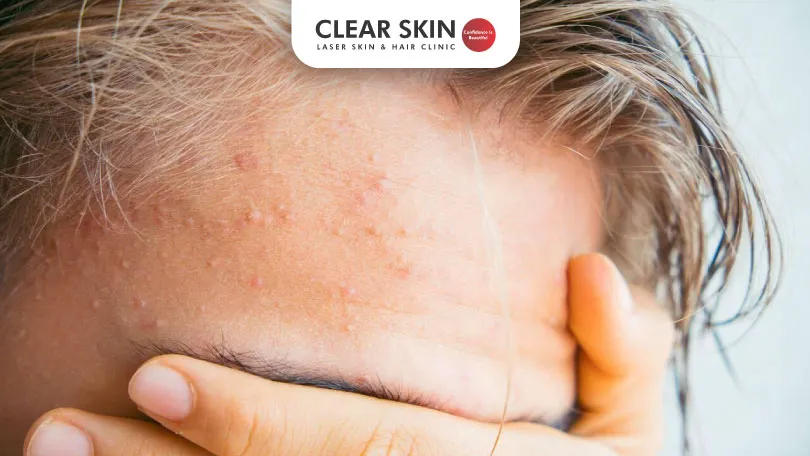
Forehead is one of the most common places to find acne. It is considered to be a part of the oily T zone of the face, where the concentration of oil glands are higher than other parts of the body. Let us understand the reasons for forehead acne, its identification, and treatment.
Acne is a skin condition which is caused by the clogging of hair follicles on the skin. Dead skin cells and dirt when mixed along with sebum, cause the plugging of hair follicles and skin pores. Bacteria growing in these clogged pores can cause infection and skin inflammation.
Table Of Content
- 9 Causes of Forehead Acne
- Forehead Acne : How do they Appear?
- Acne on Forehead : Prevention and Treatment
- Conclusion
9 Causes of Forehead Acne
1. Hormonal Changes and Androgen Sensitivity, The Most Commonly Missed Cause
If you are a woman who gets forehead acne in a predictable pattern, typically flaring in the week before your period and clearing afterwards , the cause is almost certainly hormonal, not topical.
Androgens (testosterone and DHT) stimulate sebaceous glands to produce more oil. In the days before menstruation, oestrogen drops while progesterone rises , creating a relative androgen surplus that spikes sebum production across the T-zone. This is the mechanism behind menstrual acne, and the forehead is one of its most common sites.
In women with PCOS (polycystic ovary syndrome) , one of the most prevalent hormonal conditions in Indian women , androgens are chronically elevated. This causes persistent, often cystic acne that does not respond to topical treatments alone.
Post-pill acne is another pattern that confuses patients: stopping oral contraceptives causes a rebound surge in androgens, triggering acne flares 2–4 months after discontinuation in women who were previously clear. This is often misdiagnosed as a new skin problem rather than recognised as a hormonal rebound.
In adult men, persistent forehead acne through the 30s and beyond often reflects androgen sensitivity in sebaceous glands, a genetic trait that keeps sebum production elevated even without an underlying hormonal disorder.
How to identify it: Acne follows a cyclical pattern (monthly in women), involves deeper cysts rather than surface blackheads, and does not improve with topical-only treatment over 8–12 weeks.
2. Excess Sebum Production
Even without a hormonal trigger, the T-zone produces more sebum than the rest of the face by default. When sebum production exceeds the rate at which it can exit through the follicle, the backup combines with dead skin cells to form a comedone, the beginning of every acne lesion.
Factors that further elevate sebum in the T-zone include heat and humidity (sebaceous glands are more active in warm conditions), stress-induced cortisol, a high-glycaemic diet, and some medications. India’s climate , hot for most of the year and humid in the monsoon , creates baseline sebum conditions that are higher than in temperate climates, which is one reason acne is so prevalent here.
3. Hair Products and Pomade Acne
Hair gels, waxes, pomades, leave-in conditioners, dry shampoos, and hair serums all contain ingredients that are comedogenic when they come into contact with facial skin. The transfer happens during styling (product touches the hairline), during sleep (product on hair transfers to the forehead on the pillow), and through sweat (product migrates as hair gets wet).
The forehead and hairline are the most affected areas , hence the term “pomade acne”, which refers specifically to comedonal acne along the hairline from hair product contact. The comedones are typically non-inflamed blackheads and whiteheads in a distribution that follows the hairline.
4. Traditional Hair Oiling (Champi) , India-Specific Trigger
This is one of the most common causes of forehead acne in Indian patients that almost never appears in dermatology articles , because it is almost entirely an Indian practice.
Champi (traditional scalp massage with hair oil , coconut, almond, castor, jasmine, or amla oil) is a deeply ingrained part of hair care in India. The problem is that these oils do not stay on the scalp. During application, oil drips onto the forehead. During the oiling session, as you bend forward or tilt your head, oil runs along the hairline. With sweat or warm water, oil on the hair migrates to the forehead skin. The pillow you sleep on after an overnight oiling session becomes coated in oil that your forehead contacts for hours.
Coconut oil , one of the most popular and culturally valued hair oils in India , rates 4 out of 5 on the comedogenicity scale. It blocks pores effectively. Applied to hair in contact with acne-prone forehead skin, it reliably causes comedonal forehead acne: clusters of small, non-inflamed bumps along the hairline that seem to appear from nowhere and don’t respond to topical benzoyl peroxide.
What to do: Apply oil only to the scalp and hair shaft, not the hairline. Clip the hair back and protect the forehead with a dry cloth or cotton band during oiling. Wash the face (especially the forehead and hairline) thoroughly after oiling. If you oil overnight, consider switching to a non-comedogenic oil such as jojoba (rating: 2/5) or argan oil (rating: 0/5), or reduce oiling frequency.
5. Helmet Friction , Acne Mechanica (India-Specific Trigger)
India has mandatory helmet laws for two-wheeler riders , and millions of Indians wear helmets daily, often for hours. The helmet’s inner padding sits directly against the forehead, creating a microenvironment of heat, sweat, friction, and occlusion. This is the exact combination that produces acne mechanica: acne caused by mechanical pressure and friction rather than bacteria or excess oil.
The pattern is recognisable: breakouts that concentrate along the band where the helmet sits , across the forehead, between the temples , in people who wear helmets regularly. The acne is typically comedonal and papular, worsens in summer and monsoon (more sweat), and clears or reduces significantly when helmet use is interrupted (e.g., during travel or illness).
Generic forehead acne articles written outside India never mention this. It is an entirely India-specific trigger with no good online content addressing it , which means treating it correctly requires knowing it exists.
What to do: Clean the inner helmet padding weekly (or more often in summer). Wear a thin cotton undercap between the helmet and the forehead , this absorbs sweat and reduces direct friction and occlusion. Apply a light, oil-free SPF before riding (skin barrier protection). After removing the helmet, wash the forehead with a salicylic acid cleanser promptly.
6. Dandruff (Seborrhoeic Dermatitis of the Scalp)
Dandruff flakes don’t just fall on clothing , they fall onto the forehead. The same organism responsible for dandruff, Malassezia furfur, produces inflammatory byproducts when it overgrows on the scalp. These travel to the forehead skin and contribute to follicular inflammation and blocked pores.
If you notice that your forehead acne worsens when your dandruff is worse, this is the mechanism at work. Treating dandruff , with a ketoconazole 2% shampoo, zinc pyrithione shampoo, or selenium sulphide, will reduce forehead acne without any change to your face care routine. This is also true in reverse: if forehead acne is responding poorly to standard treatment, checking for and treating dandruff often produces unexpected improvement.
7. Comedogenic Skincare and Sunscreen
This is the cause patients most frequently overlook, because it feels counterintuitive: the products they are applying to protect their skin may be causing their acne.
Many common skincare ingredients are comedogenic, they block pores on contact. Mineral oils, isopropyl myristate, silicones, lauric acid (a component of coconut oil), and certain waxes are all high on the comedogenicity scale and present in popular sunscreens, moisturisers, and makeup primers.
In India, this problem is compounded by sunscreen avoidance. Patients avoid SPF because they believe it causes acne, which leaves skin unprotected , causing post-inflammatory hyperpigmentation to worsen, while also damaging the skin barrier in ways that worsen acne long-term. The solution is not to avoid sunscreen but to switch to a non-comedogenic formulation (gel-based or fluid SPF with no mineral oil, no high-comedogenicity actives).
Incomplete makeup removal is the related issue: foundation, BB cream, and powder products left on the skin overnight, or removed incompletely with a quick wipe , leave comedogenic residue in the follicles. Double cleansing (micellar water or cleansing balm, followed by a gel cleanser) removes these residues completely.
8. Diet: High-Glycaemic Foods and Dairy
The diet-acne link is moderate in evidence , not as strong as it is sometimes presented, but real enough to be worth testing if other causes have been addressed.
High-glycaemic foods (white rice, maida-based products, bread, biscuits, samosas, pav bhaji , sugary chai, cold drinks, mithai, and heavily processed snacks) cause rapid blood sugar spikes followed by insulin surges. Elevated insulin increases IGF-1 (insulin-like growth factor 1), which stimulates androgen production and sebaceous gland activity. In India, where refined carbohydrates are dietary staples, this is a significant potential contributor.
High-fat dairy, full-fat milk, large quantities of paneer, dahi, or ghee , is associated with acne worsening in some studies, possibly because of the hormonal content of cow’s milk. This is a sensitive subject in India given the cultural centrality of dairy; the pragmatic approach is a trial reduction (swap full-fat for low-fat milk, reduce paneer frequency) for 4–6 weeks and observe whether the pattern changes.
Diet alone rarely causes severe acne. But if you have addressed skincare, hair oil, and helmet friction and still see unexplained flares, dietary audit is a reasonable next step.
9. Stress and Cortisol
Psychological stress triggers the release of cortisol and CRH (corticotropin-releasing hormone), both of which directly stimulate sebaceous gland activity and promote follicular inflammation. This is why exam periods, work deadlines, and major life stressors reliably trigger or worsen acne flares , the mechanism is biochemical, not psychosomatic.
Sleep deprivation amplifies this: inadequate sleep elevates cortisol and impairs the skin’s ability to repair overnight. Indian college students and young professionals report consistent patterns of forehead acne during exam season and high-deadline periods, a pattern that is real, documented, and rarely addressed with specific advice.
Stress management is not a generic wellness recommendation here , it is a specific treatment lever for stress-pattern acne. Consistent sleep schedules (7–8 hours), structured rest periods, and exercise (which reduces cortisol long-term, even though it temporarily spikes it) all have documented skin benef
Forehead Acne: How do they Appear?
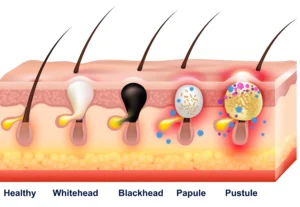
Forehead acne can present in various forms, depending on the severity and underlying causes:
- Comedones (Whiteheads and Blackheads): These are small bumps that result from clogged pores. Whiteheads are closed comedones, while blackheads are open comedones exposed to air.
- Papules and Pustules: These are inflamed red bumps. Papules are solid and don’t contain pus, while pustules have a white center filled with pus.
- Cysts and Nodules: In severe cases, deeper and more painful lesions like cysts and nodules can develop, indicating a more intense inflammatory response.
Acne on Forehead : Prevention and Treatment
Forehead acne is often preventable with certain improvements in lifestyle habits. Simple actions like regularly washing the face, and cleaning it, dabbing or washing of sweat and not allowing it to stay for long on the face, avoiding frequent use of hair products and skin products like pomades, hair gels, hair oils, and make up products can aid prevent acne on forehead.
Keep these few points in mind to prevent forehead acne, or keep the existing condition from getting severe.
- Wash your face twice a day. Pat dry, without rubbing.
- For oily and greasy hair, wash often, with shampoos specifically used for treating oily hair.
- Avoid touching your forehead or scratching or rubbing it with your fingers, thereby preventing the transfer of dirt particles into the skin pores.
- Do not allow hair to constantly come in contact with your forehead.
- Wearing hats, caps and bandanas can lead to sweat accumulation within the pores. Avoid wearing them for long periods of time.
Natural Remedies
- Aloe Vera Gel: Its anti-inflammatory properties can help soothe and reduce acne.
- Green Tea Extract: Rich in antioxidants, green tea can help reduce sebum production and fight bacteria.
Medical Treatments
If lifestyle changes and over-the-counter products don’t improve forehead acne, it may be time to consult a dermatologist. Possible treatments include:
- Topical Treatments: Benzoyl peroxide, salicylic acid, and retinoids can help reduce acne and prevent new breakouts.
- Oral Medications: In severe cases, oral antibiotics or hormonal treatments may be prescribed to manage acne.
- Procedures: Dermatologists may recommend treatments like chemical peels, laser therapy, or drainage and extraction for severe acne.
There are some natural remedies which may help prevent and control acne breakout on the forehead. Some of them include aloe vera gel treatment and green tea extract. If you are not sure how severe your condition is, prefer to consult an acne doctor in Pune for a treatment prescription.
Professional Treatments at Clear Skin
- Salicylic acid and glycolic chemical peels: Exfoliate the follicle opening, dissolve comedones, and reduce oil production in the T-zone. Especially effective for comedonal forehead acne. Chemical peel treatment at Clear Skin.
- Carbon laser peel: Carbon particles are applied to the skin surface, absorbed into pores, then vaporised with laser energy , removing debris from follicles, reducing oil production, and killing Cutibacterium acnes. Particularly effective for oily, acne-prone Indian skin. Carbon laser peel at Clear Skin.
- Acne treatment programme: For persistent or severe forehead acne, a dermatologist-designed combination protocol addresses causes topically, systemically, and with in-clinic procedures. Acne treatment in Pune , Clear Skin.
Acne के लिए Best Medicine | Best Medicine For Acne | Clear Skin, Pune
Do You Know?
Roughly 250 Patients Are Treated
Everyday By These Dermatologists
(You are one click away from flawless skin)
Meet Our Dermatologist!




Conclusion
Forehead acne is not specific to any particular age group. Though commonly observed in teenagers, when they hit puberty, anyone can get acne on forehead, due to various reasons as discussed above.
It is important to maintain facial hygiene along with a clean hair and scalp routine in order to prevent accumulation of excessive sebum in skin pores which is the leading cause of forehead acne.
If your acne problem persists even after trying out good skin care and home remedies, visit a dermatologist for better diagnosis and management.
Further Reading
Topical vs Oral Acne Treatment: Which Is Right?
Topical vs oral acne treatment compared – how each works, when dermatologists prescribe them, side effects, and which suits your acne in Pune.
Why Do White Patches Appear on Skin?
A single white patch could be tinea versicolor, vitiligo, pityriasis alba, or early leprosy, each needs a different treatment.
Carbon Laser vs Chemical Peel for Acne: Which Works Better for Oily Indian Skin?
Confused between carbon laser and chemical peels? Compare benefits, downtime, cost, and acne results to choose the right treatment for your skin.
Subcision vs Laser for Deep Acne Scars: Which Gives Better Results?
Looking for the best treatment for deep acne scars? Compare subcision, RF microneedling, Pico laser, and CO2 laser before choosing your treatment.
Have thoughts? Please let us know
We are committed not only to treating you, but also educating you.