
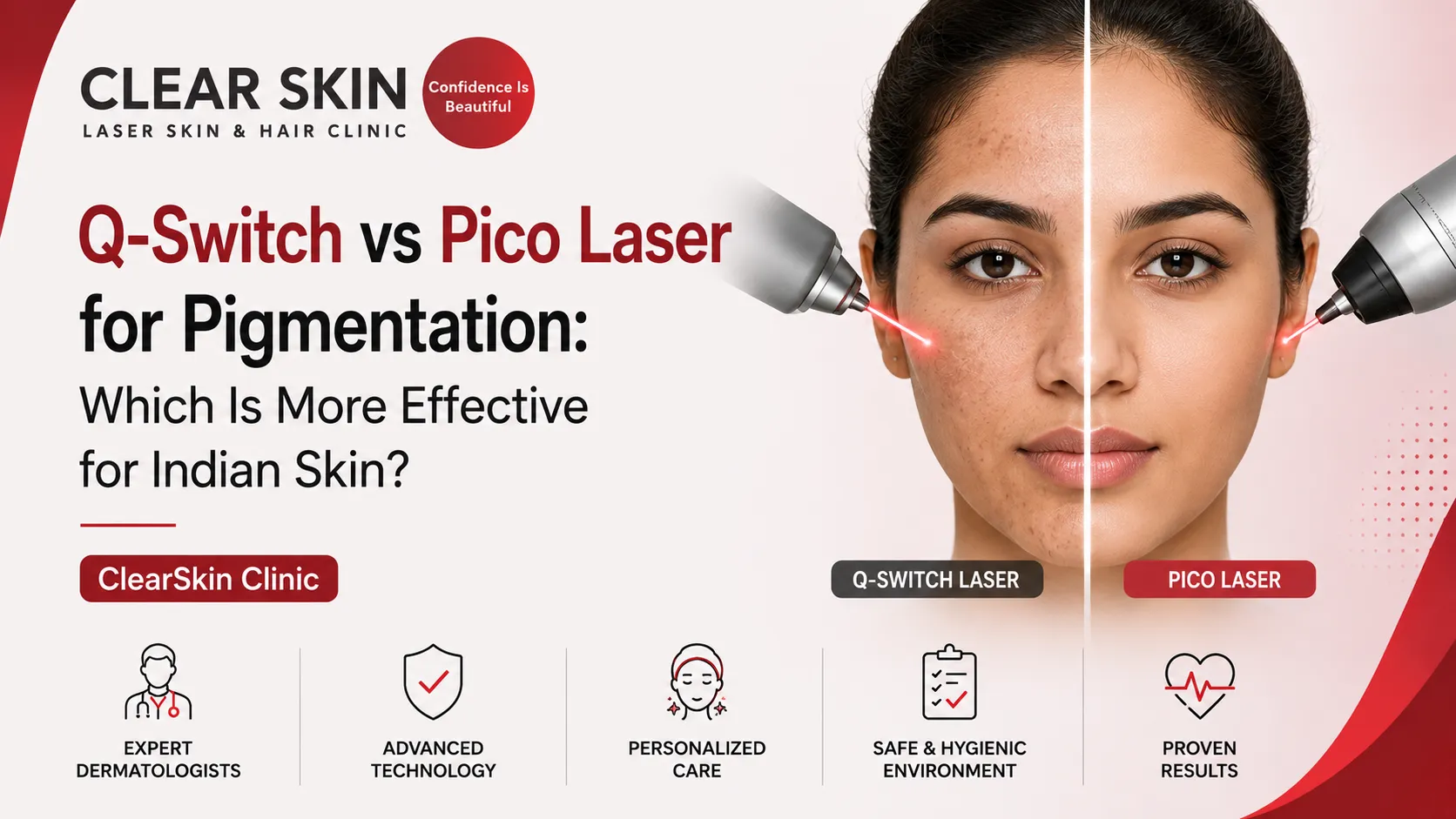
Q-Switch vs Pico Laser for Pigmentation: Which Is More Effective for Indian Skin?

Written by Clear Skin Content Team | Medically Reviewed by Dr. Dhanraj Chavan on July 17, 2026
Medical Disclaimer: This article is for informational purposes only. Consult a qualified dermatologist for personalised medical advice.
If you’ve consulted more than one dermatologist about laser treatment for pigmentation, you’ve likely heard both names: Q-switch and Pico laser. Both use light energy to fragment melanin deposits.
Both are used across reputable clinics in India. Both produce genuine results. But they are built on different physics, work through different mechanisms, and carry different risk profiles for Indian skin and the differences matter most precisely when pigmentation is complex, stubborn, or when melasma rather than simple PIH is the concern.
Understanding what separates these two technologies will help you evaluate what’s actually being proposed in your consultation and whether the protocol matches your specific pigmentation type.
Table Of Content
- The Physics Difference That Changes Clinical Outcomes
- How Each Performs on Specific Indian Skin Pigmentation Types?
- Direct Comparison Table: Q-Switch vs Pico Laser
- Why the Dermatologist’s Experience Matters More Than the Device?
- FAQs
- Conclusion
The Physics Difference That Changes Clinical Outcomes
The fundamental distinction between Q-switch and Pico lasers is pulse duration how fast the energy is delivered. This single variable changes the dominant physical mechanism through which melanin is destroyed.
Q-Switched Laser: Nanosecond Pulses
Q-switched lasers deliver energy in nanoseconds billionths of a second. At this speed, the dominant effect is photothermal: the melanin absorbs the light energy and converts it to heat, which shatters the melanin granule. Heat is generated in the process and that heat affects surrounding tissue to a small but clinically relevant degree, particularly in the more thermally sensitive melanocytes of Indian Fitzpatrick IV–VI skin.
The Nd:YAG Q-switch at 1064nm is the standard option for Indian skin because this wavelength is absorbed by melanin while generating relatively less heat in the dermis than shorter wavelengths like 532nm or 694nm.
Pico Laser: Picosecond Pulses
Pico lasers deliver energy in picoseconds trillionths of a second, 100–1,000 times shorter than Q-switch pulses. At these ultra-short durations, the energy creates a sharp photoacoustic mechanical pressure wave rather than a primarily thermal effect. The melanin granule is physically shattered by the pressure wave not heated until it breaks. The result: more complete fragmentation of melanin with significantly less heat generated in surrounding tissue.
For Indian skin, less heat means lower risk of triggering PIH. For melasma specifically where heat is documented to stimulate already-hyperreactive melanocytes and cause rebound worsening this reduced thermal effect is a clinically important advantage.
How Each Performs on Specific Indian Skin Pigmentation Types?
PIH from Acne Both Effective, Q-Switch More Cost-Efficient
For fresh-to-moderate epidermal PIH from acne breakouts, Q-switch Nd:YAG laser toning at conservative settings produces reliable improvement over 4–8 sessions. It has decades of documented safety on Indian skin at appropriate parameters. Pico laser also produces excellent results for PIH but at a higher cost per session. For straightforward PIH that hasn’t been treated before, Q-switch is a clinically sound and more affordable starting choice.
Solar Lentigines and Sun Spots Both Highly Effective
Discrete solar lentigines respond well to both technologies. Pico laser often achieves clearer results per session due to more complete photoacoustic pigment fragmentation. For patients where cost is a consideration and pigmentation is uncomplicated sun-induced spotting, Q-switch is entirely appropriate.
Melasma Pico Laser Has a Clinical Advantage
This is where the technologies genuinely diverge in clinical significance. For melasma on Indian skin, Q-switch laser carries a well-documented risk: when applied at too-high fluence or too frequently, the thermal component stimulates the hyperreactive melanocytes that drive melasma producing a rebound flare that leaves patients darker than when they started. This is not rare. It is the most common reason patients present at a new clinic with worsened melasma having been treated elsewhere.
Pico laser’s photoacoustic mechanism generates significantly less heat, reducing the probability of triggering the melanocyte stimulation that causes rebound. Combined with appropriate session intervals and mandatory sun protection, Pico laser is the preferred choice for complex or stubborn melasma on Indian skin. For more comprehensive melasma-specific guidance, the full melasma treatment protocol outlines how laser fits within a layered management approach.
Mixed Epidermal-Dermal Pigmentation Pico Laser’s Photoacoustic Depth Advantage
Mixed-depth pigmentation where melanin deposits sit at both epidermal and dermal levels responds incompletely to surface-level treatments. Pico laser’s photoacoustic pressure wave penetrates deeper into the dermis than Q-switch thermal fragmentation at equivalent fluence, providing better clearance of the dermal component. For patients who have done multiple Q-switch sessions with only partial improvement that has plateaued, escalating to Pico is the logical clinical next step.
Direct Comparison Table: Q-Switch vs Pico Laser
How Q-Switch Toning Works for Melasma
Q-switched Nd:YAG at 1064nm in toning mode low fluence, large spot size, full-face coverage progressively reduces overall melanin density. For mixed epidermal-dermal melasma where peels have cleared the surface component but dermal pigment persists, 1064nm offers deeper penetration than any surface peel can achieve.
The Critical Risk: Rebound Flares
At too-high fluence or applied too frequently, Q-switch laser heats the hyperreactive melasma melanocytes and triggers the very pigment production it’s trying to reduce. This rebound phenomenon is documented, not rare, and is the most common presentation when patients arrive at a clinic with darker melasma than before they started treatment elsewhere. The therapeutic window for Q-switch on melasma is narrow conservative energy, conservative intervals, mandatory sun protection not aggressive, high-energy spot treatment.
What Conservative Laser Toning Achieves for Melasma?
Correctly applied Q-switch toning over 6–10 sessions produces gradual, cumulative melanin density reduction. For mixed-depth melasma, it reaches the dermal component that chemical peels cannot. The key is patience the conservative protocol requires more sessions than an aggressive approach, but it avoids the flares that set patients back months.
Understanding the full melasma treatment options and protocol helps patients see where laser fits in a longer-term management strategy.
Why the Dermatologist’s Experience Matters More Than the Device?
This is the point that rarely appears in device marketing but it’s arguably more important than the technology itself. A Q-switch laser operated by an experienced dermatologist who calibrates fluence, spot size, and session intervals specifically for Indian skin will consistently outperform a Pico laser operated at incorrect settings. The machine provides the mechanism; the clinical judgment around it determines whether it works safely.
Before any laser treatment for pigmentation, ask your dermatologist what specific settings they use for your skin tone and pigmentation type. An answer that references fluence, wavelength, and pulse parameters not just “we adjust for your skin” reflects the calibration rigour that Indian skin requires.
“Pico laser has changed how we approach difficult pigmentation cases particularly melasma in Indian patients. With Q-switch, the therapeutic window is narrow. Too much energy and we risk stimulating the very melanocytes we’re trying to quieten. Pico gives more room to work. The mechanical shattering is more thorough, and with less heat, the risk of triggering a flare is genuinely lower. For patients who’ve done multiple Q-switch courses with partial results, Pico is typically the step-up we recommend.” Dr. Dhanraj Chavan, Clear Skin Clinic
Book a Laser Pigmentation Consultation at Clear Skin Clinic
The Role of Topicals and SPF Alongside Laser
Laser treatment for pigmentation without a rigorous home protocol consistently underperforms. Tranexamic acid, niacinamide, and azelaic acid used consistently between sessions extend results and reduce the rate of repigmentation. SPF 50+ PA+++ applied every morning including on days you don’t go outdoors is non-negotiable. UV exposure counteracts the effect of every laser session invested in clearing melanin. Patients who are rigorous about sun protection consistently achieve better and more durable outcomes.
Understanding how skin rejuvenation and pigmentation management work together helps position laser treatment within a complete skincare approach rather than viewing it as an isolated intervention.
Frequently Asked Questions (FAQs)
Is Pico laser worth the extra cost over Q-switch?
For mild-to-moderate PIH or fresh sun spots being treated for the first time, Q-switch is the cost-efficient starting point. For melasma, stubborn pigmentation, or mixed epidermal-dermal pigmentation that hasn’t fully responded to Q-switch, Pico’s additional cost is justified by clinically better outcomes and lower complication risk on Indian skin.
Can Q-switch laser make melasma worse?
Yes when applied at high fluence or without rigorous post-treatment sun protection. Thermal stimulation of the hyperreactive melanocytes driving melasma can trigger a rebound flare. Conservative low-fluence toning protocols (not aggressive spot treatment) are the safe Q-switch approach for melasma.
How many Pico laser sessions are needed for pigmentation?
Typically 3–6 sessions spaced 3–4 weeks apart, depending on pigmentation type and depth. Maintenance sessions every 6–12 months prevent seasonal pigmentation accumulation and sustain results.
Is Pico laser safe for dark Indian skin?
Yes. The 1064nm Pico wavelength is well-tolerated by Fitzpatrick IV–VI skin. The reduced thermal mechanism lowers PIH risk. The 532nm Pico wavelength requires more caution on darker tones an experienced dermatologist selects the appropriate wavelength for your skin tone and target pigmentation.
Can Pico laser and chemical peels be combined?
Yes and this combination is frequently used in clinical practice. Chemical peels address surface epidermal PIH and improve skin texture; Pico laser reaches deeper pigment that peels cannot access. Combined protocols with adequate session spacing produce better overall outcomes for mixed pigmentation than either modality used alone. Understanding how chemical peels work alongside laser helps contextualize how both tools complement each other.
Do You Know?
Roughly 250 Patients Are Treated
Everyday By These Dermatologists
(You are one click away from flawless skin)
Meet Our Dermatologist!

Conclusion
Q-Switch and Pico lasers can both provide effective results for pigmentation, but the better choice depends on the type, depth, and severity of pigmentation rather than simply choosing the newer technology. Q-Switch Nd:YAG can be a practical and cost-effective option for straightforward post-acne pigmentation and sunspots, while Pico laser may offer an advantage for stubborn, mixed-depth pigmentation and complex melasma on Indian skin.
The skill of the dermatologist is just as important as the laser itself. Proper wavelength, fluence, pulse settings, treatment intervals, and strict sun protection all influence safety and results, particularly for Fitzpatrick IV–VI Indian skin. Laser treatment should also be supported by an appropriate skincare routine to reduce the chance of pigmentation returning.
If you are unsure whether Q-Switch or Pico laser is right for your pigmentation, consult a qualified dermatologist for an individual assessment. At Clear Skin Clinic Pune, a personalised treatment plan can help match the laser and settings to your specific pigmentation concern and skin type.
Further Reading
Tattoo Removal Reviews from Pune Patients – Results After Q-Switch Laser at Clear Skin
Laser and chemical peels both treat sun damage and dark spots, but through different mechanisms.
Dark Circles: Fillers vs PRP vs Laser in Pune
Under-eye dark circle treatment in Pune – fillers vs PRP vs laser compared on results, longevity, and cost. Reviewed by Dr. Dhanraj Chavan.
PIH After Acne: Causes & Treatment | Clear Skin Pune
Post-inflammatory hyperpigmentation (PIH) is a flat dark mark after acne, not a scar. Learn why Indian skin is prone to it and how Clear Skin Pune treats it.
HIFU vs Botox vs Fillers vs Thread Lift for Anti-Aging in Pune – Which is Right for You?
Laser and chemical peels both treat sun damage and dark spots, but through different mechanisms.
Have thoughts? Please let us know
We are committed not only to treating you, but also educating you.