
PRP for Acne Scars: Sessions, Cost, and Results

Written by Clear Skin Content Team | Medically Reviewed by Dr. Dhanraj Chavan on November 20, 2026
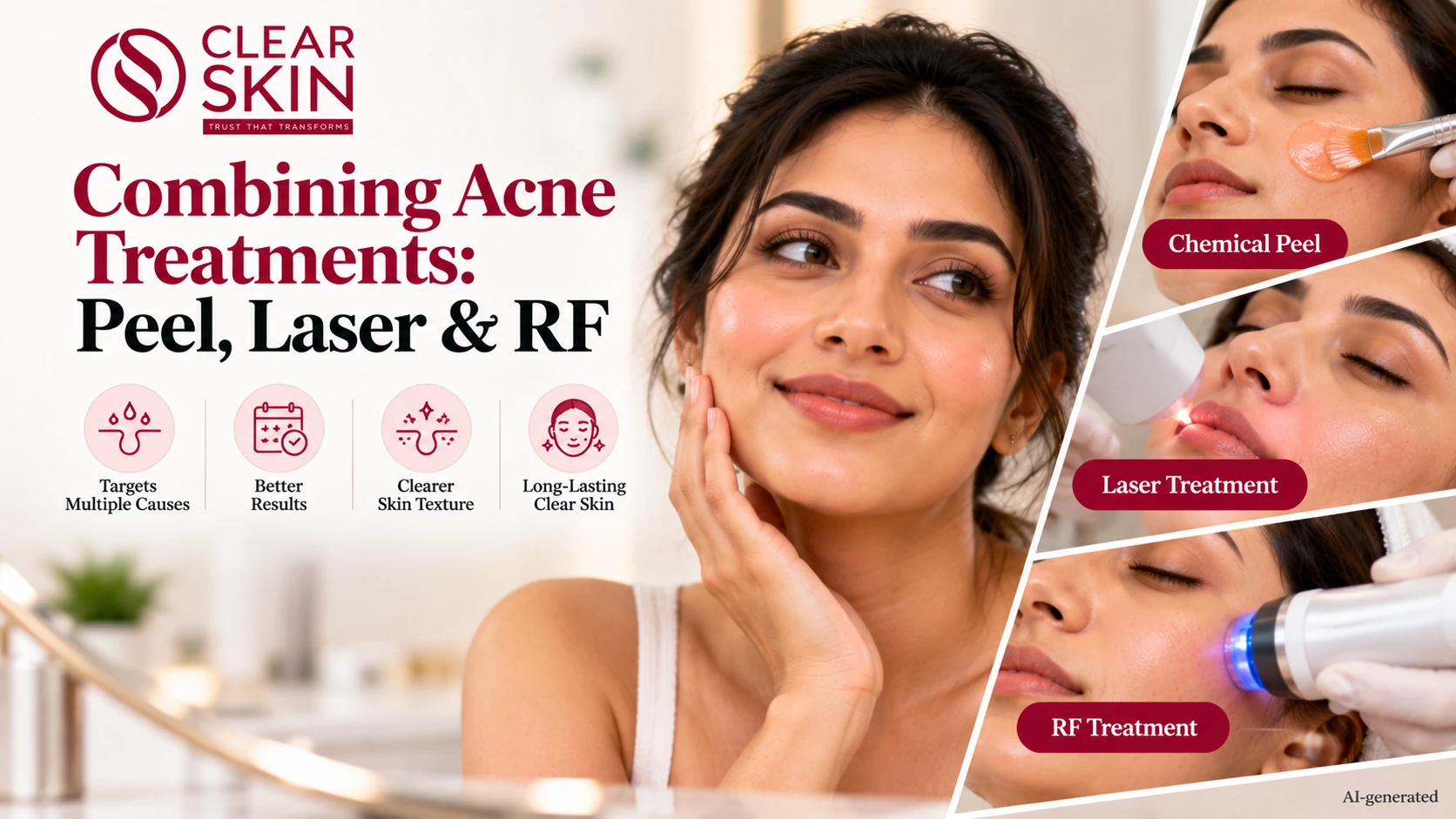
PRP draws on the body’s own repair system — your blood’s platelets concentrating them 5–10 times above baseline and delivering the resulting growth factors directly into acne scar tissue. These growth factors tell fibroblasts (the skin’s collagen-producing cells) to lay down new collagen exactly where it has been lost. Depressed scars fill gradually over 3–6 months as this new collagen remodels. PRP works best on rolling and shallow boxcar scars where the collagen loss is diffuse. It is less effective on ice-pick scars (too narrow for new collagen to fill from below) and not a tool for raised scars. Three to six sessions, spaced 4–6 weeks apart, is the standard course. Results are gradual and natural — not dramatic overnight change, but measurable improvement in scar depth, texture, and skin quality.
You cleared your acne six months ago. The pimples are gone. What remains is a topography of shallow craters across the cheeks — rolling depressions that catch light unevenly in photographs, and that no foundation covers convincingly.
Your dermatologist mentions PRP. You have heard of it for hair loss. You are wondering whether the same approach works for skin, what the evidence looks like, and whether it is worth the sessions.
This is exactly the right question to ask before committing to a course of any scar treatment.
Table Of Content
- At a Glance
- What Is PRP and How Does It Work on Acne Scars?
- Which Acne Scar Types Respond to PRP?
- PRP Alone vs PRP Combined with Microneedling RF
- How Many Sessions and When Results Appear?
- What the Clinical Evidence Shows?
- Downtime and What to Expect After Each Session?
- Expert Insight
- Summary
- Frequently Asked Questions
- Conclusion
At a Glance
|
What it is |
Platelet Rich Plasma — concentrated from your own blood, injected or infused into acne scar tissue |
|
How it works |
Growth factors in platelets stimulate fibroblasts to produce new collagen, filling depressed scars |
|
Best scar types |
Rolling scars, shallow boxcar scars, early atrophic scars |
|
Less effective for |
Deep ice-pick scars, very old severe scars, raised hypertrophic scars |
|
Sessions needed |
3–6 sessions, spaced 4–6 weeks apart |
|
When results appear |
Gradual improvement from month 2–3; full result at 6 months |
|
Most common combination |
PRP + Microneedling RF in the same session |
|
Downtime |
Mild redness and swelling for 24–48 hours |
|
Why it works for Indian skin |
Autologous (own blood) so no allergy risk; low post-inflammatory hyperpigmentation risk compared to ablative lasers |
What Is PRP and How Does It Work on Acne Scars?
Platelet Rich Plasma is prepared from the patient’s own blood.
The process:
- A small volume of blood (10–20 mL) is drawn from the arm
- The blood is centrifuged (spun at high speed) to separate platelets and plasma from red blood cells
- The resulting PRP contains 5–10 times the normal concentration of platelets
- This concentrated PRP is activated (sometimes with calcium chloride) to release growth factors
- The activated PRP is injected into the dermis at the scar sites, or applied topically immediately after microneedling opens channels in the skin
What platelets do in skin repair:
Platelets contain alpha granules loaded with growth factors:
- PDGF (Platelet-Derived Growth Factor): stimulates fibroblast proliferation
- TGF-β (Transforming Growth Factor-beta): triggers collagen and fibronectin synthesis
- VEGF (Vascular Endothelial Growth Factor): promotes new blood vessel formation, improving tissue nutrition
- EGF (Epidermal Growth Factor): stimulates epidermal cell regeneration
- FGF (Fibroblast Growth Factor): supports collagen maturation and remodelling
Together, these create the same cascade the body uses to heal a wound — except it is concentrated and directed precisely at the scar site. The result over 3–6 months is new collagen that fills the depressed area from below.
Platelet Rich Plasma Therapy (PRP) at Clear Skin Clinic uses clinically established preparation protocols.
Which Acne Scar Types Respond to PRP?
Scar type determines how much benefit PRP delivers. The full spectrum of acne scars includes several structural subtypes, each with different treatment responses.
Rolling scars — PRP works well Rolling scars have gently sloping edges and a broad, shallow depression. The collagen loss is diffuse across a wider area. PRP-stimulated collagen fills this type of depression effectively over multiple sessions. Rolling scars are the strongest indication for PRP.
Shallow boxcar scars — PRP works moderately well Boxcar scars have defined vertical walls and a flat base. Shallow boxcar scars (less than 0.5 mm deep) show meaningful improvement with PRP. Deep boxcar scars (deeper walls, more collagen loss) respond partially PRP softens the base but may not fully raise the floor to skin level without additional treatments like subcision or laser.
Ice-pick scars — PRP has limited effect Ice-pick scars are narrow, deep channels extending to the lower dermis. The channel is too narrow for new collagen to build up from below it closes off at the surface before the base can fill. These scars require punch excision, TCA CROSS (chemical reconstruction), or specific laser techniques. PRP is not the primary tool here.
Raised / hypertrophic scars — PRP is not indicated Raised acne scars involve excess collagen, not a deficiency. Adding more collagen stimulus is counterproductive. These are managed with intralesional steroid injections, laser resurfacing, or silicone-based treatments.
PRP Alone vs PRP Combined with Microneedling RF
PRP is increasingly used in combination with Microneedling Radiofrequency (RF) in the same session, and the combination produces consistently better outcomes than either alone.
How the combination works: Microneedling RF creates thousands of micro-channels through the skin with its needle array while simultaneously delivering radiofrequency energy into the dermis. This does two things: it physically breaks up fibrotic scar bands that tether rolling scars from below, and it stimulates its own collagen response in the surrounding dermis. PRP applied immediately after is absorbed through these open channels at much greater depth and concentration than topical application alone allows.
What the evidence shows: Several peer-reviewed studies compare PRP alone, microneedling alone, and the combination. The combination consistently produces greater improvement in ECCA (Echelle d’Evaluation Clinique des Cicatrices d’Acné) scar scores — the validated scale for acne scar severity — than either treatment used in isolation.
Who gets which protocol:
- Mild rolling scars with good skin quality: PRP injections alone may be sufficient
- Moderate rolling and boxcar scars: PRP combined with microneedling RF delivers better depth response
- More severe or mixed scar types: RF microneedling with PRP plus additional modalities (subcision, peel, laser) in a staged plan
How Many Sessions and When Results Appear?
Standard course: 3–6 sessions, spaced 4–6 weeks apart
The spacing allows the collagen remodelling cycle to complete between sessions. Collagen production triggered by growth factors takes 6–8 weeks to produce visible structural change — booking sessions too close together adds PRP stimulus before the previous response has matured.
Timeline of results:
|
Timepoint |
What to expect |
|
After session 1 |
Mild improvement in skin texture; some reduction in redness around scars |
|
Months 1–2 |
Incremental softening of scar edges; skin hydration and glow improves noticeably |
|
Month 3 |
Rolling scars visibly shallower; skin surface texture more even |
|
Month 6 |
Full collagen maturation; maximum improvement from the course visible |
|
Beyond 6 months |
Results are stable; a maintenance session every 6–12 months helps sustain them |
The key expectation to manage is that PRP improvement is gradual and cumulative. Patients who assess after session 2 and expect dramatic change will be disappointed. Patients who complete the full course and photograph results at 6 months see the real outcome.
What the Clinical Evidence Shows?
Multiple randomised controlled trials and split-face studies have assessed PRP for acne scars:
A 2019 study published in the Journal of Cosmetic Dermatology (Ibrahim et al.) compared PRP injections to saline in a split-face design across 30 patients with atrophic acne scars. The PRP-treated side showed 62% improvement in ECCA scores at 6 months compared to 12% on the control side.
A 2020 meta-analysis of 11 trials (Marwah et al.) concluded that PRP combined with microneedling produced significantly greater improvement than microneedling alone for atrophic acne scars, with the difference most pronounced for rolling scars.
Studies consistently show that PRP is effective, but that it is not a monotherapy for severe scarring — it is most effective as a component of a planned multi-modal approach.
Downtime and What to Expect After Each Session?
Downtime from PRP for acne scars is mild compared to ablative laser treatments.
Immediately after: Redness and mild swelling at injection sites. The face looks slightly flushed. This is normal and expected.
24–48 hours: The redness settles. Some patients report mild tenderness at injection points. Makeup is typically avoided for the first 24 hours; after that it can be applied gently.
Days 3–7: Skin returns to normal. No peeling, no crusting, no open wounds.
Avoid for 48 hours: Direct sun exposure, vigorous exercise (increases facial flushing), active skincare ingredients (retinoids, acids, vitamin C serums) on the treated area.
Avoid for 1 week before each session: Blood-thinning medications or supplements (aspirin, ibuprofen, fish oil, vitamin E) where medically safe to pause — these affect platelet function and can reduce PRP quality. Always confirm with your prescribing physician before pausing any medication.
Expert Insight
“PRP is one of the more satisfying treatments for rolling scars specifically, because it works with the skin’s own biology rather than applying external energy,” says Dr. Dhanraj Chavan, Senior Dermatologist at Clear Skin Clinic. “The improvement is gradual — which I always explain clearly upfront — but at the 6-month mark, patients who complete the full course see real textural change. Combined with microneedling RF, the results are meaningfully better than PRP injections alone for moderate to severe scarring.”
Summary
PRP for acne scars concentrates the patient’s own blood platelets and delivers their growth factors to scar tissue, stimulating fibroblasts to produce new collagen. Rolling scars and shallow boxcar scars respond best. Ice-pick scars show limited response. A standard course of 3–6 sessions, 4–6 weeks apart, produces gradual improvement visible from month 3 and reaching maximum at month 6. The combination of PRP with Microneedling RF in the same session consistently outperforms either treatment alone in clinical studies. PRP is autologous (own blood) and carries minimal allergy or infection risk. It is most effective as part of a multi-modal scar treatment plan rather than as a standalone approach for severe scarring. See patient outcomes at Acne Scars before-and-after results.
Frequently Asked Questions
Is PRP for acne scars permanent?
The collagen produced during a PRP course is real structural tissue, it does not dissolve or fade the way a filler would. However, skin continues to age and new acne can create new scars. Most patients see sustained results for 2–3 years, with an optional maintenance session every 6–12 months to reinforce the collagen base. The term “permanent” is not used because the skin continues to change over time.
How does PRP compare to laser for acne scars?
Ablative lasers (CO2, erbium) produce faster and more dramatic results but require 5–14 days of downtime, carry higher post-inflammatory hyperpigmentation risk on darker skin tones, and are more expensive per session. PRP is gentler, has 24–48 hours of downtime, is safer on Indian skin tones, and costs less per session but requires more sessions and produces more gradual change. Many patients benefit from using both: PRP with microneedling RF as the collagen-building foundation, and targeted laser for PIH or specific deeper scars.
Can I do PRP if my acne is still active?
PRP for scars should wait until acne is under stable control defined as fewer than 2–3 new lesions per month. Doing scar treatment while active acne continues creates new scars during the treatment course, undermining results and wasting sessions. Get the acne under control with prescription treatment first, then begin the scar plan.
Will PRP help my dark marks from acne, or only the indentations?
PRP’s primary mechanism is collagen production it addresses the structural depression (the scar itself). Post-inflammatory hyperpigmentation (PIH), the flat dark marks, is a pigmentation issue that responds better to topical brightening agents, chemical peels, or targeted laser sessions. Some patients see mild brightening with PRP as the growth factors support overall skin quality, but this is a secondary benefit, not PRP’s primary action.
How many sessions will I actually need?
The standard starting point is 3–6 sessions spaced 4–6 weeks apart. The specific number depends on scar severity: mild rolling scars in patients with good skin quality may see sufficient results at 3 sessions; moderate to severe mixed scarring typically requires the full 5–6 session course. A dermatologist assesses your scar grade at the first appointment and estimates a realistic session number before you commit.
Do You Know?
Roughly 250 Patients Are Treated
Everyday By These Dermatologists
(You are one click away from flawless skin)
Meet Our Dermatologist!



Conclusion
If you have rolling or shallow boxcar acne scars and have been told you are a candidate for PRP, the evidence supports a well-designed course of sessions producing meaningful, sustained improvement. The key is committing to the full course and assessing at the 6-month mark — not after the first two sessions.
Find your nearest Clear Skin Clinic on Google Maps or call +91 95845 84111 to book an acne scar assessment and find out which treatment combination suits your scar pattern.
See a doctor urgently if any injection site shows rapidly increasing redness, warmth, or swelling beyond the first 48 hours this may indicate infection and needs prompt evaluation.
Disclaimer: This article is for general educational purposes only. It does not replace personal medical advice. PRP outcomes depend on scar type, severity, skin quality, and individual response. Consult a qualified dermatologist for an assessment of your specific scar pattern before beginning treatment.
Further Reading
Dermal Fillers and Fat Grafting for Acne Scars: What They Fix, What They Don’t
Fillers and fat grafting lift depressed acne scars from below — not by rebuilding collagen, but by physically restoring lost volume.
Dark Circle Treatment Reviews in Pune | Clear Skin
Real Clear Skin Pune patient results for dark circle treatment – see before and after outcomes, treatments used, and what to expect.
Combining Acne Treatments: Peel, Laser & RF | Clear Skin
Can you combine acne treatments? Compare chemical peels, laser, RF microneedling and PRP, including treatment timing and safety considerations.
HydraFacial for Acne-Prone Skin: Safe or Not?
Is HydraFacial safe for acne-prone skin? Discover its benefits, risks, suitability for active acne and when to consult a dermatologist in Pune.
Have thoughts? Please let us know
We are committed not only to treating you, but also educating you.