
Laser Hair Removal Before and After Results – Things to Know

Written by Clear Skin Content Team | Medically Reviewed by Dr. Dhanraj Chavan on August 23, 2026
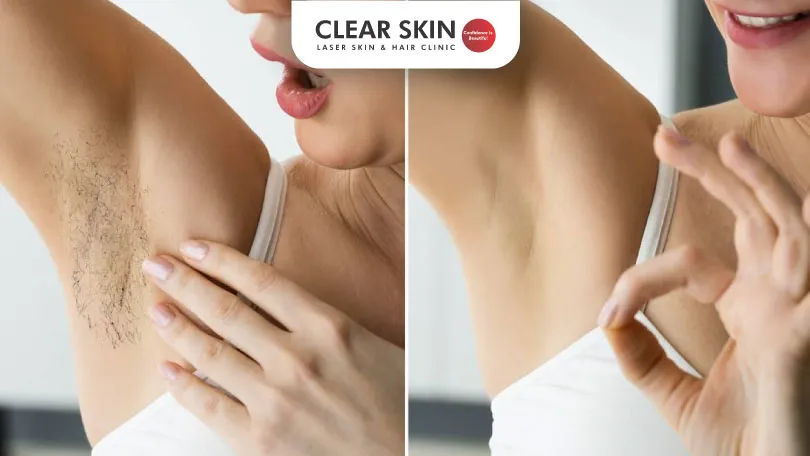
If you have spent years in a cycle of monthly waxing appointments, post-wax redness, ingrown hairs, and last-minute shaving before a trip or event, you already know the frustration. What most patients researching laser hair removal actually want to know is not whether it works in general but what it looks like specifically: what will my skin look like after the first session, the third session, and the end of the full course?
This guide answers that question in clinical detail, broken down by session and by body area.
Table Of Content
- How Diode Laser Hair Removal Works?
- Session-by-Session: What Your Skin Looks Like Before and After?
- Body Area Breakdown: Sessions Needed and What to Expect?
- Before Treatment: What to Do in the Weeks Before Your Session
- After Each Session: Skin Care Protocol
- Laser Hair Removal for Indian Skin: What Is Different?
- The Real Cost of Not Starting: Monthly Waxing vs Laser Hair Removal
- Questions Patients Ask Before Booking
- Conclusion
How Does Diode Laser Hair Removal Works?
Diode laser targets the melanin (pigment) in individual hair follicles, converting light energy to heat and destroying the follicle’s ability to regrow. Because the laser targets melanin in the follicle specifically, it can only destroy hairs that are in the active growth phase (anagen phase) at the time of treatment. At any given moment, approximately 20 to 30 percent of hairs on the body are in anagen phase. This is why multiple sessions are required: each session targets a different cohort of follicles as they cycle into active growth.
At Clear Skin, diode laser is the standard for all skin types including Fitzpatrick IV-VI (most Indian skin tones). Diode laser at 810 nm wavelength has a strong affinity for melanin in the follicle while sparing the surrounding skin, making it significantly safer for darker skin tones than IPL or older laser systems.
Session-by-Session: What Your Skin Looks Like Before and After?
After Session 1
Within 24 to 72 hours of your first session, treated hairs appear to grow. This is not new growth. The laser has destroyed the follicle but the shaft is still in place and pushing out as the follicle dies. This shedding process is normal and expected. Gently exfoliating the area with a washcloth after 5 to 7 days helps the shed hairs release. By week 3 to 4, the treated area will appear noticeably cleaner with sparser regrowth than before treatment. Most patients see 10 to 20 percent reduction in density after session 1.
After Session 2 and 3
By session 3, most patients see 30 to 50 percent reduction in hair density. Remaining hairs are typically finer and lighter than before treatment began. The interval between sessions (typically 4 to 6 weeks for most body areas) is timed to coincide with the next anagen cycle, ensuring each session targets a fresh cohort of active follicles. Regrowth between sessions becomes noticeably slower: patients who previously waxed every 3 weeks find they can extend to 5 to 6 weeks between sessions.
After Session 4 and 5
This is typically where patients notice the most dramatic change. 50 to 70 percent reduction in hair density is common at this stage. Areas like underarms, which previously required waxing every 2 to 3 weeks, may see only fine, sparse regrowth at 6 to 8 week intervals. Skin texture in treated areas often improves as well: the cycle of repeated waxing and shaving that causes chronic folliculitis, ingrown hairs, and darkening of the underarm and bikini area begins to resolve.
After Session 6 to 8 (End of Initial Course)
Most patients achieve 70 to 90 percent permanent hair reduction by the end of the standard course. What remains is typically fine, light vellus hair that is cosmetically insignificant for most patients, and occasional coarser hairs in hormonally active areas (chin, upper lip, bikini) that may require annual maintenance sessions. For non-hormonal areas (legs, underarms, back), results are largely permanent after the initial course.
Patients with PCOS or other hormonal conditions that drive active hair follicle stimulation typically need a longer initial course (8 to 10 sessions) and may need maintenance sessions every 6 to 12 months as new follicles are activated by circulating androgens.
Body Area Breakdown: Sessions Needed and What to Expect?
|
Body Area |
Sessions Needed |
Expected Reduction |
Notes |
|
Underarms |
6 to 8 |
80 to 90% |
Fastest responding area; dark coarse hair responds best |
|
Lower legs |
6 to 8 |
75 to 90% |
Even reduction across large area; 2 to 3 extra sessions for fine ankles |
|
Full legs |
8 to 10 |
75 to 90% |
Thigh hair often finer; may need additional sessions |
|
Bikini line |
6 to 8 |
70 to 85% |
Hormonal sensitivity may require maintenance |
|
Full Brazilian |
8 to 10 |
70 to 85% |
Coarser follicles respond well; ongoing maintenance for PCOS |
|
Upper lip |
8 to 12 |
60 to 80% |
Hormonally driven; maintenance sessions typically needed |
|
Chin and jaw |
8 to 12 |
60 to 80% |
PCOS patients often need longer course and ongoing maintenance |
|
Full face |
8 to 12 |
65 to 80% |
Lower density than body; slower visible progression |
|
Forearms |
6 to 8 |
70 to 85% |
Fine hair requires careful parameter setting |
|
Back and shoulders |
8 to 10 |
75 to 85% |
Large area; typically 2 to 3 extra sessions for complete coverage |
See actual before and after laser hair removal results from Clear Skin patients
Before Treatment: What to Do in the Weeks Before Your Session?
Stop waxing, threading, and epilating 4 to 6 weeks before your first session. These methods remove the hair shaft from the follicle, which is what the laser targets. Shaving is the correct method of hair removal during your treatment course because it cuts the shaft above the skin while leaving the follicle intact.
Shave the treatment area 24 hours before your session. This ensures the laser energy reaches the follicle without being absorbed by surface hair.
Avoid sun exposure for 4 weeks before treatment and apply SPF 50 to exposed treatment areas daily. Tanned or sun-darkened skin has elevated surface melanin, which increases the risk of surface burns and reduces the energy that reaches the follicle.
Avoid photosensitising medications in the 2 weeks before treatment. These include certain antibiotics (particularly tetracyclines and fluoroquinolones), topical and oral retinoids, and St John’s Wort. Inform your dermatologist of all current medications at your consultation. Most medications do not affect treatment but a small number affect skin photosensitivity.
Do not use numbing creams before your session without your dermatologist’s guidance. Numbing creams can affect skin temperature and alter laser parameters. If you have low pain tolerance, discuss this at your consultation and the clinic will manage it appropriately.
After Each Session: Skin Care Protocol
Immediately after treatment, the treated area will appear slightly red and feel warm, similar to mild sunburn. This resolves within 2 to 24 hours depending on the area and skin type. Apply the soothing gel or moisturiser provided or recommended by your dermatologist. Cool compresses can reduce discomfort in the first few hours.
For the first 48 hours after each session, avoid heat exposure including hot showers, steam rooms, saunas, and intense exercise. Avoid deodorants containing alcohol on freshly treated underarm skin for 24 to 48 hours. Apply SPF 50 daily to treated areas that will be exposed to sunlight. Do not wax, thread, or epilate between sessions. Shaving is fine after 48 hours if needed.
From day 5 to 14, gently exfoliate the treated area with a washcloth or mild scrub to help shed treated hairs. This is not painful and significantly improves the visual result by clearing the area of dead follicle shafts.
Laser Hair Removal for Indian Skin: What Is Different?
Most LHR research originates from Western clinical settings where lighter skin (Fitzpatrick I-III) is the norm. For Indian patients (predominantly Fitzpatrick IV-VI), several considerations apply.
Diode laser at 810 nm is the appropriate choice for Fitzpatrick IV-VI. It has strong absorption in dark hair follicles while lower absorption in the surrounding epidermis, minimising PIH risk. IPL (Intense Pulsed Light) is not ideal for darker Indian skin tones because the broad spectrum of wavelengths increases the risk of surface hyperpigmentation. At Clear Skin, all laser parameters are calibrated specifically for Indian skin tones.
PCOS and laser hair removal: Polycystic Ovary Syndrome affects a significant proportion of Indian women in their reproductive years and is one of the most common reasons patients seek LHR for facial hair (upper lip, chin, jaw, neck) and body hair. PCOS creates ongoing androgen stimulation of hair follicles. Laser permanently destroys active follicles, but circulating androgens can activate dormant follicles that were not previously producing terminal hair. This means PCOS patients typically need a longer initial course, annual maintenance sessions in hormonally active areas, and ideally concurrent management of the underlying hormonal condition for optimal and lasting results. LHR is still highly effective for PCOS patients and most report significant quality-of-life improvement, but realistic expectations about maintenance are important.
Post-inflammatory hyperpigmentation (PIH): Indian skin is more prone to PIH after any procedure that causes surface inflammation. Proper diode laser parameters, adequate interval between sessions, and consistent SPF use between sessions significantly reduce this risk. If post-treatment darkening does occur, it typically resolves with a topical regimen (niacinamide, azelaic acid) within 4 to 8 weeks.
The Real Cost of Not Starting: Monthly Waxing vs Laser Hair Removal
A woman waxing full legs and underarms at a Pune salon typically spends Rs. 600 to 1,500 per session every 3 to 4 weeks, amounting to Rs. 9,000 to 22,000 per year. Over 10 years, that is Rs. 90,000 to 220,000 spent on a temporary solution that also involves monthly time commitment, post-wax redness, ingrown hair management, and skin darkening over treatment areas. A complete LHR course at Clear Skin costs more upfront but is a finite investment. After the initial course, most non-hormonal areas require no further treatment. Patients who factor the lifetime cost of waxing into their decision consistently find that LHR becomes cost-neutral within 2 to 4 years and saves significantly beyond that.
Book your laser hair removal consultation at Clear Skin, Pune
Questions Patients Ask Before Booking
How many sessions of laser hair removal will I need?
Most body areas require 6 to 8 sessions spaced 4 to 6 weeks apart. Facial hair in hormonally active areas (upper lip, chin) typically requires 8 to 12 sessions. Patients with PCOS generally need a longer initial course and annual maintenance sessions. Your dermatologist will estimate session count at the first consultation after assessing your hair density, follicle type, and skin tone.
Does laser hair removal work on Indian skin?
Yes, but laser selection matters. Diode laser at 810 nm is the standard for Fitzpatrick IV-VI (most Indian skin tones) because it targets dark hair follicles with lower surface absorption than older lasers or IPL. At Clear Skin, all treatments for Indian skin are performed with diode laser at calibrated parameters for darker skin tones. IPL is not used as an alternative for Indian patients.
Is laser hair removal painful?
Most patients describe it as a mild snapping sensation, similar to a rubber band flick, with a warming sensation in the treated area. Underarms and bikini areas are more sensitive than legs or arms. Pain tolerance varies; most patients find the discomfort manageable and significantly less uncomfortable than waxing. Cooling systems built into modern diode lasers reduce surface discomfort substantially.
Can I do laser hair removal if I have PCOS?
Yes. LHR is one of the most effective interventions for PCOS-related hair growth and is recommended by dermatologists for this purpose. You will likely need a longer initial course (8 to 10 sessions) and maintenance sessions annually in hormonally active areas, because circulating androgens can activate new follicles over time. Ideally, managing the underlying PCOS with a gynaecologist or endocrinologist alongside LHR produces the best long-term results.
How long do laser hair removal results last?
For non-hormonal areas (legs, underarms, back, arms), results after a full course are largely permanent. Most patients see 80 to 90 percent permanent reduction with no further treatment needed. For hormonally active areas (upper lip, chin, bikini) in patients with normal hormone levels, results are long-lasting but occasional maintenance sessions every 1 to 3 years address any follicle reactivation. For PCOS patients, annual maintenance in facial and bikini areas is typical.
Can I get laser hair removal if I have dark skin?
Yes. Fitzpatrick IV-VI skin responds very well to diode laser hair removal when correct parameters are used. The contrast between dark hair and darker skin is less than in lighter skin types, which means energy parameters need careful calibration, but the treatment is safe and effective. Indian patients with very dark skin should specifically ask which laser technology their clinic uses and confirm it is diode, not IPL.
What should I avoid after a laser hair removal session?
For 48 hours after each session: avoid heat (hot showers, steam rooms, intense exercise), avoid alcohol-based products on treated skin, avoid sun exposure, and apply SPF 50 to treated areas daily. Do not wax or thread between sessions. Shaving is fine after 48 hours. From day 5 onwards, gentle exfoliation of treated areas helps clear shed hairs and improves the visual result.
Do You Know?
Roughly 250 Patients Are Treated
Everyday By These Dermatologists
(You are one click away from flawless skin)
Meet Our Dermatologist!

Conclusion
The first consultation includes a skin and hair assessment: your dermatologist will assess your hair type, density and distribution across treatment areas, your Fitzpatrick skin tone, and any relevant medical history (PCOS, current medications, recent sun exposure). A patch test may be performed on a small area of skin before the first full session. You will receive a treatment plan with session count estimate, session spacing, and pre-treatment instructions specific to your skin and the areas you want to treat.
Clear Skin’s dermatologists have performed laser hair removal for thousands of patients across Pune including patients with darker Indian skin tones and PCOS. See laser hair removal before and after results from Clear Skin patients.
Further Reading
Gym & Sweat Acne: Causes & Prevention | Clear Skin Pune
Gym acne (acne mechanica) is caused by sweat, heat, and friction. Learn where it appears, why Pune’s humidity worsens it, and how to prevent breakouts.
Best Treatments for Back Acne and Body Scars
Struggling with back acne and body scars? Learn about effective home remedies and professional treatments to achieve clear, blemish-free skin.
Melasma Treatment Reviews in Pune | Clear Skin
Real Clear Skin Pune patient results for melasma treatment – see before and after outcomes after laser and chemical peel, and what to expect.
Best Treatment for Pigmentation on Face
Discover top treatments for pigmentation on the face. Get clear, even-toned skin with dermatologist-recommended pigmentation solutions in Pune.
Have thoughts? Please let us know
We are committed not only to treating you, but also educating you.