
Laser Toning for Melasma: Sessions, Cost, and Is It Safe for Indian Skin?

Written by Clear Skin Content Team | Medically Reviewed by Dr. Dhanraj Chavan on November 22, 2026
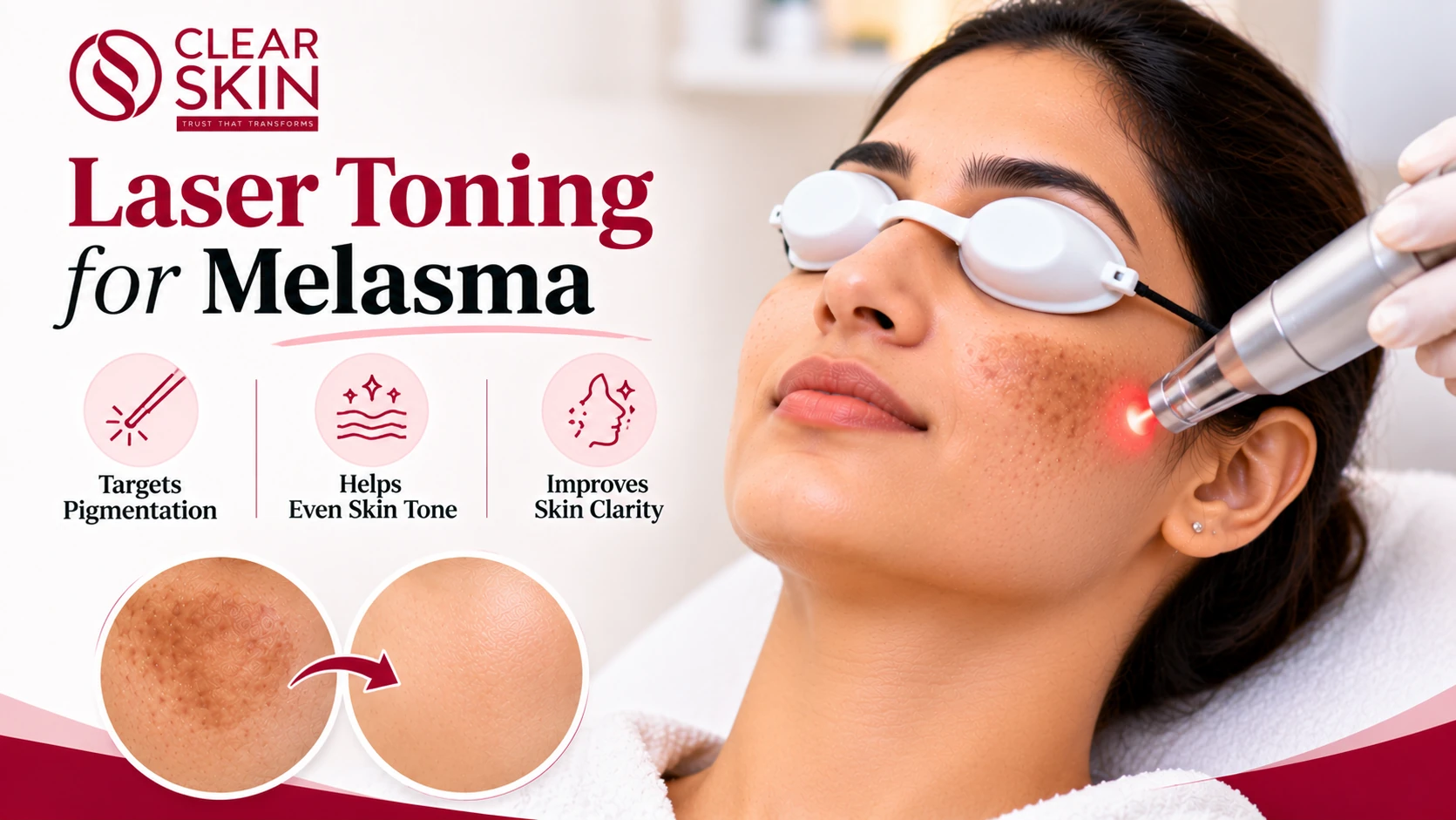
Laser toning for melasma uses Q-switched Nd:YAG laser at 1064 nm in a low-fluence, multi-pass protocol to gradually fragment melanin pigment deposits in the epidermis without generating the heat that would stimulate new melanin production or cause post-inflammatory hyperpigmentation. The result over 6–10 sessions is progressive lightening of melasma patches. The key distinction from other laser treatments is protocol: the same laser at higher fluence (used for tattoo removal) can worsen melasma. Low-fluence toning at the correct parameters is specific to melasma treatment. It is safe and effective on Indian skin tones. Combination with topical prescription agents and oral tranexamic acid consistently produces better and more sustained results than laser alone.
You have been told you need laser treatment for your melasma. You have also heard that laser can make melasma worse, and you have seen before-and-after photographs online that show both outcomes. You want to understand why these results differ, and whether laser toning is the right treatment for your skin.
The confusion is understandable. The word “laser” describes many different devices with different wavelengths, energy levels, and protocols. What worsen melasma and what treats it are both categorised as laser, but they operate completely differently.
Table Of Content
- At a Glance
- What Is Laser Toning and How Is It Different From Other Lasers?
- Why 1064 nm Is Specifically Chosen for Indian Skin?
- How a Laser Toning Session for Melasma Works?
- How Many Sessions and When Results Appear?
- Pico Laser for Melasma: When It’s Considered
- What Laser Toning Cannot Do for Melasma?
- Combination Protocol: Why Laser Alone Is Not Enough?
- Expert Insight
- Summary
- Frequently Asked Questions
- Conclusion
At a Glance
|
Procedure name |
Laser toning / Q-switched Nd:YAG toning at 1064 nm |
|
How it works |
Low-fluence, multi-pass laser energy fragments melanin deposits in the skin without heat-related damage |
|
Why 1064 nm specifically |
Less melanin absorption at this wavelength compared to 532 nm, lower risk of post-inflammatory hyperpigmentation (PIH) on darker skin |
|
Best melasma type |
Epidermal melasma (pigment in upper skin layers); some benefit for mixed epidermal/dermal |
|
Sessions for active treatment |
6–10 sessions, spaced 2–3 weeks apart |
|
Maintenance sessions |
1 session every 4–8 weeks after initial course |
|
Downtime |
Minimal, mild redness for 1–2 hours; sunscreen required the same day |
|
Safe for Indian skin? |
Yes, 1064 nm toning is specifically suited to Fitzpatrick IV–VI skin |
|
Combination |
Most effective combined with topical prescription agents and oral tranexamic acid |
What Is Laser Toning and How Is It Different From Other Lasers?
The Q switched ND Yag Laser is the same device used for tattoo removal. The difference in melasma treatment is entirely in how it is used.
For tattoo removal: high fluence (energy), single or few passes, targeting large aggregates of exogenous pigment particles in the dermis. The high energy physically shatters the pigment.
For laser toning (melasma): low fluence, multiple rapid passes over the same treatment area, targeting the skin’s own melanin in the epidermis and superficial dermis. The energy is deliberately low enough to fragment melanin granules gradually without generating significant heat.
This distinction is critical. The same Nd:YAG laser used at tattoo-removal parameters on melasma skin can:
- Generate localised heat that activates melanocytes and worsens pigmentation
- Cause post-inflammatory hyperpigmentation, a darker inflammatory response that is often worse and more persistent than the original melasma
Low-fluence toning avoids this by keeping energy levels below the threshold that triggers thermal damage or significant inflammatory response. The tradeoff is that results are gradual (across multiple sessions) rather than dramatic in one treatment.
Why 1064 nm Is Specifically Chosen for Indian Skin?
The Nd:YAG laser operates at two principal wavelengths: 1064 nm (infrared, penetrates deeply) and 532 nm (green, superficial, more absorbed by melanin and haemoglobin).
For melasma on Indian skin (Fitzpatrick IV–VI), 1064 nm is the appropriate wavelength for three reasons:
- Lower melanin absorption Melanin absorbs light across a broad spectrum, but its absorption coefficient is higher at shorter wavelengths (532 nm) than at 1064 nm. On skin with higher baseline melanin content, which is true of Fitzpatrick IV–VI skin, a wavelength with lower melanin absorption delivers energy more selectively to the target pigment while generating less heat in the surrounding melanin-rich epidermis. This reduces the risk of non-specific thermal injury.
- Deeper penetration 1064 nm penetrates further into tissue than 532 nm. This is relevant for melasma that has a dermal or mixed component, pigment deposits sitting deeper than the epidermis that shorter wavelengths cannot reach effectively.
- Lower PIH risk profile in published evidence Clinical studies specifically comparing low-fluence Nd:YAG toning at 1064 nm versus other laser modalities in Asian and Indian patients consistently show that the 1064 nm toning protocol has the most favourable PIH risk profile among laser options for darker skin tones. This is not simply theoretical, it is supported by the volume of clinical evidence from Indian and Southeast Asian dermatology departments over the past two decades.
How a Laser Toning Session for Melasma Works?
Before the session:
- Makeup is removed and the face is cleansed
- Topical anaesthetic is usually not required, the sensation during toning is mild
- A patch test on a small area may be performed for first-time patients to confirm skin response at the planned fluence
- Topical prescription agents are paused for 24–48 hours before some sessions (the dermatologist specifies this)
During the session:
- Eye protection is worn (shields, not simply closing eyes, laser eye protection is specific equipment)
- The handpiece is passed over the treatment area in rapid, overlapping strokes, multiple passes at low fluence per session
- Sensation: mild warmth and a snapping sensation with each pulse; described by most patients as tolerable without anaesthesia
- Session duration: 20–30 minutes for the full face
Immediately after:
- Mild redness and warmth, settles within 1–2 hours
- Broad-spectrum SPF 50+ sunscreen is applied before leaving the clinic
- Normal activities resume immediately
- No peeling, no crusting, no open skin
What to avoid after each session:
- Sun exposure without SPF, the first few days after a session are when the skin is most vulnerable to UV-triggered reactivation
- Heat sources: saunas, steam rooms, vigorous outdoor activity in direct sun for 48 hours
- Prescribed topical retinoids for 24–48 hours immediately after (the dermatologist confirms the specific pause period)
- Other active skin treatments (peels, microneedling) until the skin has fully settled
How Many Sessions and When Results Appear?
Active treatment phase: 6–10 sessions, 2–3 weeks apart
The spacing between sessions is deliberate. Melanin fragmented by the laser is cleared by the skin’s immune system (macrophages engulf and remove the fragments). This process takes 2–3 weeks. Booking sessions too close together adds laser stimulus before the previous session’s clearance has completed.
What to expect at each stage:
|
Timepoint |
Expected observation |
|
Sessions 1–2 |
Minimal visible change. Skin tone may appear slightly more even. This is the priming phase. |
|
Sessions 3–4 |
Visible lightening of patch intensity begins. Edges of patches may start to fade. |
|
Sessions 5–6 |
Progressive patch fading. Areas of epidermal melasma respond most clearly. |
|
Session 7–10 |
Further refinement. Dermal component shows slower response than epidermal. |
|
4 weeks after final session |
Full melanin clearance from the active course assessed. Maintenance plan established. |
|
Ongoing maintenance |
1 session every 4–8 weeks prevents melanocyte reactivation and sustains results. |
A realistic framing: Laser toning for melasma is a course, not a single treatment. The clinical expectation is meaningful improvement, typically 40–70% reduction in melasma severity index scores in published studies, not complete elimination. Dermal melasma (pigment in deeper layers) responds more slowly and partially compared to epidermal melasma. A dermatologist who assesses the depth of your melasma at consultation can give you an accurate expectation before you begin.
Pico Laser for Melasma: When It’s Considered?
Pico Laser Treatment is an evolution of Q-switched technology. Where Q-switched lasers deliver pulses in nanoseconds (billionths of a second), picosecond lasers deliver pulses in picoseconds (trillionths of a second), 100 times shorter.
The significance for melasma is thermal: ultra-short pulses mean the energy is delivered and dissipated before significant heat can build in the surrounding tissue. The photomechanical effect (physical fragmentation of pigment) is preserved while the photothermal effect (heat-related tissue response) is minimised.
When pico laser is considered over conventional Q-switched toning:
- Patients with resistant or recurrent melasma that has shown partial response to conventional toning
- Patients with significant dermal component where deeper penetration with less thermal risk is advantageous
- Patients with Fitzpatrick V–VI skin tone where further minimising PIH risk is a priority
Pico laser is typically higher in cost per session than conventional Q-switched Nd:YAG toning. Whether it is the more appropriate choice depends on melasma type, skin tone, prior treatment history, and the dermatologist’s clinical judgment.
What Laser Toning Cannot Do for Melasma?
Understanding the limits of laser toning prevents the common pattern of incomplete response leading to disappointment or unnecessary repeated courses:
Laser toning does not stop melanocyte reactivation. The overactive melanocytes that produce melasma remain in the skin throughout the patient’s life. Laser clears the existing pigment; it does not change the underlying cellular reactivity to sun, heat, and hormonal signals. Without continued photoprotection and maintenance treatment, cleared melasma will return.
Laser toning is less effective for deeply dermal melasma. The 1064 nm wavelength penetrates reasonably well, but very deep dermal deposits clear slowly or incompletely with toning alone. These cases may require a combination approach including Q-switched laser plus topicals plus peels over an extended maintenance period.
Laser toning is not appropriate without concurrent photoprotection. A patient who undergoes laser toning sessions and continues to have significant unprotected sun exposure is counteracting the treatment at every session. Melanocytes reactivated by UV between sessions will produce new pigment faster than the laser can clear the previous deposits.
Combination Protocol: Why Laser Alone Is Not Enough?
The clinical evidence consistently shows that combination treatment, laser toning plus topical prescription agents plus oral tranexamic acid, outperforms laser toning alone for melasma.
Why this is the case:
Laser toning targets existing melanin deposits. Topical prescription agents (hydroquinone, tretinoin, azelaic acid) suppress new melanin production between sessions. Oral tranexamic acid targets the hormonal signalling pathway that tells melanocytes to overproduce pigment in the first place. Together, they address the condition at three levels simultaneously:
- Existing pigment (laser)
- New pigment production (topicals)
- The driving signal for overproduction (tranexamic acid)
Chemical Peels can be added for the epidermal component, particularly superficial mandelic or glycolic peels in between laser sessions, to accelerate clearance of surface pigment while the laser addresses the deeper deposits.
The practical implication: a patient who attends laser sessions without concurrent topical treatment is getting partial benefit from the plan. A patient who follows the full combination protocol consistently, laser sessions, topicals, oral agent, daily SPF, typically achieves better results with fewer total sessions.
Expert Insight
“Laser toning for melasma on Indian skin is well-established and safe when the protocol is correct, specifically low-fluence, multi-pass Q-switched Nd:YAG at 1064 nm,” says Dr. Dhanraj Chavan, Senior Dermatologist at Clear Skin Clinic. “What I want patients to understand is that laser toning is one part of the plan, not the whole plan. The patients who do best are those who come in for their sessions and also use their topicals correctly every day and are rigorous about sun protection. The laser clears what’s there. Everything else determines whether it comes back.”
Summary
Laser toning for Melasma uses Q-switched Nd:YAG at 1064 nm in a low-fluence, multi-pass protocol to gradually fragment melanin deposits without triggering the heat-related responses that worsen melasma or cause PIH. It is specifically safe and appropriate for Indian skin tones (Fitzpatrick IV–VI), where shorter wavelengths and higher fluences carry significant PIH risk. A standard active course runs 6–10 sessions over 3–5 months, with maintenance sessions every 4–8 weeks thereafter. Results are progressive, meaningful improvement in melasma severity over the course, not dramatic clearing in one session. Pico laser is an evolution offering reduced thermal risk for resistant or deep dermal melasma. Combination with topical prescription agents and oral tranexamic acid consistently produces superior and more durable outcomes than laser alone. Daily SPF 50+ throughout treatment is non-negotiable.
Frequently Asked Questions
How many laser toning sessions will I need for melasma?
Most patients with epidermal melasma begin seeing visible lightening from session 3–4. A complete active course runs 6–10 sessions spaced 2–3 weeks apart. The number depends on melasma severity, depth (epidermal vs mixed vs dermal), skin tone, and how consistently topical and sun protection measures are maintained between sessions. After the active course, maintenance sessions every 4–8 weeks prevent recurrence.Can laser toning make melasma worse?
Laser toning at the correct parameters (low fluence, 1064 nm, multi-pass) is specifically designed to avoid the responses that worsen melasma. However, overtreatment, using too many sessions too close together, or too high a fluence, can trigger paradoxical melanocyte stimulation and worsen pigmentation. This is why the spacing between sessions (2–3 weeks) and correct fluence selection are non-negotiable aspects of a safe melasma laser protocol. IPL and ablative lasers used for melasma carry a significantly higher risk of worsening.How long do laser toning results for melasma last?
Results from an active laser toning course are not self-sustaining. Without maintenance sessions and continued sun protection, melasma typically recurs within weeks to months after the final active session, as the melanocytes remain reactive to UV and hormonal triggers. With maintenance sessions every 4–8 weeks plus daily SPF 50+, results can be sustained long-term. Most patients maintain significantly improved skin tone with this plan.Can I wear makeup after laser toning for melasma?
Most patients can apply mineral-based makeup 24 hours after a session, once any redness has fully settled. Some clinics recommend 48 hours before applying any cosmetics. The more important restriction is sun protection, broad-spectrum SPF 50+ must be applied before leaving the clinic immediately after each session and every morning throughout treatment.Is laser toning for melasma done differently in Indian clinics compared to what I read about in international literature?
The core protocol, low-fluence Q-switched Nd:YAG at 1064 nm, is used internationally for Asian and Indian skin. What differs is the specific parameters: fluence levels, number of passes, session spacing, and pre-treatment skin priming are adjusted for Indian skin tones (Fitzpatrick IV–VI), where the margin between effective treatment and PIH induction is narrower than in lighter skin tones. An experienced dermatologist who regularly treats Indian patients with melasma will have refined parameters that reflect this. These are not published as fixed numbers, they are clinical judgments adjusted for each patient’s skin tone and response.Do You Know?
Roughly 250 Patients Are Treated
Everyday By These Dermatologists
(You are one click away from flawless skin)
Meet Our Dermatologist!


Conclusion
If you have melasma and are considering laser toning, the clinical evidence supports its effectiveness and safety on Indian skin, provided the correct protocol is used and the treatment is part of a comprehensive plan rather than a standalone procedure.
Find your nearest Clear Skin Clinic on Google Maps or call +91 95845 84111 to book a melasma consultation and get a treatment plan built around your skin tone, melasma depth, and history.
See a doctor promptly if melasma patches are rapidly enlarging, changing in character, or associated with other skin changes, a dermatologist should confirm diagnosis before beginning any laser treatment.
Disclaimer: This article is for general educational purposes only. Laser treatment for melasma must be performed by a trained dermatologist using appropriate equipment and parameters for the patient’s skin tone. Incorrect laser parameters can worsen melasma. This content does not replace a clinical consultation.
Further Reading
Melasma Treatment Cost in Pune 2026 | Clear Skin
Melasma treatment cost in Pune 2026 – laser, peel, and maintenance session pricing, what affects the cost, and what to expect at Clear Skin.
Melasma Treatment Cost in Pune: Laser, Peel, and Oral Options Explained
Melasma treatment in Pune involves a combination of approaches, topical, oral, chemical peels, & laser. what each costs, how many sessions are typically needed.
PRP for Acne Scars: Sessions, Cost, and Results
PRP uses your own blood’s growth factors to rebuild collagen in depressed acne scars. which scar types respond, how many sessions are needed.
Dermal Fillers and Fat Grafting for Acne Scars: What They Fix, What They Don’t
Fillers and fat grafting lift depressed acne scars from below — not by rebuilding collagen, but by physically restoring lost volume.
Have thoughts? Please let us know
We are committed not only to treating you, but also educating you.