
Dermatologist Guide to Acne Types: How to Identify What You Have?
Table Of Content
- Key Takeaways
- The Two-Category Classification
- Non-Inflammatory Acne – Comedones
- Inflammatory Acne – Four Lesion Types
- Three Subtypes Commonly Misdiagnosed
- How Type Determines Treatment at Clear Skin?
- As Verified By
- Frequently Asked Questions
- Conclusion
Medically reviewed by Dr. Dhanraj Chavan, MBBS, MD Dermatology | Clear Skin Clinic, Pune
Key Takeaways
- Acne lesions are classified as non-inflammatory (comedones) or inflammatory (papules, pustules, nodules, cysts)
- Type identification precedes treatment – the wrong agent for the wrong lesion type delays results and worsens outcomes
- Comedonal acne responds to retinoids and salicylic acid; inflammatory types require antibacterial or systemic treatment
- Three subtypes frequently misdiagnosed as standard acne: hormonal acne, fungal acne (Malassezia folliculitis), acne mechanica
- Nodular and cystic acne (Grade 3-4) carry the highest risk of permanent scarring in Indian skin (Fitzpatrick Type IV-V)
- Post-inflammatory hyperpigmentation (PIH) is a consequence of inflammatory acne – not a type – and affects up to 65% of Indian patients
Key Attributes of Acne
| Attribute | Value |
|---|---|
| Classification | Non-inflammatory (comedones) vs. inflammatory (papules, pustules, nodules, cysts) |
| Severity Grades | Grade 1 (mild) to Grade 4 (very severe) |
| Highest Scarring Risk | Nodular and cystic acne (Grade 3–4) |
| Most Commonly Misdiagnosed | Hormonal acne, fungal acne, acne mechanica<\strong> |
| PIH Risk in Indian Skin | Up to 65% of Fitzpatrick Type IV–V patients |
| Clinical Assessment Axes at ClearSkin | Depth of involvement, morphology, and perilesional skin condition |
Acne type identification is a clinical process that determines which treatment a patient needs – because the type of lesion, not just its severity, dictates which agent will work. Prescribing an antibacterial for purely comedonal skin, or a topical retinoid alone for active cysts, are errors that delay results while the skin continues to scar.
At Clear Skin Clinic, Pune, Dr. Dhanraj Chavan assesses each patient’s acne type alongside three clinical axes: depth of involvement, morphology, and the condition of the surrounding skin. This assessment framework prevents the most common treatment mismatches seen in patients who have tried multiple products without results.
This guide covers the complete classification of acne lesion types – including three subtypes frequently misdiagnosed as standard acne – and explains how type maps directly to the correct treatment grade.
The Two-Category Classification
Dermatologists divide all acne lesions into two primary categories based on whether inflammation is present.
Non-inflammatory acne consists of blocked follicles with no active immune response – no redness, no pus, no bacterial activity at the surface level. These are earliest-stage lesions that respond to agents that clear follicular blockage.
Inflammatory acne involves an active immune response: bacteria proliferating inside a blocked follicle, white blood cells mobilised, and visible redness, swelling, or pus. This category carries the risk of post-inflammatory hyperpigmentation and permanent scarring.
Treating inflammation with a pore-clearing acid alone – or treating comedones with an antibiotic – misses the actual mechanism. The category determines the treatment category.
Non-Inflammatory Acne – Comedones
Comedones are blocked follicles: excess sebum mixed with dead skin cells forming a plug that prevents normal follicle drainage. There are two forms, distinguished by whether the follicle opening is sealed.
Whiteheads (closed comedones): A thin layer of skin covers the plug, trapping it below the surface. They appear white or skin-coloured – flat or slightly raised, painless. Whiteheads cannot be cleared by washing; the blockage is subepidermal. Topical retinoids (adapalene, tretinoin) applied consistently over 6–8 weeks are first-line – they accelerate cell turnover and prevent new plugs from forming.
Blackheads (open comedones): The same blocked follicle, open at the surface. Sebum oxidises on contact with air and turns dark — this is a chemical reaction, not dirt. The difference between blackheads and whiteheads is structural: open vs. closed follicle, same underlying cause. Salicylic acid (2%) dissolves intercellular bonds between dead skin cells, helping the plug loosen naturally.
Both are Grade 1 acne. Neither should be squeezed – unsterile compression pushes sebum deeper and converts comedones into inflammatory papules.
Inflammatory Acne – Four Lesion Types
Once a blocked follicle becomes a site of active bacterial growth, the immune system responds. The four inflammatory lesion types reflect the depth and severity of that response.
Papules: Small, solid, raised red bumps (1–5 mm) with no visible pus. The immune response is localised around the follicle wall but hasn’t produced a pus pocket yet. Papules are tender to the touch. Squeezing a papule forces bacteria and debris into adjacent tissue – typically producing two or three new papules within days.
Pustules: A matured papule with a visible white or yellow pus centre – accumulated dead white blood cells. Pustules sit at the skin surface and often resolve with minimal scarring when left alone. They are Grade 2 lesions and respond well to topical antibiotics combined with benzoyl peroxide. How to manage pustules on the face starts with not interfering before they surface naturally.
Nodules: Solid, painful lumps extending deep into the dermis – often 5–10 mm or larger, with no visible head. Caused by a severe rupture of the follicle wall that spills bacteria and sebum into the surrounding dermis. At Clear Skin Clinic, nodular acne is Grade 3 and always treated systemically – topical agents do not penetrate to the depth where nodular activity occurs. Blind pimples – the patient-facing term for nodular acne — are frequently managed incorrectly because they are mistaken for deep pustules.
Cysts: The most severe inflammatory lesion. A large, pus-filled sac deep within the dermis, often fluctuant on palpation, deeply painful, and the primary source of ice-pick and boxcar scars in Indian skin. Cystic acne is Grade 4 and requires oral isotretinoin in most cases. Early intervention is critical – untreated cysts that are squeezed at home almost always leave permanent atrophic scarring.
Three Subtypes Commonly Misdiagnosed
To recap: all acne lesions are either non-inflammatory (comedones) or inflammatory (papules through cysts), with type and grade determining the correct treatment. At Clear Skin Clinic, Dr. Dhanraj Chavan assesses type alongside depth, morphology, and perilesional skin before prescribing. Three common subtypes fall outside standard classification and are frequently misidentified — leading to treatment failure.
Hormonal acne: Presents predominantly along the jawline, chin, and lower cheeks – not the T-zone. Lesions are typically deep papules or cysts that flare cyclically with the menstrual cycle. They do not respond well to standard topical antibiotics because the root cause is androgen-driven sebum overproduction, not follicular hyperkeratinisation alone. Stress compounds hormonal acne through cortisol-mediated androgen activity. Hormonal assessment and systemic treatment – oral contraceptives or spironolactone for women – are required alongside topical agents.
Fungal acne (Malassezia folliculitis): Caused by Malassezia yeast, not Cutibacterium acnes. Presents as uniform, small, itchy papules or pustules on the forehead, chest, or upper back – monomorphic in appearance. Crucially, it does not respond to antibiotics and worsens with prolonged antibiotic use, which depletes competing bacteria and allows Malassezia to proliferate further. Antifungal medication (topical ketoconazole or oral fluconazole) is curative. A dermatologist can distinguish the two clinically.
Acne mechanica: Triggered by repeated friction, pressure, or heat – from masks, helmets, backpack straps, or phones held against the cheek. Presents as follicular papules and pustules at pressure points. Treatment combines standard topical agents with removal of the mechanical trigger.
PIH – a consequence, not a type: Post-inflammatory hyperpigmentation is the dark mark left after an inflammatory lesion resolves. It is not acne – it is the skin’s inflammatory response in Fitzpatrick Type IV-V skin. Up to 65% of Indian acne patients develop PIH. It requires its own treatment layer (hydroquinone, tranexamic acid, azelaic acid) running alongside active acne management.
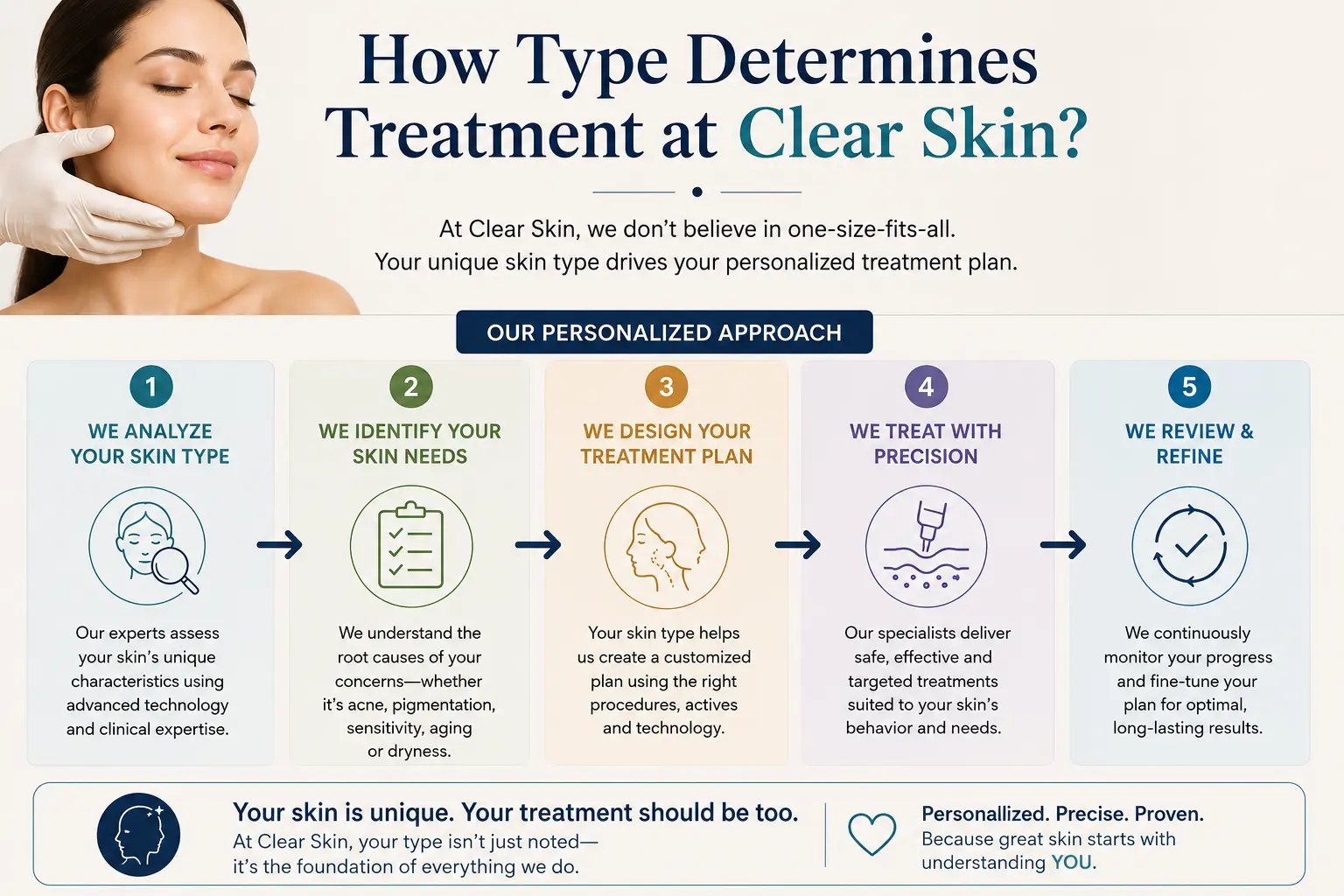
How Type Determines Treatment at Clear Skin?
Dr. Dhanraj Chavan’s clinical assessment follows three axes before prescribing any treatment plan.
Depth of involvement – epidermal only (comedones), full dermis (nodules), or extending into subcutaneous tissue (cysts with underlying volume loss). Depth determines whether topical agents are sufficient or systemic medication is required.
Morphology – lesion borders, atrophy, distribution pattern, and whether the acne is monomorphic (all one type, suggesting fungal or hormonal origin) or polymorphic (mixed types, standard bacterial acne).
Perilesional skin condition – in patients with chronic acne, the skin surrounding atrophic lesions often shows sebaceous hyperplasia: slightly thickened, raised areas caused by enlarged sebaceous glands around the scar. This finding informs the scar treatment plan once active acne is settled.
This three-axis reading prevents the most common clinical errors: treating PIH instead of the active lesion, applying topical antibiotics to comedonal-only skin, or using aggressive actives on an already-inflamed barrier. Understanding what makes skin acne-prone is the foundation before any treatment begins. For patients whose acne has already caused scarring, the acne scars treatment pathway at Clear Skin addresses each scar morphology with the appropriate modality – always after active acne is fully resolved.
As Verified By
- American Academy of Dermatology – Acne Types: https://www.aad.org/public/diseases/acne/truly-have-acne/types
- NCBI – Malassezia folliculitis vs. acne vulgaris: https://www.ncbi.nlm.nih.gov/pmc/articles/PMC5595550/
- Cleveland Clinic – Hormonal Acne: https://my.clevelandclinic.org/health/diseases/21792-hormonal-acne
- Indian Dermatology Online Journal – PIH in darker skin types: https://www.ncbi.nlm.nih.gov/pmc/articles/PMC3579484/
- NHS UK – Acne: https://www.nhs.uk/conditions/acne/
Frequently Asked Questions
What are the main types of acne?
Acne is classified as non-inflammatory (blackheads and whiteheads) or inflammatory (papules, pustules, nodules, and cysts). Non-inflammatory types are blocked follicles with no immune response. Inflammatory types involve active bacterial activity and an immune reaction. Most patients present with a combination of types simultaneously, which is why treatment usually requires more than one agent.
How do I know what type of acne I have?
Non-inflammatory acne appears as painless white or dark bumps with no redness. Inflammatory acne is red, tender, and in severe cases deeply painful with no visible head. Hormonal acne clusters along the jawline and chin. Fungal acne presents as small, itchy, uniform bumps on the forehead or chest that do not respond to standard treatments. A dermatologist confirms type through clinical examination of lesion morphology and distribution.
What type of acne causes permanent scarring?
Nodular and cystic acne – Grade 3 and 4 – carry the highest risk of permanent atrophic scarring. These deep inflammatory lesions damage the dermis and, in severe cases, the subcutaneous layer. In Indian skin (Fitzpatrick Type IV–V), even moderate inflammatory acne frequently causes post-inflammatory hyperpigmentation if untreated. Squeezing any inflammatory lesion at home significantly increases the risk of permanent scarring.
Is fungal acne the same as bacterial acne?
No. Bacterial acne is caused by Cutibacterium acnes. Fungal acne (Malassezia folliculitis) is caused by a yeast overgrowth – and responds to the opposite treatment. Antibiotics used for bacterial acne worsen fungal acne by eliminating competing bacteria. Antifungal medication is required. The two can look similar but are distinguished by lesion uniformity, location, and the presence of itch – a dermatologist can confirm clinically.
How is hormonal acne different from regular acne?
Hormonal acne is driven by androgen-stimulated sebum overproduction rather than follicular blockage alone. It appears along the jawline and chin – not the forehead – and flares cyclically around menstruation. It does not respond well to topical antibiotics. Hormonal assessment (androgens, LH/FSH) and systemic hormonal treatment are often required alongside topical agents. PCOS is a common underlying cause in women aged 20-35.
Can you have more than one type of acne at the same time?
Yes – most patients present with multiple types simultaneously. Comedones and inflammatory papules frequently coexist. Patients with hormonal acne often also develop fungal acne after prolonged antibiotic use. Treatment must address all active types – which is why single-ingredient approaches frequently underperform. A combination treatment plan, matched to all lesion types present, produces faster and more durable results.
Which type of acne needs a dermatologist?
Grade 3 and 4 acne (nodular and cystic) always requires dermatologist care. Grade 2 (moderate papules and pustules) should be assessed if OTC products have not worked after 8–12 weeks, if lesions are leaving dark marks or scars, or if acne is worsening. Suspected hormonal or fungal acne requires diagnosis before treatment begins. At Clear Skin Clinic, Dr. Dhanraj Chavan assesses type, grade, and skin profile at the first consultation.
Conclusion
Identifying acne type correctly is the difference between a plan that works in 6–8 weeks and one that stalls while the skin continues to scar. Whether you are dealing with persistent comedones, deep cysts, jawline flare-ups, or marks that won’t fade, a clinical assessment at Clear Skin Clinic is the fastest path to the right diagnosis and the right treatment.
Book your consultation with Dr. Dhanraj Chavan at Clear Skin Clinic, Pune: https://www.clearskin.in/contact-us/