
Tan Removal Treatment in Pune: Peel vs Laser vs Facial, What Actually Works

Written by Clear Skin Content Team | Medically Reviewed by Dr. Dhanraj Chavan on November 26, 2026
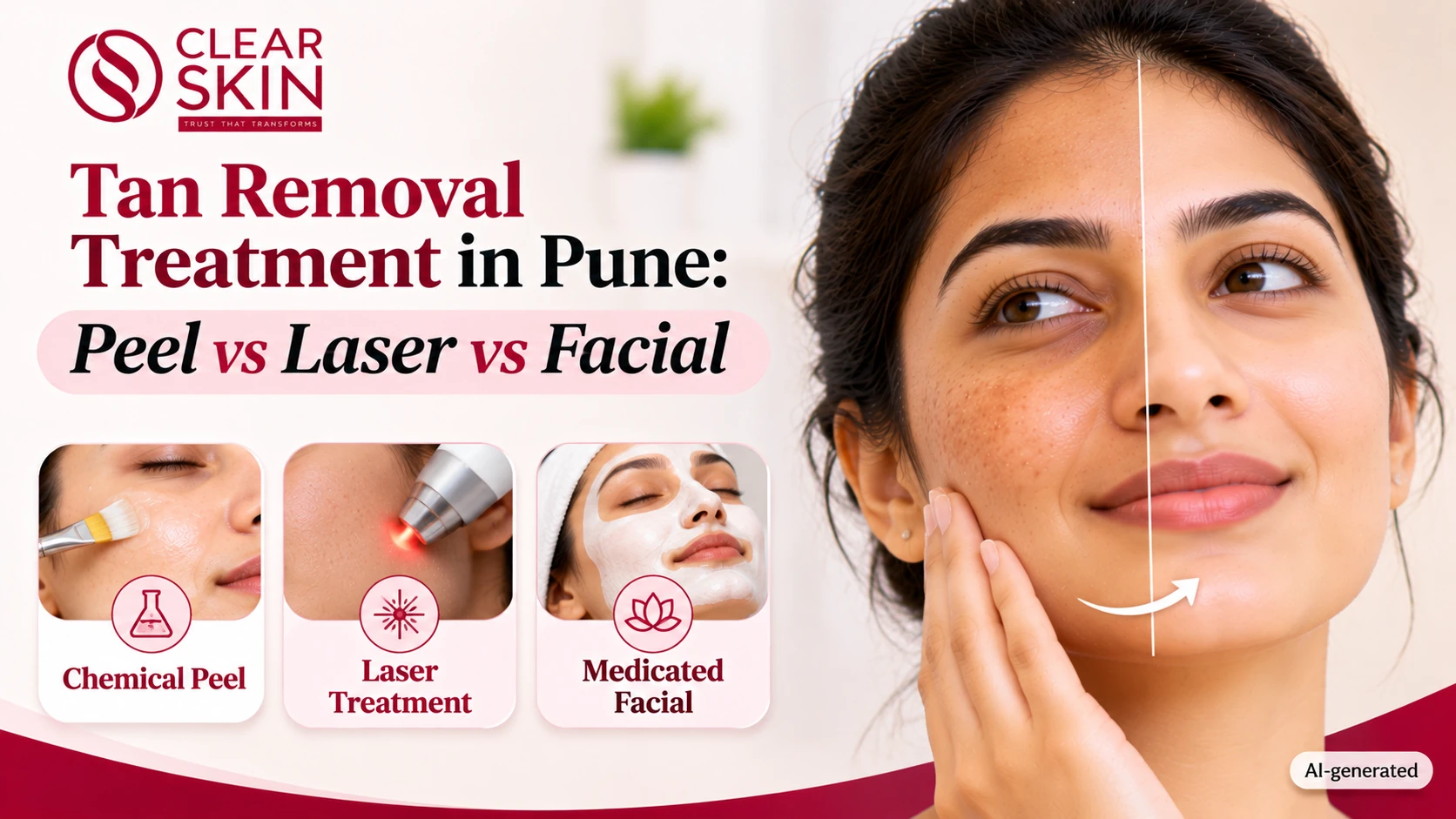
Have you tried a de-tan facial but noticed that your skin looks darker again after a few days? Not every tan removal treatment reaches the same layer of skin or provides the same results. A salon facial may give temporary brightness, while clinical treatments such as chemical peels and laser toning address pigmentation differently.
Tan removal treatments in Pune fall into three distinct tiers: salon-level de-tan facials (surface brightening, temporary), clinical chemical peels (genuine epidermal pigment removal across multiple sessions), and laser treatments (targeted melanin clearance, faster results, higher cost). They are not interchangeable, they address different depths of pigmentation at different levels of intensity. For mild, recent tan, a course of superficial chemical peels is usually the most practical starting point: effective on Indian skin, predictable, and without significant downtime. For stubborn or longer-standing tan, laser in combination with peels accelerates the response. Without consistent SPF 50+ use throughout treatment, all three approaches work against themselves, UV reactivates the melanocytes that were just cleared.
The question is a reasonable one: you have visible darkening from sun exposure, on the face, the neck, the arms, and you want to know what actually removes it, as opposed to what merely claims to remove it.
The range of products and treatments available for tan removal is wide, and the marketing claims that accompany them are not always proportionate to what the treatments can deliver. This article covers what each type of treatment genuinely does, what it cannot do, and how to match the approach to the depth and extent of your tan.
Table Of Content
- At a Glance
- What a Tan Is, and Why It Matters for Treatment Choice?
- Tier 1: Salon De-Tan Facials, What They Do and Don’t Do?
- Tier 2: Chemical Peels, The Clinical Standard for Tan Removal
- Tier 3: Laser Tan Removal, When Peels Are Not Enough
- Face vs Body Tan, Different Considerations
- What Determines How Many Sessions You Need?
- Expert Insight
- Summary
- Frequently Asked Questions
- Conclusion
At a Glance
|
What a tan is |
UV-induced melanin increase in the epidermis, the skin’s protective response to sun damage |
|
Why Indian skin tans more visibly |
Higher baseline melanin means a larger relative response to UV stimulus |
|
Salon de-tan facial |
Surface-level treatment; temporary brightening lasting days to 2 weeks; no clinical evidence for deeper pigment removal |
|
Chemical peel |
Removes pigmented epidermal cells; meaningful tan reduction across 4–6 sessions; moderate downtime |
|
Laser (Q-switched Nd:YAG / carbon peel) |
Targets melanin deposits more specifically; faster visible results; higher cost per session |
|
Best approach for mild tan |
Chemical peel, effective, appropriate cost, minimal downtime |
|
Best approach for stubborn or deep tan |
Laser in combination with peels |
|
Non-negotiable after all treatments |
Daily SPF 50+, without it, the tan returns faster than the treatment cleared it |
What a Tan Is, and Why It Matters for Treatment Choice?
A tan is the skin’s protective response to ultraviolet radiation. When UV hits the skin, it causes direct DNA damage to epidermal cells. In response, melanocytes, the pigment-producing cells, produce more melanin and distribute it to the surrounding keratinocytes (skin cells), where it absorbs UV and limits further damage. The increased melanin density in the epidermis is what appears as visible darkening.
Tan is primarily an epidermal condition, the excess melanin sits in the upper layers of the skin, within and between keratinocytes that are continuously turning over. This is why tans do fade naturally over weeks to months as the pigmented skin cells are shed and replaced by new, less-pigmented cells.
The two practical implications for treatment:
- Because tan is epidermal, treatments that accelerate epidermal cell turnover (chemical peels) or directly target melanin in the epidermis (laser) are effective.
- Because epidermal cells turn over naturally, even untreated tan fades, the question is timeline (weeks to months without treatment vs days to weeks with treatment).
Tan vs post-inflammatory hyperpigmentation (PIH): These are different conditions and require different treatment intensities. PIH, the dark marks left after acne, injury, or inflammation, involves a more complex inflammatory pigmentation process and can sit in both the epidermis and dermis. It often requires more intensive treatment than a straightforward sun tan. If your “tan” does not fade at all over several months without sun exposure, it may be PIH or another Skin Pigmentation condition requiring a dermatologist’s assessment.
Tier 1: Salon De-Tan Facials, What They Do and Don’t Do?
De-tan facials, bleach treatments, and brightening facials are widely available at salons and spas. They typically involve a combination of:
- Mild exfoliant scrubs or enzyme masks to remove the topmost dead skin layer
- Brightening serums (vitamin C, kojic acid, licorice extract) applied topically
- Possibly a mild chemical exfoliant at low concentration
What they achieve: Removal of the topmost layer of dead, pigmented skin cells and temporary brightening of the skin surface. The result looks cleaner and somewhat brighter immediately after.
What they don’t achieve: Penetration deep enough into the epidermis to remove the melanin that is integrated into living keratinocytes or sitting in the basal layer. The improvement is surface-level.
Duration of results: Days to 2 weeks. As new cells reach the surface, the visible tan returns to its pre-treatment level.
When a salon de-tan facial is appropriate: As a quick cosmetic refresh before an event; as a maintenance addition to a clinical plan; for very mild, superficial tan on skin that has not been significantly damaged. It is not a substitute for clinical tan removal in patients with significant sun-induced darkening.
Tier 2: Chemical Peels, The Clinical Standard for Tan Removal
Chemical Peels are the most practical and cost-effective clinical approach to tan removal for most patients in Pune.
How Chemical Peels Remove Tan
A chemical peel applies an acid solution to the skin that breaks the bonds holding dead and pigmented epidermal cells together, accelerating their removal. The peel also stimulates the production of new, less-pigmented cells, and depending on the acid and concentration, may suppress melanin synthesis directly (kojic acid, azelaic acid peels).
The key mechanism for tan removal: accelerated turnover of the pigmented epidermal layer. Cells that would naturally shed over 4–6 weeks are removed over days, and the new cells that replace them have produced less melanin because: a) The UV stimulus has been removed (assuming the patient is protecting from sun) b) Some peeling agents have direct melanin-suppressing activity
Which Peel Types Are Used for Tan on Indian Skin
|
Peel |
Mechanism for Tan |
Depth |
Indian Skin Safety |
|
Glycolic acid (20–50%) |
Accelerates cell turnover; mild melanin suppression |
Superficial |
Good with correct concentration; avoid high % on first treatment |
|
Mandelic acid (20–40%) |
Larger molecule, slower penetration, gentler |
Superficial |
Excellent, preferred for Fitzpatrick IV–V sensitive skin |
|
Lactic acid |
Exfoliation + mild brightening |
Superficial |
Good |
|
Kojic acid (combination) |
Tyrosinase inhibition + exfoliation |
Superficial |
Good |
|
Salicylic acid (20–30%) |
Keratolytic, penetrates follicle |
Superficial |
Good, particularly useful for tan with concurrent congestion |
What to avoid: Deep TCA peels for general tan removal on Indian skin are unnecessary and carry PIH risk. The superficial peels above are sufficient for epidermal tan pigment.
Session Structure
A clinical course for tan removal typically involves 4–6 sessions spaced 2–4 weeks apart. Each session may progress in concentration as the skin tolerates treatment. Results are cumulative, visible tan reduction typically begins after session 2–3.
Pre-peel preparation: 2–4 weeks of prescribed topical priming (vitamin C serum, mild exfoliating cleanser) conditions the skin and reduces PIH risk.
Post-peel care: Mild peeling (fine flaking, not sheets of skin) for 3–7 days depending on peel depth. No active exfoliants during the peeling phase. SPF 50+ from the morning of the peel onward without exception.
Result: Meaningful, genuine tan reduction across the full epidermal layer, not just surface brightening. For recent, mild-to-moderate tan, a 4–6 session peel course produces significantly clearer skin tone.
Tier 3: Laser Tan Removal, When Peels Are Not Enough?
For stubborn, long-standing, or more intense tan, or when faster results are needed, laser treatment targets melanin deposits more specifically and efficiently than peels alone.
Q-Switched Nd:YAG Laser (1064 nm)
The Q switched ND Yag Laser at 1064 nm in low-fluence toning mode selectively targets melanin deposits in the epidermis. The laser energy is absorbed by melanin granules, fragmenting them into smaller particles that are cleared by the skin’s immune system. Surrounding tissue receives minimal thermal load.
For tan removal on Indian skin, low-fluence multi-pass toning is specifically appropriate:
- It targets epidermal melanin effectively
- The low-fluence approach minimises PIH risk on Fitzpatrick IV–VI skin
- Multiple sessions at this setting gradually clear the tan while maintaining safety
Sessions for tan removal: 4–6 sessions for general facial/neck tan; body areas may require more. Spaced 2–3 weeks apart.
Carbon Laser Peel (Hollywood Peel)
The carbon laser peel is a specific protocol particularly suited to overall skin brightening and tan reduction:
- A thin layer of liquid carbon is applied to the skin and allowed to dry
- The Q-switched laser is passed over the skin, vaporising the carbon layer
- As the carbon absorbs and vaporises, it removes the topmost layer of dead pigmented skin cells and heats the dermis mildly to stimulate collagen
The result: immediate skin brightening, significant reduction in surface tan, improved texture, reduced pore appearance, in a single session with no downtime beyond mild redness for a few hours.
The carbon peel is a popular single-session brightening treatment for special occasions and works well as a standalone or as part of a maintenance plan.
Laser vs Peel for Tan Removal: Head-to-Head
|
Chemical Peel Course |
Laser Toning Course |
|
|
Mechanism |
Accelerated cell turnover + melanin suppression |
Targeted melanin fragmentation |
|
Sessions |
4–6, every 2–4 weeks |
4–6, every 2–3 weeks |
|
Downtime per session |
3–7 days mild peeling |
1–2 hours redness; none significant |
|
Speed of visible results |
From session 2–3 |
Often from session 1–2 |
|
Cost per session |
Lower |
Higher |
|
PIH risk on Indian skin |
Low with correct peel selection |
Low with correct parameters |
|
Best for |
Mild-moderate tan; budget-conscious patients |
Stubborn tan; faster results needed |
|
Best combination |
Alternate peel + laser sessions |
Alternate laser + peel sessions |
The combination approach, alternating peel and laser sessions, consistently outperforms either alone for significant tan with concurrent pigmentation issues. The peel clears epidermal pigment rapidly; the laser addresses the deeper deposits and prevents rapid repigmentation between sessions.
Face vs Body Tan, Different Considerations
Face: Most responsive to treatment. Skin turns over faster than body skin. Chemical peels at the concentrations used for facial treatment are effective within 4–6 sessions. Laser toning is well-tolerated.
Neck and chest: Similar to face but slightly less responsive. Often treated in the same session as facial peels or laser.
Arms and legs: Slower cell turnover than face. More sessions may be needed for equivalent clearance. Body-strength peel concentrations differ from facial.
Underarms: Underarm darkening is frequently not simple tan, it may involve friction-related PIH, shaving irritation, deodorant reactions, or hormonal factors. This is a distinct condition treated with specific protocols. If your primary concern is underarm darkening, a separate consultation assesses the actual cause before choosing treatment.
What Determines How Many Sessions You Need?
Tan depth and duration: A recent 2-week holiday tan in an otherwise unexposed person will respond to 3–4 peel sessions. A patient who has had continuous year-round sun exposure for years without sun protection, with deep chronic tan and concurrent PIH, requires more sessions and a staged plan.
Skin tone: Deeper skin tones have higher melanin density at baseline, the contrast between the original skin tone and the tan may be less dramatic, but melanocytes are more reactive, meaning reactivation during treatment is a greater risk. This argues for more conservative peel concentrations and laser parameters and more sessions rather than aggressive single-session approaches.
Concurrent sun protection: A patient in active treatment who continues daily unprotected sun exposure is undermining every session. The tan that the peel removes on a Friday is partially re-established by Monday if sun protection is not used. Sun protection is not a recommendation for this treatment, it is a requirement for the treatment to work.
Expert Insight
“The most common mistake I see with tan removal is patients choosing the strongest available treatment expecting one-session results,” says Dr. Dhanraj Chavan, Senior Dermatologist at Clear Skin Clinic. “On Indian skin, an aggressive approach, a deep peel at high concentration, or high-fluence laser, carries a real PIH risk where the treatment itself causes darker marks than the tan. The correct approach is gentler, more consistent: 4–6 sessions of the right peel or laser toning, combined with daily sunscreen. That consistently gives better results than trying to do it in one or two sessions.”
Summary
Tan removal treatments in Pune range from salon de-tan facials (temporary surface brightening) through clinical chemical peels (genuine epidermal pigment removal across a 4–6 session course) to laser toning (targeted melanin fragmentation, faster visible results, higher cost). For mild to moderate tan on Indian skin, a course of appropriate chemical peels, mandelic, glycolic, or salicylic based on skin type, is the most practical clinical approach. For stubborn or deeper tan, alternating peel and laser sessions in combination produces the strongest and most durable result. The HydraFacial Treatment adds skin hydration and surface brightening as a complement to clinical tan removal plans. Daily SPF 50+ throughout and after treatment is non-negotiable, without it, UV reactivates melanocytes faster than any treatment clears them.
Frequently Asked Questions
How long does it take to remove a tan with chemical peels?
A mild, recent sun tan typically shows visible improvement from session 2–3 of a peel course. A complete 4–6 session course spaced 2–4 weeks apart produces significantly clearer skin tone, with full results at 4–6 weeks after the final session. Longer-standing tan or tan combined with PIH takes more sessions. The timeline assumes consistent daily sun protection between sessions, without it, results will be slower and less complete.Is laser tan removal safe for Indian skin?
Q-switched Nd:YAG laser at 1064 nm in low-fluence toning mode has an established safety record for Indian skin (Fitzpatrick IV–VI) when used at correct parameters. The risk of post-inflammatory hyperpigmentation (PIH), a common concern for laser on darker skin, is low with low-fluence toning. The important caveat is that parameters must be set appropriately for Indian skin by an experienced operator. High-fluence laser or IPL for tan removal on Indian skin carries significant PIH risk. Confirm which specific laser and protocol will be used before proceeding.Can a de-tan facial permanently remove my tan?
No. Salon de-tan facials remove the topmost layer of dead, pigmented skin cells and produce temporary surface brightening. They do not reach the living epidermal cells or the melanin deposits integrated into them. Results typically last days to 2 weeks. For lasting tan removal, clinical treatment (chemical peels or laser) is required, combined with daily sun protection to prevent immediate re-tanning.I tan very quickly and easily, does that mean treatment won’t work for me?
Patients who tan easily have higher melanocyte reactivity, their melanocytes respond strongly to UV stimuli. This means treatment clears existing tan effectively (the same reactive melanocytes respond to peels and laser), but it also means UV exposure after treatment reactivates pigmentation faster than in people with lower melanocyte reactivity. For patients who tan quickly, the solution is rigorous sun protection throughout and after treatment, combined with regular maintenance sessions. The treatment works, the maintenance requirement is simply higher.Does tan removal treatment also help with dark patches and uneven skin tone?
Chemical peels and laser toning for tan also improve overall skin tone evenness and can reduce mild post-inflammatory hyperpigmentation (PIH) and superficial pigmented spots. However, deeper pigmentation (dermal PIH, melasma with dermal component, age spots in the dermis) may require additional or different treatment beyond the tan removal course. If uneven skin tone or dark patches persist despite completing a tan removal course, a dermatologist assessment determines the pigmentation type and appropriate next step.Do You Know?
Roughly 250 Patients Are Treated
Everyday By These Dermatologists
(You are one click away from flawless skin)
Meet Our Dermatologist!





Conclusion
Tan removal treatment in Pune ranges widely in what it can deliver. Matching the treatment level to the degree of tan, and committing to sun protection throughout, determines whether the investment produces lasting results or temporary brightening.
Find your nearest Clear Skin Clinic on Google Maps or call +91 95845 84111 to book a skin assessment and get a tan removal plan suited to your skin tone and pigmentation depth.
See a doctor if skin darkening is uneven, patchy, appears suddenly without obvious sun exposure, or is associated with other skin changes, these may indicate pigmentation conditions other than tan that require different treatment.
Disclaimer: This article is for general educational purposes only. Treatment approach for skin darkening should be determined by a dermatologist based on individual skin tone, pigmentation type, and history. This content does not replace clinical advice.
Further Reading
Why Melasma Comes Back After Treatment?
Melasma recurs after treatment because the melanocytes that caused it remain reactive to sun, heat, and hormones for life.
Anti-Aging Cost in Pune 2026 | Clear Skin
Anti-aging treatment cost in Pune 2026 – HIFU, Botox, fillers, and thread lift pricing, what affects it, and how to plan at Clear Skin.
Laser Toning for Melasma: Sessions, Cost, and Is It Safe for Indian Skin?
Laser toning uses low-fluence Q-switched Nd:YAG at 1064 nm to target melasma pigment without triggering post-inflammatory hyperpigmentation on darker skin
Melasma Treatment Cost in Pune 2026 | Clear Skin
Melasma treatment cost in Pune 2026 – laser, peel, and maintenance session pricing, what affects the cost, and what to expect at Clear Skin.
Have thoughts? Please let us know
We are committed not only to treating you, but also educating you.