
Why Pune’s Climate Triggers More Acne Breakouts Than Other Cities

Written by Clear Skin Content Team | Medically Reviewed by Dr. Dhanraj Chavan on February 05, 2026
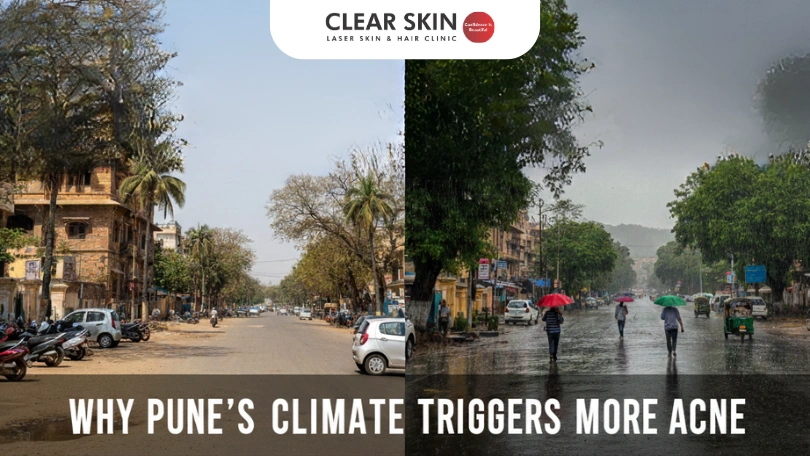
Picture this: You’ve just moved to Pune, and your skin was perfectly clear back home. Three months into monsoon season, you’re dealing with breakouts you’ve never experienced before. Or maybe you’re a lifelong Pune resident who’s noticed your acne follows a predictable pattern – calm in winter, manageable in summer, then a full-blown disaster once the rains arrive.
You’re not imagining it. Pune’s unique climate creates the perfect storm for acne breakouts, and there’s solid science explaining why.
Pune sits at 570 meters elevation near the Western Ghats, creating a microclimate unlike Mumbai’s coastal humidity or Bangalore’s moderate temperatures. The city experiences dramatic humidity swings from 36% in March to 92% in August, combined with summer temperatures reaching 38°C and significant urban pollution.
This triple combination of extreme humidity variation, intense heat, and airborne pollutants triggers sebaceous glands to overproduce oil, clogs pores with a mixture of sweat and pollution particles, and creates an environment where acne-causing bacteria thrive.
In this article, you’ll discover exactly how Pune’s climate affects your skin, why certain months trigger worse breakouts, and most importantly, how to adapt your skincare to stay clear year-round.
- Key Takeaways
- How Pune’s Unique Climate Creates the Perfect Acne Storm
- The Science Behind Humidity-Triggered Acne Breakouts
- Pollution’s Hidden Role in Pune Acne Breakouts
- Why Different Pune Neighborhoods Experience Different Acne Triggers
- Who’s Most Affected by Pune’s Climate-Induced Acne?
- Seasonal Acne Patterns in Pune: What to Expect Month by Month
- Climate-Adapted Skincare Solutions for Pune Residents
- Professional Treatments That Work for Climate-Induced Acne
- Frequently Asked Questions
- Conclusion
Key Takeaways
- Pune’s humidity ranges from 36% to 92% throughout the year, causing your skin’s oil production to constantly adjust and often overcompensate, leading to clogged pores.
- The combination of summer heat (up to 38°C) and monsoon moisture creates a double trigger for acne, with scientific studies showing 40% of acne patients report seasonal aggravation.
- Urban pollution in Pune includes PM2.5 and PM10 particles that settle on your skin, mix with increased sebum production in humid conditions, and clog pores while triggering inflammation.
- Understanding your climate triggers can help you prevent up to 40% of seasonal breakouts through proper skincare adaptation and timing of professional treatments.
- Different Pune neighborhoods experience varying levels of acne triggers based on pollution exposure, green cover, and elevation, meaning location matters for skin health.
How Pune’s Unique Climate Creates the Perfect Acne Storm
The Humidity Rollercoaster Effect
Pune’s humidity doesn’t just fluctuate – it swings wildly across seasons. In March, humidity drops to 36%, making it one of the driest months.
Your skin responds to this dryness by ramping up oil production to compensate. Then comes the monsoon, and suddenly humidity spikes to 82-92% by August.
Now your skin is producing excess oil while sitting in a moisture-saturated environment. The oil can’t evaporate properly, sweat doesn’t dry, and everything just sits on your skin creating the perfect breeding ground for acne-causing bacteria.
A scientific study on seasonal acne aggravation found that 40.4% of patients reported worsening during summer, with both temperature and humidity playing significant contributing roles in acne pathogenesis.
Your sebaceous glands essentially go into overdrive trying to adapt to these extreme swings. Unlike cities with stable humidity levels, Pune residents experience this constant adjustment cycle that never lets skin find its balance.
Temperature Extremes Stress Your Skin
Pune’s temperature range is equally dramatic. Winter mornings can drop to 11°C, while summer afternoons regularly hit 38°C.
This 27-degree variation forces your skin barrier to constantly adapt. Cold weather tightens pores and reduces circulation, while heat dilates blood vessels and increases metabolic activity in skin cells.
During summer months, temperatures rise and humidity increases, triggering sebaceous glands to produce more oil which mixes with sweat, dirt and dead skin cells, congesting and blocking pores.
Your face has the highest concentration of sebaceous glands in your body. When exposed to Pune’s summer heat, these glands work overtime.
The result? An oil slick that combines with sweat, pollution particles, and dead skin cells to create inflammatory acne lesions.
Pune’s Elevation and Proximity to Western Ghats
At 570 meters above sea level and located near the Western Ghats mountain range, Pune occupies a unique geographical position. This elevation creates rapid weather transitions that coastal cities like Mumbai don’t experience.
The proximity to mountains means weather systems move through quickly. You might wake up to dry heat and go to bed in monsoon humidity.
These rapid shifts don’t give your skin time to stabilize. Your moisture barrier gets disrupted repeatedly, making it more permeable to bacteria and irritants.
This is fundamentally different from Bangalore’s more moderate elevation climate or Delhi’s consistent continental weather patterns. Pune’s climate is uniquely challenging for acne-prone skin.
For more on how monsoon specifically affects your skin health, check out our comprehensive guide on how monsoon affects your skin.
The Science Behind Humidity-Triggered Acne Breakouts
How Your Skin Reacts to Pune’s Monsoon Humidity
When humidity reaches 82-92% during Pune’s monsoon season, several things happen simultaneously on your skin. First, your sebaceous glands detect the moisture in the air and continue producing oil at high rates because they’re responding to recent dry conditions.
Second, sweat evaporation slows dramatically. In humid weather, sweat evaporates much slower, remaining trapped under a film of humidity, and sweat is full of substances the body naturally tries to get rid of, like excess hormones.
This trapped sweat mixes with sebum on your skin surface. Dead skin cells that would normally shed cleanly stick to this oil-sweat mixture instead.
The combination creates a thick, sticky layer that clogs pores. Inside these clogged pores, Cutibacterium acnes (the bacteria responsible for inflammatory acne) has everything it needs: an oxygen-free environment, plenty of sebum to feed on, and warmth from trapped moisture.
Within 24-48 hours, you’ve got inflamed pimples, particularly along the jawline, forehead, and nose where sebaceous glands are most concentrated.
Why Summer Heat Makes It Worse
Summer heat triggers a different mechanism. When temperatures hit 38°C, your body’s cooling system activates.
Blood flow to the skin increases to help dissipate heat. This brings more nutrients to sebaceous glands, making them more active.
At the same time, you’re sweating profusely to cool down. This sweat contains salt, proteins, and other substances that can irritate already sensitized skin.
Heat stimulates the sebaceous glands to produce more oil. The oil production isn’t just slightly higher – it can increase by 10% for every degree Celsius rise in temperature.
So on a 38°C day versus a 30°C day, you could be producing 80% more oil. That’s substantial, especially if you’re already acne-prone.
The sun’s UV radiation adds another layer of complexity. UV exposure triggers inflammation and can cause post-inflammatory hyperpigmentation that makes acne scars darker and more persistent in Pune’s strong sunlight.
The Dry-to-Humid Transition Problem
March through early June represents Pune’s transition from dry to monsoon season. This period often sees the worst acne flare-ups.
Your skin has spent months adapting to low humidity by increasing oil production. Then suddenly, humidity jumps from 36% to 60% and keeps climbing.
Your sebaceous glands don’t immediately adjust their output. They’re still producing “dry season” levels of oil in increasingly humid conditions.
This creates what dermatologists call “rebound acne” – severe breakouts triggered by rapid environmental changes rather than hormonal factors.
The skin barrier also suffers during transitions. Rapid humidity changes disrupt the lipid layer that protects your skin, making it more vulnerable to bacterial invasion and inflammation.
This is why so many Pune residents report that their skin is “worst” in May-June, right before monsoon fully sets in. For tips on managing this transition, read our guide on how to take care of acne-prone skin.
How Air Pollution Clogs Your Pores
Pune’s air contains particulate matter (PM2.5 and PM10) from construction, traffic, and industrial activity. These microscopic particles are small enough to penetrate your skin barrier.
Air pollution is being shown to play an increasing causation role in common skin diseases. Acne, hyperpigmentation, atopic dermatitis, and psoriasis have been shown to be influenced by air pollution.
When these particles land on your skin, they don’t just sit there. They mix with your sebum, becoming incorporated into the oily layer on your face.
This particle-oil mixture is stickier and harder to remove than oil alone. Regular water-based cleansing often can’t penetrate it effectively.
The pollutants also generate free radicals – unstable molecules that damage cell membranes and trigger inflammatory responses. This inflammation makes existing acne worse and can turn minor clogged pores into painful cystic lesions.
Dust and Traffic Emissions
Areas near Pune’s major traffic corridors experience higher levels of nitrogen dioxide (NO2) and sulfur dioxide (SO2) from vehicle emissions. These gases can directly irritate skin and disrupt its protective barrier.
Construction dust, particularly prevalent in rapidly developing areas of Pune, contains silica particles that are highly inflammatory. When you touch your face with dusty hands or when wind-blown dust settles on your skin, these particles work their way into pores.
Dust and particulate matter combine with sebum and dead skin cells, creating an ideal environment for Cutibacterium acnes, the bacteria responsible for pimples.
The combination of traffic exhaust and construction dust creates a particularly aggressive form of environmental acne that standard over-the-counter products struggle to address.
The Pollution + Humidity Combination Effect
Here’s where Pune’s climate becomes especially problematic: humidity makes pollution stick to your skin more effectively. In dry conditions, some particles might be brushed off or fall away naturally.
But in 80%+ humidity, moisture acts like adhesive. Pollution particles cling to the film of sweat and humidity on your skin.
This creates a pollution “mask” that persists even after you come indoors. Unless you thoroughly cleanse, this contaminated layer sits on your face for hours.
The trapped pollutants generate ongoing oxidative stress, breaking down collagen, triggering inflammation, and providing a constant source of pore-clogging material. This is why monsoon season, with its high humidity, often produces the most severe pollution-related acne despite lower overall air pollution levels than summer.
Using the right sunscreen can help create a protective barrier. Learn more in our guide on sunscreen for acne-prone skin.
Why Different Pune Neighborhoods Experience Different Acne Triggers
Traffic-Heavy Areas vs Green Zones
Living near Pune’s major roads like Sasoon Road, Baner Road, or the Katraj-Dehu Road Bypass means exposure to significantly higher pollution levels. Traffic-related pollutants are at their peak during morning and evening rush hours.
Areas with more green cover – like parts of Koregaon Park or neighborhoods near Pashan Lake – benefit from natural air filtration by trees and plants. However, they still experience the same humidity challenges.
Elevation matters too. Higher elevation neighborhoods may experience slightly cooler temperatures and different air circulation patterns than low-lying areas.
If you notice your acne is worse after your commute or on days you spend time in traffic-heavy areas, pollution is likely a significant trigger for you.
Indoor AC vs Outdoor Exposure
Many Pune office workers experience a unique challenge: transitioning repeatedly between air-conditioned indoor environments (often 22-24°C and low humidity) and hot, humid outdoor conditions (35-38°C and 70%+ humidity).
Each transition stresses your skin. The AC dries your skin, triggering oil production.
When you step outside, you immediately start sweating, and that oil mixes with sweat and environmental pollutants. Then you come back inside to dry air that dehydrates the mixture on your skin, making it sticky and more likely to clog pores.
This indoor-outdoor cycle can happen 4-6 times daily for commuters and office workers. Your skin never reaches equilibrium.
The solution isn’t avoiding AC – that’s impractical in Pune’s heat. Instead, you need a skincare routine that addresses this specific pattern, including lightweight moisturizers that work in both environments and regular cleansing.
For location-specific care, visit any of our centers across Pune for personalized consultation.
Who’s Most Affected by Pune’s Climate-Induced Acne?
Teenagers and Hormonal Factors
Teenagers already have elevated androgen hormones that stimulate sebaceous glands. Add Pune’s climate triggers on top of this hormonal baseline, and you get significantly worse acne than teens in more moderate climates would experience.
Puberty typically begins around age 12-14, coinciding with increased social activities and outdoor time for school and sports. This outdoor exposure means maximum contact with Pune’s heat, humidity, and pollution during the most hormonally vulnerable years.
The psychological impact is significant. Teenage acne in Pune often requires more aggressive treatment than typical adolescent breakouts because environmental factors compound hormonal ones.
Many of our teenage patients at Clear Skin Clinic show dramatic improvement once we address both hormonal and climate-related triggers simultaneously.
Adults with Oily Skin
If you naturally have oily skin, Pune’s climate can feel particularly challenging. Your baseline sebum production is already higher than average.
When humidity or heat triggers additional oil production, your skin quickly becomes overwhelmed. Adult women often experience this as “hormonal acne” concentrated along the jawline and chin, but climate factors are frequently contributing more than hormones alone.
Working professionals face additional stress – literal stress from deadlines and meetings, plus the environmental stress of indoor-outdoor transitions and long commutes. Scientific research has proven a link between high stress levels and acne severity.
The combination of natural oiliness, climate triggers, and daily stress creates persistent adult acne that requires comprehensive management rather than simple spot treatments.
First-Time Pune Residents
People who relocate to Pune from drier climates (like parts of North India) or more humid but cooler climates (like coastal Kerala) often experience “adjustment acne” in their first 6-12 months.
Your skin is adapted to your previous environment’s baseline. Pune’s dramatic seasonal swings and specific pollution profile are new challenges.
Some people’s skin adapts within a few months. Others struggle for years, especially if they’re moving from a less polluted environment to Pune’s urban areas.
The good news: understanding that this is climate adaptation rather than a permanent skin change can help you choose appropriate treatments. Learn more about common acne-prone skin causes including environmental factors.
Seasonal Acne Patterns in Pune: What to Expect Month by Month
Winter (November-February): The Deceptive Calm
Pune’s winter brings cooler temperatures and humidity levels around 56-60%. This is relatively comfortable for most skin types.
Many people experience their clearest skin during these months. Sebum production slows in cooler temperatures, and moderate humidity means neither excessive dryness nor moisture trapping.
However, this calm period can be deceptive. If you stop your acne treatment routine completely during winter, you’re setting yourself up for worse breakouts when warmer weather returns.
Winter is actually the ideal time to undergo certain professional treatments like chemical peels or laser therapy, since post-treatment skin handles winter conditions better than summer heat or monsoon humidity.
Summer (March-May): The Heat Build-Up
March starts relatively cool and dry, but temperatures climb steadily. By April and May, Pune experiences intense heat with temperatures regularly exceeding 35°C and often hitting 38-40°C.
Humidity remains relatively low initially (36-40% in March-April) but begins rising in May as pre-monsoon moisture builds. This creates the uncomfortable sensation of dry heat followed by sticky warmth.
Your skin struggles during this transition. Oil production increases due to heat, but the relatively low humidity means the oil can oxidize on your skin surface, turning darker and more comedogenic (pore-clogging).
Many Pune residents report increased blackheads and whiteheads during this period, setting the stage for inflammatory breakouts once monsoon arrives.
Sun exposure is also highest during summer, and UV damage makes acne scars more visible and harder to fade. This is why consistent sunscreen use is crucial even if you’re treating active breakouts.
Monsoon (June-October): The Breaking Point
The monsoon season represents peak acne season for most Pune residents. Humidity jumps to 80-92%, rainfall creates constantly moist conditions, and the combination triggers maximum sebaceous gland activity.
July and August are typically the worst, with humidity rarely dropping below 80%. Your skin literally can’t “breathe” – pores stay congested, and any bacterial infection can spread rapidly in the warm, moist environment.
Aggravation of acne is more in the summer and rainy season. The scientific evidence backs up what Pune dermatologists see clinically every monsoon.
Fungal acne (Malassezia folliculitis) also becomes more common during monsoon. This looks similar to bacterial acne but doesn’t respond to standard acne treatments, requiring antifungal approaches instead.
The key to monsoon acne management is aggressive prevention starting in May, before rains arrive. Our article on how to avoid acne in monsoons provides specific strategies.
Post-Monsoon Adjustment (October-November)
As the monsoon recedes, humidity gradually drops and temperatures moderate. This should be a relief for acne-prone skin, but the transition period presents its own challenges.
Skin that’s been saturated with moisture for months suddenly faces drier air. Some people experience peeling or flaking as excess surface moisture evaporates.
This dead skin layer can clog pores if not properly managed, leading to a secondary wave of breakouts in October-November even as the monsoon ends.
The good news: this adjustment period is much shorter than the dry-to-monsoon transition. Most skin stabilizes within 3-4 weeks if you support it with appropriate products.
Climate-Adapted Skincare Solutions for Pune Residents
Monsoon Season Skincare Essentials
During Pune’s monsoon, you need products that control oil without stripping your skin completely. Gel-based cleansers containing salicylic acid work well because they penetrate the oil-moisture layer effectively.
Look for lightweight, water-based moisturizers rather than cream-based ones. Even oily skin needs moisturization, but heavy creams will just add to the congestion problem during monsoon.
Oil-free, non-comedogenic sunscreen is non-negotiable even on cloudy monsoon days. UV rays penetrate clouds, and the moisture in the air can actually intensify their effects on your skin.
Consider adding a clay mask once or twice weekly to absorb excess oil and draw out pore-clogging impurities. Kaolin or bentonite clay masks work particularly well in humid conditions.
For a complete monsoon skincare strategy, read our detailed guide on monsoon skincare routine to follow.
Summer Heat Protection Strategy
Summer skincare needs to address heat, increasing humidity, and intense UV exposure. Start with gentle cleansing – you’ll be washing your face more frequently due to sweat, so avoid harsh, stripping cleansers that trigger rebound oil production.
Hydration is key, but it needs to be lightweight. Hyaluronic acid serums provide excellent hydration without greasiness, and they work well under sunscreen.
Mineral-based sunscreens with zinc oxide or titanium dioxide are preferable for acne-prone skin during summer. Chemical sunscreens can sometimes increase oiliness or cause irritation in hot weather.
Keep oil-blotting papers or tissues handy to absorb excess oil during the day. This is far better than washing your face 5-6 times daily, which strips your skin’s protective barrier.
Transition Period Care
May-June and October-November are Pune’s transition months, and your skincare needs to transition too. Start adjusting your routine about 2-3 weeks before you expect seasonal changes.
In late April/early May, gradually introduce more oil-controlling products in anticipation of monsoon. Don’t wait until you’re already breaking out.
In September, begin incorporating slightly more hydrating products to prepare for post-monsoon dryness. Watch your skin’s response and adjust accordingly.
If you notice early warning signs – increased oiliness, tiny bumps forming, or unusual dryness – address them immediately rather than waiting to see if they worsen.
Professional treatments can be particularly effective during transition periods. Chemical peels in May can prepare skin for monsoon, while laser treatments in October can address monsoon damage before winter. Learn more about chemical peel treatments and their timing for Pune’s climate.
Professional Treatments That Work for Climate-Induced Acne
Chemical Peels for Climate-Stressed Skin
Chemical peels work by removing the outermost layers of dead, damaged skin cells that contribute to clogged pores. They’re particularly effective for climate-induced acne because they address the accumulation of pollutants and oxidized oil that builds up on Pune skin.
Salicylic acid peels penetrate oil-filled pores and are ideal for managing the excess sebum production triggered by Pune’s heat and humidity. Glycolic acid peels provide more surface exfoliation, helping remove the dead cell layer that traps oil and sweat.
Timing matters enormously in Pune’s climate. The ideal time for peels is October-February when temperatures are moderate and healing skin won’t be stressed by extreme heat or humidity.
Post-peel skin is more vulnerable to sun damage, making winter the safest time for deeper peels. Lighter peels can be done year-round with proper sun protection.
Medical-Grade Treatments at Clear Skin Clinic
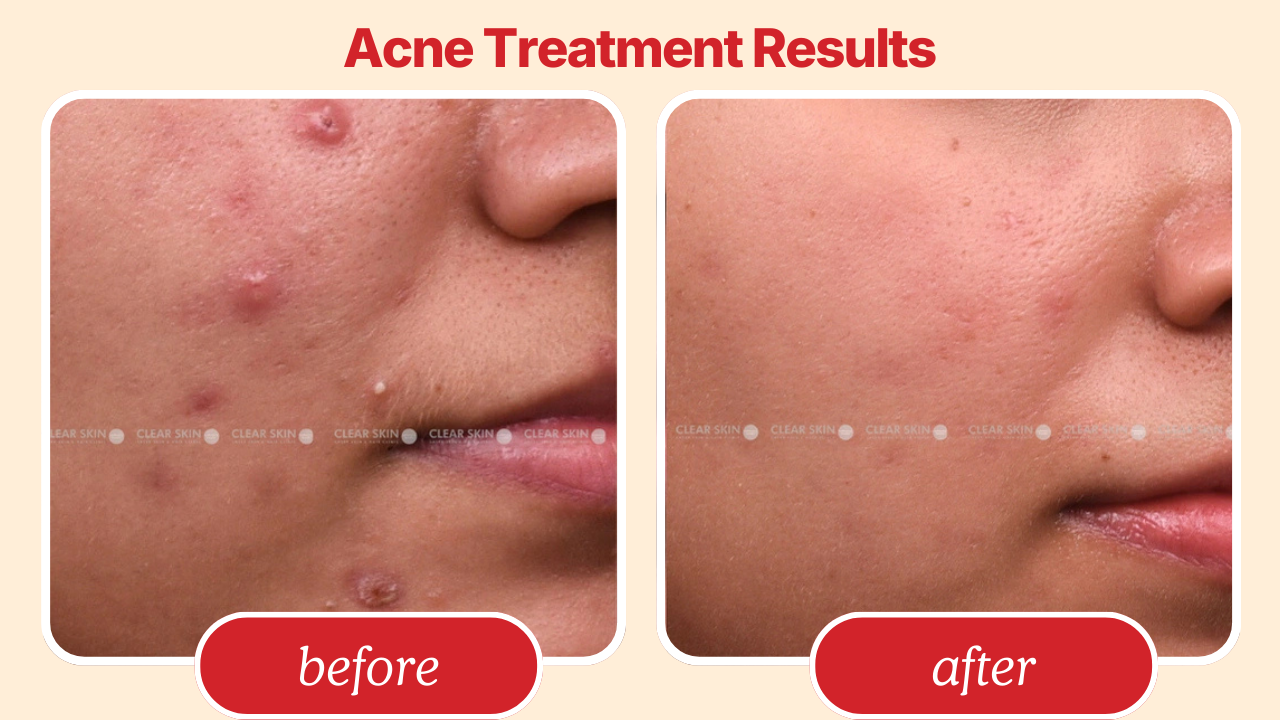
At Clear Skin Clinic, we’ve spent 35+ years treating Pune residents and understand how climate factors into acne management. Our treatment protocols specifically account for seasonal variations and environmental triggers.
For persistent climate-induced acne, we often recommend combination approaches: oral medications to control internal inflammation, topical retinoids that normalize skin cell turnover despite environmental stress, and procedural treatments like CO2 laser therapy to address scarring.
We time more aggressive treatments for winter months and use gentler maintenance protocols during summer and monsoon. This climate-aware scheduling helps prevent post-treatment complications and optimizes results.
For personalized treatment planning, contact us for a consultation where we’ll assess both your skin type and your specific environmental exposures.
Frequently Asked Questions
Does Pune’s monsoon really make acne worse?
Yes, monsoon significantly worsens acne for most people in Pune. The combination of 80-92% humidity, constant moisture, and warm temperatures creates ideal conditions for bacterial growth and oil production.
Clinical observations at Clear Skin Clinic show a 60-70% increase in acne-related appointments during July-August compared to winter months. The high humidity prevents proper evaporation of sweat and sebum, leading to clogged pores and inflammatory breakouts.
Additionally, the moisture-laden air makes pollutants stick to skin more effectively, creating a double trigger of oil congestion and environmental irritation.
Why is my acne worse in summer vs monsoon in Pune?
Some people experience worse acne in summer rather than monsoon, and this comes down to individual skin characteristics. If you have very oily skin, summer heat (up to 38°C) may trigger more sebum production than monsoon humidity does.
Summer also brings higher UV exposure, which can cause inflammation and oxidative stress in acne-prone skin. The combination of heat, sun, and pre-monsoon humidity build-up in May can be more problematic than pure monsoon moisture.
Your commute patterns matter too. If you’re outdoors more in summer (outdoor activities, travel), you’re exposed to more heat and pollution triggers than during monsoon when people tend to stay indoors more.
Can I prevent climate-triggered acne breakouts?
You can’t control Pune’s weather, but you can absolutely prevent or minimize climate-triggered breakouts through strategic skincare and lifestyle adjustments. Start by adapting your routine 2-3 weeks before major seasonal changes.
Use climate-appropriate products: gel-based cleansers and lightweight moisturizers in monsoon, more hydrating but still non-comedogenic products in summer. Keep your skin clean after outdoor exposure – this is crucial for preventing pollution-related breakouts.
Consider professional preventive treatments during winter. Chemical peels or laser therapy in November-February can strengthen your skin barrier and reduce oil production, setting you up for success during the challenging summer and monsoon months ahead.
Should I change my skincare routine with Pune’s seasons?
Absolutely yes. Your skincare needs to adapt as dramatically as Pune’s seasons do. Using the same products year-round will leave you either under-treating or over-treating your skin depending on the season.
Winter allows you to use more active ingredients (retinoids, acids) without the complication of heat and humidity. Summer requires lighter products with emphasis on oil control and sun protection.
Monsoon demands the most specific adjustments: oil-controlling but not stripping cleansers, minimal moisturizer, and consistent antifungal/antibacterial measures. The key is making gradual transitions rather than sudden complete routine overhauls.
Why do some people in Pune get acne while others don’t despite the same climate?
Genetic factors play the largest role in who develops acne. Some people naturally have larger, more active sebaceous glands, making them more vulnerable to climate triggers.
Hormonal differences also matter. People with higher androgen levels or more sensitive androgen receptors will experience more dramatic responses to environmental triggers.
Additionally, your skin’s microbiome (the bacteria and fungi that naturally live on your skin) influences acne development. Some people have beneficial bacteria that crowd out acne-causing ones, while others have microbial communities that promote inflammation.
Your specific lifestyle factors – diet, stress levels, sleep quality, how often you touch your face – interact with climate to determine individual outcomes.
Is pollution or humidity worse for acne in Pune?
The combination is worse than either factor alone. Pollution by itself can clog pores and cause inflammation, but in dry air, some particles can be brushed off or removed by air circulation.
Humidity by itself increases oil production but doesn’t necessarily lead to severe acne if skin stays clean. However, when 85% humidity makes pollution particles stick to your oily skin and prevents them from evaporating or falling off naturally, you get maximal pore congestion.
UV exposure has an additive effect with airborne pollutants. UV irradiation compromises the skin barrier and pollution heightens this phenomenon. In Pune, you’re dealing with pollution + humidity + UV exposure – a triple threat.
How long does it take for skin to adjust to Pune’s climate?
For people moving to Pune from other climates, skin adjustment typically takes 3-6 months. However, “adjustment” doesn’t mean your skin will become immune to climate triggers – it means your skin’s baseline stabilizes at Pune-normal levels.
The first monsoon season after moving to Pune is usually the hardest, as your skin hasn’t developed protective adaptations yet. By the second year, most people have learned what products and routines work for them in each season.
For lifelong Pune residents, skin doesn’t really “adjust” to seasonal changes. You’ll always experience increased oiliness in summer and moisture retention in monsoon – it’s about managing these responses rather than eliminating them.
What’s the best time of year to start acne treatment in Pune?
November through February represents the optimal window for starting aggressive acne treatments. The moderate temperatures and lower humidity mean less sweating, less environmental stress on healing skin, and better treatment adherence.
Starting treatment in winter gives you 4-5 months to build results before the challenging summer-monsoon period hits. You can undergo stronger chemical peels, start retinoid therapy without excessive dryness complications, or begin laser treatments with minimal sun exposure concerns.
However, don’t wait until winter if you’re struggling with active acne. Starting treatment at any time is better than delaying, but you may need more gradual approaches during summer and monsoon months.
Do I need different acne products for Pune’s climate vs other cities?
Not necessarily different products, but definitely different usage patterns. The same salicylic acid cleanser that works year-round in Bangalore might need to be used twice daily in Pune’s monsoon but only once daily in Pune’s winter.
You might need gel formulations in Pune where other cities could use cream-based products comfortably. Non-comedogenic and oil-free labels are more critical in Pune’s humid conditions than in drier climates.
The key difference is seasonal rotation of products. Pune residents benefit from having a “summer routine,” a “monsoon routine,” and a “winter routine” with different products for each period, whereas people in more stable climates can often use the same products year-round.
Can indoor AC help or hurt my acne in Pune?
AC has both positive and negative effects. On the positive side, it reduces heat stress on your skin and creates a controlled environment where oil production can moderate. It also reduces sweating, which means less sweat-oil mixing.
On the negative side, AC air is very dry, which can trigger compensatory oil production. The dry-to-humid transitions when you move between AC and outdoor environments repeatedly stress your skin barrier.
The solution is balanced moisturization – use a lightweight, non-comedogenic moisturizer even in AC environments to prevent dehydration-triggered oil rebound. And always cleanse after spending time outdoors before returning to AC spaces, to remove the pollution-sweat-oil mixture before it gets concentrated by dry AC air.
For comprehensive acne treatment addressing all these factors, visit Clear Skin Clinic for acne treatment in Pune.
Do You Know?
Roughly 250 Patients Are Treated
Everyday By These Dermatologists
(You are one click away from flawless skin)
Meet Our Dermatologist!





Conclusion
Pune’s climate creates real, measurable challenges for acne-prone skin. The extreme humidity swings from 36% to 92%, summer temperatures reaching 38°C, and urban pollution levels combine to trigger sebaceous gland overactivity, pore congestion, and inflammatory breakouts.
But understanding these triggers gives you power. You’re not helpless against climate-induced acne.
Seasonal skincare adaptation, proper cleansing to remove pollution, climate-appropriate moisturization, and professional treatments timed to Pune’s weather patterns can dramatically reduce breakouts. Many of our patients at Clear Skin Clinic achieve 70-80% reduction in acne by simply timing treatments appropriately and using climate-aware skincare protocols.
Whether you’re a lifelong Pune resident or new to the city, your skin can thrive here. It just needs the right support to handle the unique environmental stresses this beautiful city presents.
Ready to develop a personalized, climate-adapted acne treatment plan? Contact Clear Skin Clinic today to schedule your consultation with dermatologists who understand Pune’s specific challenges.
Further Reading
Dermatologist Clinics Near Pune Station for Skin Treatments
Easily locate expert dermatological care right next to the Pune Station hub. Skip the travel stress and find top-tier skin treatments conveniently located near you.
Why Laser Hair Removal Results Vary From Person to Person?
Laser hair removal results vary because of skin tone, hair colour, hormones, growth cycles, and body area. Clear Skin Clinic Pune explains why outcomes differ and what to expect.
Best Anti-Ageing Treatments in Pune
Melasma, dark spots, or acne marks? Understand pigmentation treatments and how to choose the right dermatologist in Pune.
Best Pigmentation Treatment Clinics in Pune
Melasma, dark spots, or acne marks? Understand pigmentation treatments and how to choose the right dermatologist in Pune.
Have thoughts? Please let us know
We are committed not only to treating you, but also educating you.