
What Is Acne? A Complete Medical Overview
Table Of Content
- Key Takeaways
- Acne Condition Overview
- Types of Acne – From Mild to Severe
- Who Gets Acne?
- How Dermatologists Diagnose and Treat Acne?
- As Verified By
- Frequently Asked Questions
- Conclusion
Medically reviewed by Dr. Dhanraj Chavan, MBBS, MD Dermatology | Clear Skin Clinic, Pune
Key Takeaways
- Acne is a chronic inflammatory skin condition affecting the pilosebaceous unit (hair follicle + sebaceous gland)
- Four primary causes: excess sebum, follicular hyperkeratinisation, C. acnes bacterial overgrowth, and inflammation
- Five lesion types: whiteheads, blackheads, papules, pustules, nodules/cysts
- Affects ~85% of people aged 12–24 and up to 20% of adults over 25 in India
- Androgens are the primary hormonal trigger for sebaceous gland overactivity
- Untreated moderate-to-severe acne causes PIH and scarring in up to 30% of patients
- Dermatologist-directed treatment achieves 70–90% improvement within 3–6 months
Acne Condition Overview
| Attribute | Value |
|---|---|
| Condition type | Chronic inflammatory skin condition |
| Primary site | Face, back, chest, shoulders |
| Onset age | Typically 12–25; adult-onset common in women |
| Affected population | 85% of adolescents; up to 20% of adults in India |
| Primary cause | Androgen-driven sebum overproduction + C. acnes |
| Healing time (with treatment) | 3–6 months for significant improvement |
| Risk of scarring if untreated | Up to 30% |
Acne is a chronic inflammatory skin condition that develops when hair follicles become clogged with sebum and dead skin cells, triggering bacterial overgrowth and an immune response that produces pimples, blackheads, whiteheads, and – in severe cases – painful cysts. It affects the pilosebaceous unit: the structural pairing of a hair follicle and its attached sebaceous gland.
Acne is the most common skin disorder seen by dermatologists in India. It affects people across all age groups, skin tones, and hormone profiles – from adolescents experiencing their first breakout to adults managing recurring flare-ups well into their 30s and 40s.
Understanding what acne is at the biological level helps patients recognise why over-the-counter products fail for moderate-to-severe cases and why dermatologist-directed treatment produces more reliable, lasting results.
What Causes Acne?
Acne develops through a four-step biological sequence that begins inside the hair follicle. Understanding these steps explains why single-ingredient treatments rarely resolve persistent acne.
Step 1 – Sebum overproduction. Androgens stimulate the sebaceous glands to produce more oil than the follicle can expel. This is why acne spikes at puberty and worsens during hormonal shifts from PCOS, menstrual cycles, or stress.
Step 2 – Follicular hyperkeratinisation. Dead skin cells inside the follicle shed faster than they exit. They mix with excess sebum and form a plug – a comedo – that blocks the follicle opening.
Step 3 – C. acnes overgrowth. Cutibacterium acnes is a bacterium that normally lives on skin. Inside a blocked, sebum-rich follicle, it multiplies rapidly and releases enzymes that irritate the follicle wall.
Step 4 – Inflammation. The immune system sends white blood cells to the infected follicle. This response causes redness, swelling, and pus – the hallmarks of inflammatory acne.
All four steps must occur for acne to develop. Treatments work by interrupting one or more steps – which is why combination therapy consistently outperforms single-ingredient approaches.
Types of Acne – From Mild to Severe
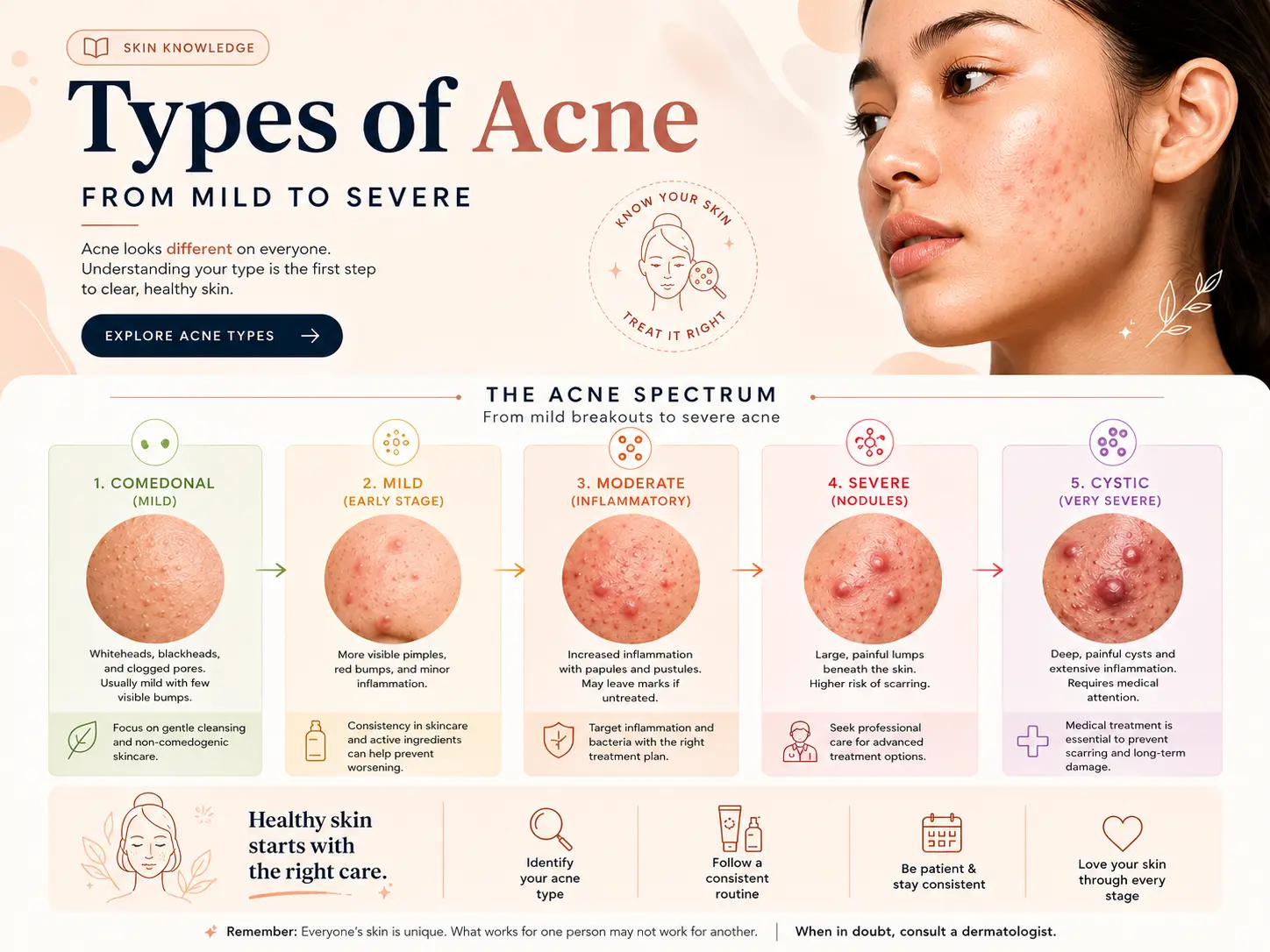
Dermatologists classify acne into two broad categories: non-inflammatory and inflammatory.
Non-inflammatory acne (comedones):
- Whiteheads (closed comedones): Blocked follicle with skin covering the plug. Appears white or skin-coloured at the surface.
- Blackheads (open comedones): Blocked follicle open at the surface. Sebum oxidises on air exposure and turns dark – not dirt.
Inflammatory acne:
- Papules: Small, raised, red bumps without pus. Caused by a moderate immune response around a blocked follicle.
- Pustules: Red lesions with a visible white or yellow centre. Pus is a collection of dead white blood cells.
- Nodules: Large, solid, painful lumps deep within the skin. Grade 3 severity at ClearSkin – requires prescription treatment.
- Cysts: The most severe form – large pus-filled lesions extending deep into the dermis. Causes the most permanent scarring if untreated.
Severity grade: Grade 1 (mild – comedones only), Grade 2 (moderate – papules + pustules), Grade 3 (severe – nodules), Grade 4 (very severe – cystic).
Who Gets Acne?
Approximately 85% of people aged 12–24 experience some degree of acne. In India, adult acne – onset after age 25 – affects up to 20% of adult women and 8% of adult men, often driven by hormonal fluctuations, stress, and diet.
At Clear Skin Clinic, the most common presentations are: post-adolescent hormonal acne in women aged 22–35, stress-triggered breakouts in IT professionals and night-shift workers, and recurring cystic acne in patients with PCOS or elevated androgen levels.
Understanding what makes your skin acne-prone is the first step toward long-term management. The connection between stress and acne is a significant driver for working adults in Pune.
How Dermatologists Diagnose and Treat Acne?
Diagnosis is clinical – a dermatologist examines lesion type, distribution, grade, and skin type. For women with suspected hormonal acne, blood tests (androgens, LH/FSH, fasting insulin) may be ordered to rule out PCOS.
Treatment is matched to grade:
Grade 1 – Mild: Topical retinoids (tretinoin, adapalene) or salicylic acid (2%) combined with benzoyl peroxide (2.5–5%). Addresses follicular plugging and bacterial load without systemic medication.
Grade 2 – Moderate: Combination topical therapy – clindamycin + benzoyl peroxide – paired with a topical retinoid. Dermatologist-recommended skincare for acne-prone skin forms an essential supporting layer.
Grade 3 – Severe: Oral antibiotics (doxycycline, minocycline) for 3–6 months, or hormonal therapy for women. Procedural options – chemical peels, comedone extraction – accelerate clearance for stubborn nodular acne.
Grade 4 – Very severe/cystic: Oral isotretinoin (0.5–1 mg/kg/day) for 16–24 weeks is the gold standard. It is the only treatment that addresses all four acne causes simultaneously.
For acne scarring – which affects up to 65% of patients with deeper Indian skin tones – the acne scars treatment pathway at Clear Skin combines surgical scar release using the Taylor Liberator with full-field ablative resurfacing on the UltraPulse CO2 laser, plus volumisation using the patient’s own intradermal microfat and plasma gel biofiller, calibrated for Fitzpatrick Type IV-V Indian skin.”
Dr. Dhanraj Chavan creates a personalised, grade-matched plan after full clinical assessment of lesion type, depth, morphology, and the condition of surrounding skin – calibrated for Fitzpatrick Type IV–V Indian skin from the first consultation. The plan addresses three goals simultaneously: clearing active acne, preventing new lesions, and managing post-inflammatory pigmentation.
As Verified By
- NCBI – Pathogenesis of Acne Vulgaris: https://www.ncbi.nlm.nih.gov/pmc/articles/PMC7080711/
- Cleveland Clinic – Acne Causes and Treatment: https://my.clevelandclinic.org/health/diseases/12233-acne
- Indian Journal of Dermatology – Acne epidemiology in Indian adults: https://www.ncbi.nlm.nih.gov/pmc/articles/PMC3900340/
- NHS UK – Acne Overview: https://www.nhs.uk/conditions/acne/
Frequently Asked Questions
What is acne and what causes it?
Acne is a chronic inflammatory skin condition that develops when sebum, dead skin cells, and bacteria block hair follicles. The four primary causes are excess sebum production driven by androgens, follicular hyperkeratinisation, overgrowth of Cutibacterium acnes bacteria, and the immune system’s inflammatory response. All four steps must occur – which is why effective treatment targets more than one cause at once.
What are the different types of acne?
Acne is classified as non-inflammatory (blackheads and whiteheads) or inflammatory (papules, pustules, nodules, and cysts). Most patients present with a combination of types. Severity is graded from Grade 1 (mild comedones) to Grade 4 (widespread cystic acne). Cystic acne is the most severe form and requires prompt dermatologist treatment to prevent permanent scarring.
Is acne a hormonal condition?
Hormones are a primary driver but not the only cause. Androgens – present in both men and women – stimulate sebaceous glands to produce excess sebum, which is why acne spikes at puberty and in conditions like PCOS. Adult hormonal acne in women typically appears around the jawline and chin, often cyclically in relation to menstruation.
At what age does acne usually start?
Acne most commonly begins between ages 12 and 14, coinciding with the rise in androgen levels at puberty. Adult-onset acne – appearing for the first time after age 25 – affects up to 20% of adult women and 8% of adult men in India, often triggered by stress, hormonal shifts, or dietary factors.
Does acne go away without treatment?
Mild comedonal acne can resolve on its own in some patients. Moderate to severe acne – particularly inflammatory, nodular, or cystic types – rarely clears without treatment and carries a significant risk of post-inflammatory hyperpigmentation and permanent scarring. Early dermatologist intervention shortens total treatment time and reduces long-term skin damage.
When should you see a dermatologist for acne?
See a dermatologist if acne is moderate or severe, if OTC products have not worked after 8–12 weeks, if acne is leaving dark marks or scars, if lesions are painful or cystic, or if it is affecting your confidence. At Clear Skin Clinic, Pune, Dr. Dhanraj Chavan assesses grade and skin type before prescribing a personalised plan. Book a consultation: https://www.clearskin.in/contact-us/
Conclusion
Acne is a well-understood medical condition with highly effective, grade-matched treatments available. The key is accurate diagnosis – identifying lesion type, grade, and underlying triggers – before beginning any protocol.
If you are dealing with persistent acne, recurring breakouts, or acne-related scarring, a dermatologist consultation is the most direct path to lasting results.
Book your consultation at Clear Skin Clinic, Pune: https://www.clearskin.in/contact-us/